

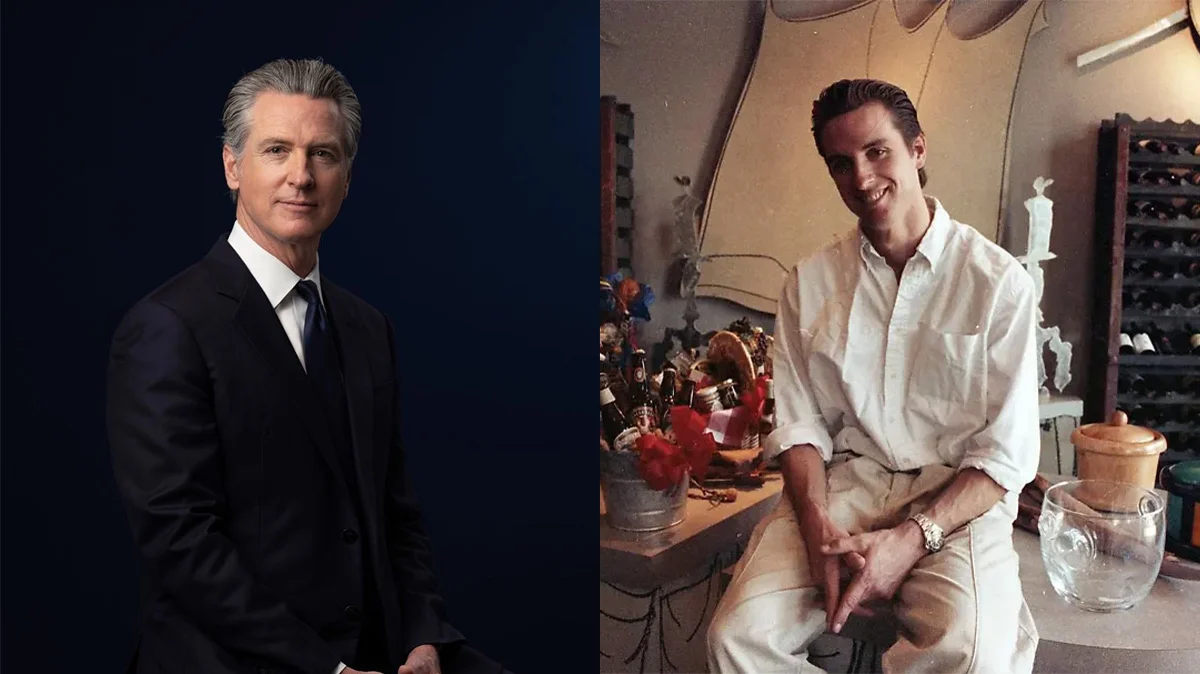
Long before the halls of the California State Capitol became his primary residence, Governor Gavin Newsom was navigating a very different kind of terrain: the competitive, high-stakes world of fine wine. For Newsom, wine was never merely a business venture; it was a formative language, a bridge between generations, and a philosophy of accessibility that would eventually define his transition from an ambitious entrepreneur to a seasoned political operator.
As part of the Oeno Files series, we take an exclusive look at how the San Francisco native’s early years in the wine industry shaped his worldview, his leadership style, and his ongoing perspective on one of California’s most vital economic engines.
The Roots of a Passion: A Shared Language
Gavin Newsom’s introduction to the world of oenology was deeply personal. Growing up in San Francisco, wine served as a conduit for his relationship with his father. In a life often defined by public scrutiny, Newsom recalls that wine acted as a silent mediator.
"Food, wine, and travel were a big part of his life," Newsom explains. "Because he could sometimes be emotionally hard to reach, wine became a kind of shared language between us—a way to sit together, talk, learn, and connect without having to force the conversation."
This early appreciation for the ritual of drinking—the way a bottle could dismantle barriers and facilitate human connection—laid the groundwork for his professional career. It was not the prestige of the label that captured his imagination, but rather the spirit of the experience.
Chronology: From the Balboa Cafe to the Boardroom
1992: The PlumpJack Genesis
At just 24 years old, an ambitious Newsom set out to disrupt the wine market. Following a pivotal dinner at the historic Balboa Cafe with his father and industry veteran Pat Kelley, the concept for the PlumpJack wine shop was born.
The goal was simple but revolutionary for the time: to demystify fine wine. Newsom wanted to create a retail space that avoided the stuffy, intimidating atmosphere of traditional wine shops, while eschewing the "discount rack" culture that degraded the craft. He managed to secure $174,000 from a circle of 15 friends and family members—including oil heir and composer Gordon Getty—to bring his vision to life.
The name "PlumpJack" was a deliberate nod to Shakespeare’s Sir John Falstaff, a larger-than-life character known for his irreverence and joy. As Newsom notes, "I loved that Falstaff mocked stuffiness and celebrated the absurdity of life. That was precisely the attitude we wanted to bring to wine."

1994–2003: Scaling the Empire
The success of the initial wine shop provided the capital and the confidence to expand. By 1994, the PlumpJack Group launched the PlumpJack Cafe, applying the same philosophy: exceptional wines without the typical, exorbitant restaurant markups. The business quickly evolved, moving from retail into production.
Recognizing the potential in the Oakville region of Napa Valley, the group acquired its first winery in 1995. This marked the beginning of a portfolio that would eventually include Cade and Odette wineries. Throughout this growth, Newsom leaned on a dedicated team, including his sister, Hilary, and general manager John Conover.
2003–Present: The Shift to Public Service
Newsom’s entry into politics was, ironically, prompted by the very industry he sought to professionalize. While running his wine shop, a bureaucratic conflict with the San Francisco Department of Health regarding the installation of a mop sink in his carpeted store served as his first lesson in the friction of government regulation.
He transitioned into public service via the San Francisco Parking and Traffic Commission, eventually joining the Board of Supervisors before being elected mayor. Upon his election as Governor of California in 2018, Newsom placed his ownership interests in the PlumpJack Group into a blind trust, effectively distancing his personal finances from his executive decision-making.
Supporting Data: The Economic Weight of California Wine
While Newsom has stepped back from the day-to-day operations of his wine businesses, the industry remains a central pillar of his state’s economy. The statistics behind the industry are staggering:
- Total Economic Impact: The California wine industry is responsible for supporting more than 422,000 jobs within the state, spanning agriculture, hospitality, tourism, and manufacturing.
- The Current Crisis: In the past year, the industry has faced a significant correction. Growers have been forced to remove roughly 40,000 acres of vines, and an estimated 100,000 tons of grapes have remained unharvested due to a glut in supply and shifting consumer demand.
- Diverse Ecosystem: Contrary to the perception that wine is an industry of the ultra-wealthy, it is supported by a broad, multigenerational network of small-scale farmers, farmworkers, cellar staff, and independent retailers.
Official Responses: Navigating Market Volatility
When asked about the current state of the California wine industry and the government’s role in its stabilization, Newsom is pragmatic. He argues that government intervention is not a panacea for long-term market trends.
"Government cannot manufacture consumer demand or wave a wand and correct an oversupply that developed over many years," he explains.
Instead, he emphasizes that the state’s role should be focused on infrastructure—pest prevention, water resilience, and scientific research. However, he is quick to pivot to the impact of federal policy. Newsom views the recent trade tensions, particularly the tariffs imposed during the Trump administration that resulted in retaliatory measures from Canada (California’s largest export market), as a primary inhibitor of industry growth.

"One of the worst things Washington could do is make a difficult market even harder," says the Governor. "It’s exactly the opposite of what California growers need."
Implications: The Man Behind the Politician
In his recent book, Young Man In A Hurry, Newsom reflects on the internal drives that propelled him from the wine shops of San Francisco to the Governor’s office. He describes the title—a phrase originally used as a critique by The Economist—as a form of self-examination.
"I came to see it less as somebody else’s critique than as a self-critique," he admits. "The impatience, ambition, insecurity, and constant need to keep moving that have shaped so much of my life."
Looking Ahead
Despite his deep-seated ties to the industry, Newsom remains adamant that his past business interests do not dictate his policy. When asked about his personal tastes, his answers reflect a seasoned enthusiast rather than a collector: he prefers drinking and sharing wine over displaying it. His palate remains eclectic, favoring Napa Cabernets for their structure, but he maintains a deep appreciation for the complexities of Burgundy, Chablis, and Italian whites.
As for his thoughts on the intersection of politics and the dinner table? When asked what wines he would choose for a hypothetical White House dinner, his response is characteristic of his political brand: sharp, defiant, and punctuated by a touch of humor. "For now," he states, "my answer is anything but Trump Wine."
Conclusion
Gavin Newsom’s journey illustrates the complex interplay between private enterprise and public duty. From the early, scrappy days of fighting for permits in San Francisco to managing the vast, interconnected interests of the state of California, he has maintained a singular focus on the importance of accessibility—whether in the price of a bottle of Cabernet or the availability of government services.
As the California wine industry faces its most challenging period in recent memory, the Governor’s perspective remains tempered by his background as a business owner who understands that, above all else, the vitality of the industry depends on its ability to reach the consumer without unnecessary friction. Whether in the tasting room or the hearing room, the "Young Man In A Hurry" continues to advocate for the industries that define the identity of the Golden State.
 Reynand Wu
 Suro Senen
 Muslim
