

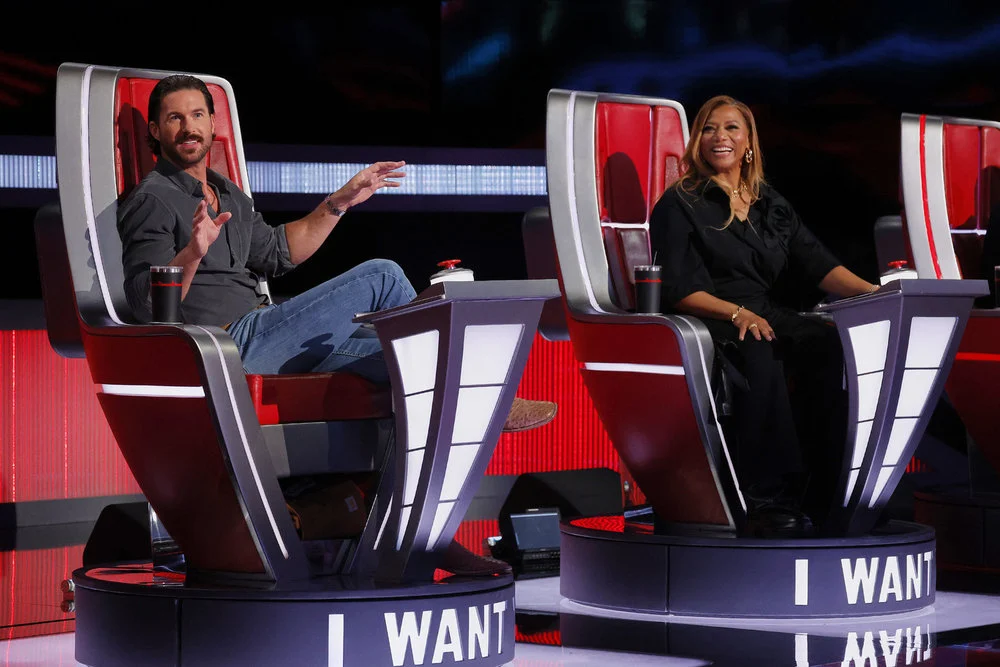
The stakes have never been higher on NBC’s The Voice. As Season 30 reaches the conclusion of its Blind Auditions, the pressure in the studio is palpable. Following four electrifying nights of performances, the competitive landscape has shifted, with veteran coaches Kelly Clarkson and Adam Levine finding themselves in a high-stakes standoff against newcomers Queen Latifah and Riley Green. With team rosters rapidly filling, every remaining spot has become a battleground, forcing the coaches to refine their strategies and lean into their unique musical identities to attract the season’s final breakout stars.
The State of the Game: Managing the Rosters
As the curtain closed on the fifth night of auditions, the math behind the competition became starkly clear. Most coaches are now hovering near their maximum capacity, with only a handful of slots remaining to round out their rosters. Queen Latifah and Riley Green have proven to be formidable additions to the panel, holding their own against the seasoned tactics of Clarkson and Levine.
Currently, team availability is at a premium. Kelly Clarkson, Riley Green, and Queen Latifah each have only two spots remaining to fill their teams of 12. Adam Levine, perhaps playing a more cautious game or seeking a very specific sound, has three spots left. All four coaches have already burned through their "First-In Button" advantages, meaning that from this point forward, the power to secure an artist rests entirely on the merit of their pitch and the perceived chemistry between coach and contestant.
"I’m really looking to fill in the gaps of what I’m currently missing," Queen Latifah remarked during the episode, highlighting her strategic approach to team building. Meanwhile, country star Riley Green emphasized the importance of versatility, noting, "The team needs to be well-rounded; we need to have a lot of different types of artists to survive the later stages of this competition."
Chronology of Night Five: A Showcase of Diverse Talent
The fifth night of the Blind Auditions brought twelve hopefuls to the stage, each vying for a life-changing opportunity. The performances ranged from soulful blues to rock-infused anthems, forcing the coaches to make difficult decisions that would ultimately define the trajectory of their respective teams.
The Early Rounds: Building Momentum
The evening opened with Brandon Diaz (29, Ashburn, Va.), who delivered a stirring rendition of "Drink You Away." The performance was a moment of redemption for Diaz, who had failed to turn a chair during Season 4 as a 14-year-old. This time, his growth was undeniable. While Adam Levine expressed regret for not turning, Queen Latifah and Kelly Clarkson were captivated, with Queen praising his ability to command the stage through strategic pauses. Diaz ultimately chose Team Queen.
Marilyn Hucek (34, Washington, D.C.) brought international flair to the stage with her interpretation of "La Tortura." While Kelly felt the performance leaned too heavily into the original artist’s style, Adam Levine disagreed, calling Hucek "a breath of fresh air" for her technical command of vibrato. She joined Team Adam.

The trend of unique song choices continued with Keiyana Osmond (32, Salt Lake City), who took a risk with "Kiss Me." By stripping the song down to her own register, she impressed Riley Green, who secured her for his team, praising her creative approach as a blueprint for success in the competition.
Mid-Show Highlights and Unexpected Turns
Dakota Cohen (25, Los Angeles) delivered one of the most talked-about performances of the night with a gritty, rock-infused take on "Changes." Adam Levine was visibly stunned, comparing her raw, raspy tone to that of Miley Cyrus. Despite aggressive efforts from other coaches, Levine’s promise to mentor her specific vision won her over to Team Adam.
The emotional stakes were high for Luke Cope (33, Kernersville, N.C.), who performed "Burning House." While he struggled with minor tempo issues, his raw vulnerability shone through, earning him a spot on Team Queen.
Perhaps the most competitive moment of the night centered on Nina Howland (24, New York), whose performance of "Love Me Like a Man" prompted a four-chair turn. The bidding war was intense, with Kelly Clarkson leveraging their shared city connection and her history of winning with powerful female vocalists. Ultimately, Howland chose Team Kelly.
Luke Curran (31, Sarasota, Fla.) provided a fascinating dilemma for the coaches. After choosing a folk song, he found himself courted by both Adam Levine and Riley Green. Despite Riley’s country roots, Curran opted for the "delusional" charm of Adam Levine, citing his status as a "day one" fan of the coach’s work.
The Final Stretch
The final performances saw Matthew Chiu (25, Brooklyn) joining Team Kelly, while Brandy Neelly (31, Louisville) secured a spot on Team Riley after a humorous reference to a cake she had baked for him in the past.
The night’s drama peaked with the performance of Kayleigh Mathews (31, Tucson, Ariz.). Her stunning delivery of "When I Call Your Name" sparked a chaotic, four-chair turn. The segment featured Riley Green deploying a "duck whistle" and a literal haystack in a desperate attempt to block Adam Levine. However, in a surprising turn of events, Mathews bypassed the country star and the rock icon alike, opting instead to join Team Queen, proving that even the most calculated strategies can be upended by an artist’s personal intuition.

Supporting Data: The Current Landscape
As of the end of the fifth episode, the roster breakdown is as follows:
- Team Kelly (10/12): Featuring a diverse mix of vocalists including Anna McElroy, Nina Howland, and Matthew Chiu.
- Team Riley (10/12): Focused on storytelling and country influence, with artists like Brandy Neelly and Keiyana Osmond.
- Team Queen (11/12): Currently the closest to completion, anchored by recent additions like Kayleigh Mathews and Brandon Diaz.
- Team Adam (10/12): A collection of rock-adjacent and eclectic artists including Dakota Cohen and Luke Curran.
Coaching Dynamics and Strategic Implications
The arrival of Queen Latifah and Riley Green has fundamentally changed the power balance of the show. Latifah brings a focus on stage presence and theatricality, often looking for artists who can "own the room." Green, meanwhile, is acting as a bridge between traditional country storytelling and the contemporary pop sensibilities required to win the show.
For Adam Levine, the season has been one of recalibration. His willingness to admit to "mistakes" in not turning his chair suggests a coach who is feeling the pressure of the new, more competitive panel. Kelly Clarkson remains the benchmark, consistently identifying "winners" based on technical prowess and the ability to interpret songs in a modern context.
The "First-In Button" has already altered the early game, but its exhaustion means the final spots will be won through negotiation and, at times, sheer persuasion. As the Blind Auditions conclude, the focus will shift from simply finding talent to refining it. The coaches are no longer looking for just any good voice; they are looking for the specific missing piece to complete their musical puzzles.
Conclusion: What to Expect Next
With only a few spots remaining across all four teams, the final night of Blind Auditions promises to be a high-pressure environment. The artists appearing in the upcoming episodes face a steep climb; the coaches are no longer looking to fill their rosters with "potential," but with finished products who can hold their own in the looming Battle Rounds.
For the fans of The Voice, Season 30 has already proven to be one of the most unpredictable iterations in the show’s history. The blend of seasoned expertise and fresh perspectives on the coaching panel has created a dynamic where no artist is safe, and no coach has a clear path to victory. As we look toward the next stage of the competition, one thing is certain: the competition is only getting started.
 Evan Lee Salim
 Layla Zulfa
 Suro Senen
