

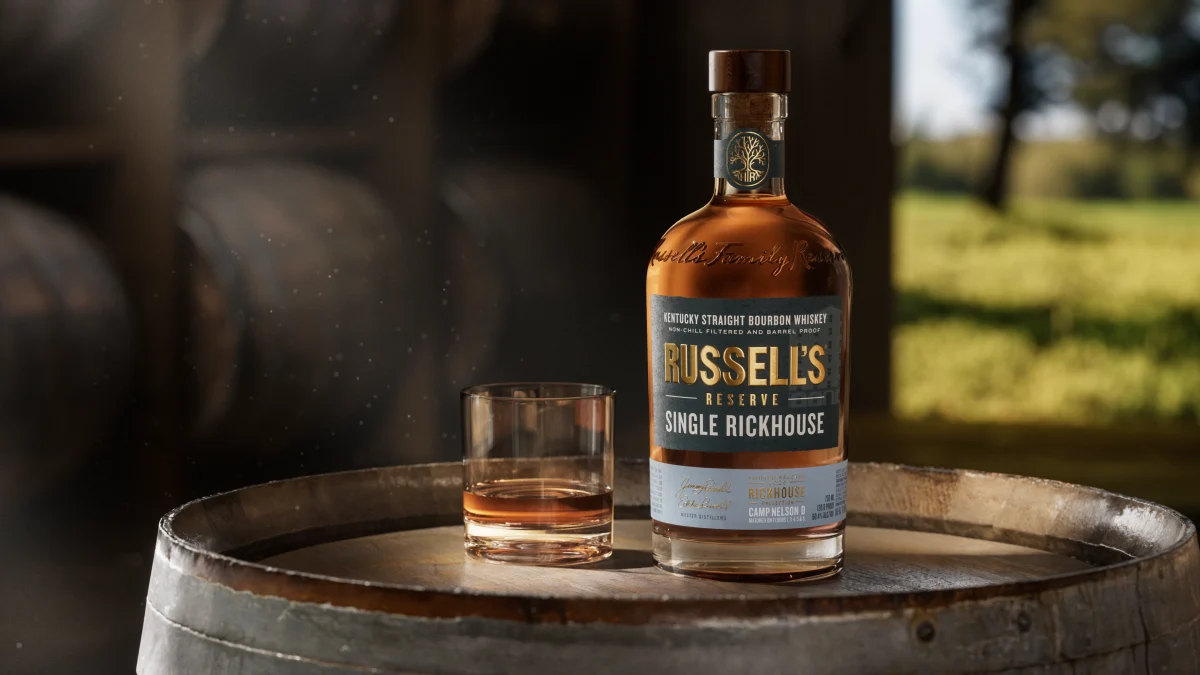
For decades, the discourse surrounding "terroir"—a concept historically tethered to the vineyards of France—has been a point of contention and curiosity in the American whiskey industry. While winemakers argue that soil, slope, and microclimate define a vintage, the whiskey world has traditionally focused on grain provenance and the variables of distillation. However, a quiet revolution is taking place in the rickhouses of Kentucky. Russell’s Reserve, the prestigious label under the Wild Turkey umbrella, is redefining this narrative by proving that the very walls, ventilation, and structural positioning of a warehouse are as influential to flavor as the mash bill itself.
With the unveiling of its latest entry in the Single Rickhouse series, Russell’s Reserve is not just releasing a premium bottle; it is offering a masterclass in atmospheric maturation.
The Evolution of a Kentucky Icon
To understand the significance of the Single Rickhouse series, one must first look at the legacy of the Wild Turkey distillery in Lawrenceburg, Kentucky. The brand is helmed by master distiller Eddie Russell, who stands as the steward of a lineage that defined modern bourbon. Having followed in the footsteps of his father, the legendary Jimmy Russell—a man whose 70-year career is synonymous with the rise of bourbon culture—Eddie is now celebrating his own 45th anniversary at the distillery.
Russell’s Reserve was born in 1998 as a personal project, a way for Eddie to commemorate his father’s 45th year in the industry. What began as a boutique experiment has blossomed into a titan of the craft spirits world. Over the last quarter-century, the label has become a benchmark for consistency and depth, anchored by its flagship 10-year-old expression. In recent years, however, the brand has pivoted toward limited-edition "prestige" releases, such as the 13-year-old and 15-year-old expressions, which have garnered a cult-like following among collectors. The Single Rickhouse series serves as the experimental pinnacle of this portfolio, moving away from master blending and toward the isolation of specific environmental variables.
Chronology: From Camp Nelson to Warehouse D
The Single Rickhouse project launched in 2022 with the release of "Camp Nelson C." The premise was simple yet radical: by bottling whiskey drawn exclusively from a single structure, the distillery could isolate the specific microclimate of that rickhouse.
Camp Nelson, a historic site where Wild Turkey ages a portion of its inventory, is widely considered by the production team to be a "sweet spot" for maturation. The conditions there—characterized by specific humidity fluctuations and airflow patterns—tend to coax distinct, concentrated flavor profiles from the charred oak barrels.
Following the success of the initial release, the series has moved through different Camp Nelson warehouses, each time varying in age and proof to showcase the unique "terroir" of that specific structure. The trajectory of these releases has been a deliberate exploration of how wood, spirit, and air interact over time.
The 2026 release represents a homecoming for Eddie Russell. It is sourced from Warehouse D, a structure that holds profound sentimental value for the distiller. It was here, nearly half a century ago, that Eddie began his career. To pull a 12-year-old whiskey from the same rafters where he once worked as a young man is a full-circle moment for the Russell family. Bottled at a robust 120.8 proof and left free of chill filtration, this release is arguably the most unfiltered expression of the brand’s history to date.
Supporting Data: The Science of the Rickhouse
The "Single Rickhouse" concept hinges on the belief that a building is a living organism. Temperature, humidity, and the "stacking" of barrels create a unique maturation environment. In traditional blending, distillers combine barrels from various floors and warehouses to achieve a consistent house profile. By contrast, the Single Rickhouse series seeks to capture the chaos and character of a single point of origin.
For this 2026 edition, Eddie Russell made an unconventional decision: to source barrels from floors one, three, four, five, and six.

"We don’t typically draw from the first floor," Russell noted in an official statement. "But some of the barrels we tasted down there contributed an earthy character that helped build the spicy, rye-like profile we found ourselves chasing."
This decision highlights a critical aspect of bourbon maturation: the "chimney effect." Heat rises, and in a multi-story rickhouse, the higher floors experience significantly higher temperatures than the ground level. The resulting interaction between the spirit and the barrel staves is accelerated on the upper floors, while the cooler, more humid first floor slows the process, allowing for deeper, earthier, and more nuanced maturation. By blending these distinct layers, the distillery has synthesized a complex profile that defies the typical expectations of a high-proof bourbon.
Official Responses and Tasting Profiles
The sensory experience of the new release is striking. Upon nosing, the whiskey presents an immediate intensity that reflects its 120.8 proof point. Yet, the palate offers a sophisticated counterpoint to the heat.
Tasting notes reveal a tapestry of flavors:
- The Spice: The most surprising element is the rye-like character. It is sharp, peppery, and incredibly dry, a rarity for a bourbon mash bill.
- The Sweetness: Balanced against the spice are layers of maple syrup, Madagascar vanilla, and toasted almond.
- The Orchard: A distinct, baked apple note lingers on the mid-palate, followed by deeper, darker fruit tones of plum and black cherry.
- The Finish: A long, lingering finish of tobacco leaf and charred oak that serves as a reminder of the 12 years spent resting in Warehouse D.
Eddie Russell’s assertion that "you’d bet it was a rye" is not mere marketing hyperbole. The inclusion of the first-floor barrels, which provide that foundational "earthy" weight, allows the spice of the higher-floor barrels to shine without becoming astringent. It is a balancing act of chemistry and intuition.
Implications for the Bourbon Industry
The release of this Single Rickhouse expression has broader implications for the American whiskey market. For one, it validates the consumer appetite for transparency in the maturation process. Enthusiasts are no longer satisfied with "age statements" alone; they want to know the why and the where behind their glass.
Furthermore, this release challenges the notion that consistency is the ultimate virtue of a major distillery. By showcasing the variability of specific warehouses, Russell’s Reserve is encouraging drinkers to appreciate the anomalies of bourbon—the "happy accidents" that occur when barrels are left to age in specific environments.
However, there is an economic reality to this level of craftsmanship. With a price point of $300 per bottle, this is an aspirational product. On the secondary market, prices are expected to climb even higher, placing it firmly in the category of a luxury investment. While this limits accessibility, it reinforces the "prestige" positioning that Wild Turkey has been cultivating for its Russell’s Reserve line. It effectively bridges the gap between mass-market production and the hyper-exclusive, small-batch world of craft distilling.
Conclusion: A Masterpiece of Environment
The 2026 Russell’s Reserve Single Rickhouse release is more than just a bottle of bourbon; it is a document of a specific time and place. It serves as a testament to the fact that when you respect the environment—when you listen to the way a specific building breathes—you can produce something that transcends the standard definitions of whiskey.
For the collector, it is a rare artifact of the distillery’s history. For the enthusiast, it is a complex, high-proof experience that challenges the palate. And for the industry, it is a clear signal that the future of bourbon lies in the details. As Eddie Russell looks back on 45 years of service, he has gifted the whiskey world with a reminder that in Kentucky, the walls of the rickhouse have stories to tell—if only we are willing to listen.
 Nana
Nana
 Nana Wu
 Asep Darmawan
