

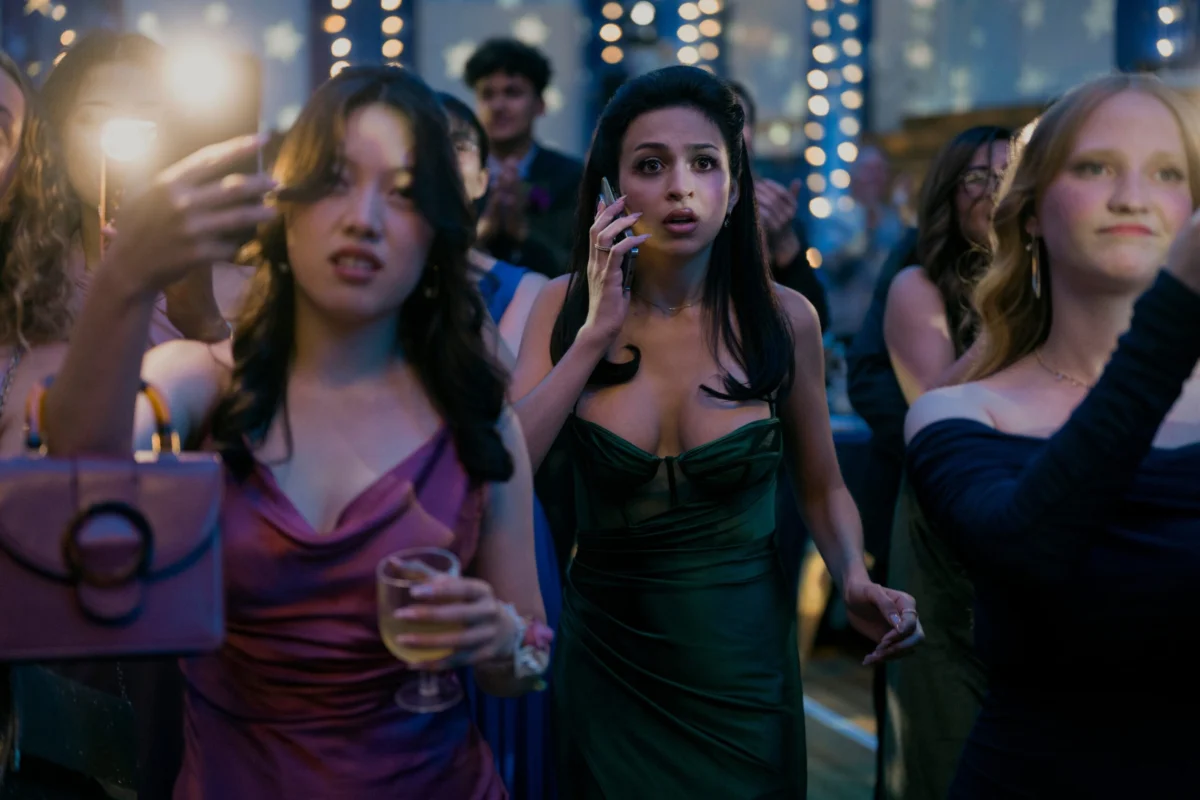
The Senior Prom is a cultural touchstone—a high school ritual etched into the collective psyche, often oscillating between the heights of romantic aspiration and the depths of teenage social anxiety. Yet, in the landscape of horror cinema, the prom serves a far more visceral purpose: it is the stage for the ultimate societal collapse. Central to this trope is Stephen King’s Carrie, a story that has been told and retold across film, television, and stage.
However, with the arrival of the new Prime Video adaptation, director Mike Flanagan has taken on the daunting task of recontextualizing this seminal work. Moving beyond the blueprints laid by Brian de Palma’s 1976 classic and subsequent iterations, Flanagan’s series doesn’t just adapt the source material—it dissects the very architecture of its most infamous sequence. The result is a 10-day, logistically grueling shoot that stands as the most complex set piece of Flanagan’s storied career.
The Challenge of the Familiar
When Mike Flanagan first approached the prospect of a new Carrie series, his initial reaction was one of skepticism. "I had the same kind of skeptical reaction I think that everybody had at the beginning," the director admitted to IndieWire. "I went off and thought about it for a long time, and it wouldn’t really leave me alone."

The weight of history is immense. From the 1976 film to the 2012 Kimberly Pierce remake, a 1999 sequel, and even a meta-commentary episode on The CW’s Riverdale, the story of Carrie White is a crowded space. To justify a new version, Flanagan had to apply the same structural deconstruction he used on The Haunting of Hill House and The Fall of the House of Usher. He needed to identify what was sacred and what was merely a product of its time.
"It began to haunt my dreams," Flanagan said of the prom sequence. "It’s the most logistically challenging and elaborate sequence of my career, by quite a bit, actually. It was brutal, but I got to spend 10 days on set at the prom with Carrie White, and I’ll have that forever."
Chronology of a Catastrophe
The brilliance of the prom sequence lies in its deceptive simplicity. As Flanagan notes, the core events—the blood drop, the initial panic, the departure of the antagonists—take place in roughly 90 seconds of real time. The narrative challenge, therefore, was not merely filming the action, but earning the emotional stakes that make that 90-second explosion feel like an inevitability.

The Entrance
The sequence begins with an atmospheric montage that establishes the gym’s transformation. Flanagan spent months planning this, often taking long walks near his Los Angeles home while listening to Lana Del Rey’s "Did you know that there’s a tunnel under Ocean Blvd."
The goal was to present the prom through Carrie’s eyes—a fever dream of stars, tinsel, and fleeting hope. This required immense technical precision. The shot, which transitions from full-speed motion to slow motion, had to be perfectly synced to the music. Because the audio track had to be played at double or triple speed for the actors to hit their marks, the entire production felt like a complex dance. Nine takes were required to ensure that the star-patterned lights reflected off the actors’ faces exactly as intended.
The Drop
Perhaps the most iconic moment in horror is the dousing of Carrie (Summer H. Howell) in pig’s blood. To achieve this, the production bypassed the "human error" of a person with a bucket, opting instead for a precise, rigged system. A tennis ball was lowered to mark the exact spot Howell needed to occupy.

The logistical reality of this shot was punishing. Five gallons of synthetic blood were used, and once the drop occurred, the scene was effectively over for the day. Howell spent significant time in a "Dexter tent"—a plastic-lined, isolated space—unable to touch anything. The blood varied in viscosity; some versions were designed to drip, while others were formulated to stick, ensuring the character’s transformation remained consistent from frame to frame.
Supporting Data: Behind the VFX and Stunt Rigging
The visual effects and stunt work required to bring this carnage to life were a collaboration between specialized teams. VFX Supervisor Becky Philpott explained that the sequence was a blend of practical effects and digital augmentation.
The "Digi-Double" Dilemma
When Carrie accidentally throws Ms. Desjardin (Amber Midthunder) through a wall of flame, the production relied on a hybrid approach. Midthunder was placed on a "non-negotiable" wire rig that allowed for a specific trajectory. However, because the distance of the throw exceeded the physical capacity of the rigging track, the team used a digital double. By scanning both Midthunder and her stunt performer, the VFX team created a seamless transition, allowing the character to be pulled through a CGI fire curtain that, if done solely with practical effects, would have been physically impossible.

Fire and Heat
The fire elements in the gym were a masterclass in lighting physics. Philpott emphasized the importance of "heat shimmer," the wavy distortion caused by intense temperatures. "I’ve seen some CG fire on other shows where that’s missing," she noted. By combining practical flame bars with CG light sources, the production avoided the "fake" look that often plagues high-budget horror.
Official Perspectives: Shifting the Narrative
Flanagan’s adaptation also introduces "The Others," a group of powered individuals who monitor Carrie. This inclusion fundamentally shifts the story from a solitary tragedy of bullying to something more cosmic. Kate Siegel, playing a leader among these individuals, and Thalia Dudek, who portrays a girl Carrie perceives as a split personality, add layers of depth that explain the telekinetic outbursts.
Flanagan was careful to avoid direct mimicry of Brian de Palma. While de Palma’s split-screen techniques and specific camera movements are legendary, Flanagan sought to move the camera in a way that felt authentic to his own vision. "Brian de Palma used the prom sequence in order to deploy an astonishing grab bag of cinematic techniques, which to me are things you do not do, because that just becomes an echo of de Palma," he explained. Instead, he and cinematographer Michael Fimognari spent five months drawing the sequence on whiteboards, planning every movement to ensure the audience understood the geography of the room.

Implications for the Horror Genre
The implications of this series are significant for the landscape of modern streaming horror. By treating the prom not as a predictable death trap but as an "Everest of Editing," Flanagan has set a new bar for how classic horror stories can be refreshed for a new generation.
The success of the sequence relies on the audience’s empathy. The chaos only resonates because the viewer has spent the preceding episodes invested in the fates of these characters. As Flanagan stated, the preparation was the most suspenseful part of the process. The series proves that even when the outcome is known—the blood will fall, the gym will burn—the journey to that moment can be reinvented.
For the production team, the prom was more than just a sequence; it was a defining moment of their collective career. "We had this great moment where we all got to take a second," Flanagan reflected. "Take a breath, look around, and remind each other that we were at the prom with Carrie White, and that’s a thing you don’t get to do in your career."

Ultimately, the Prime Video Carrie serves as a reminder that the best horror is not found in the gore itself, but in the meticulous, agonizing, and human effort required to make the nightmare look real. By balancing the practicalities of five gallons of blood and complex wire work with the emotional vulnerability of its lead, the series succeeds in making us fear the prom all over again.
 Iffa Jayyana
 Dwi Wanna
 Laily UPN
