

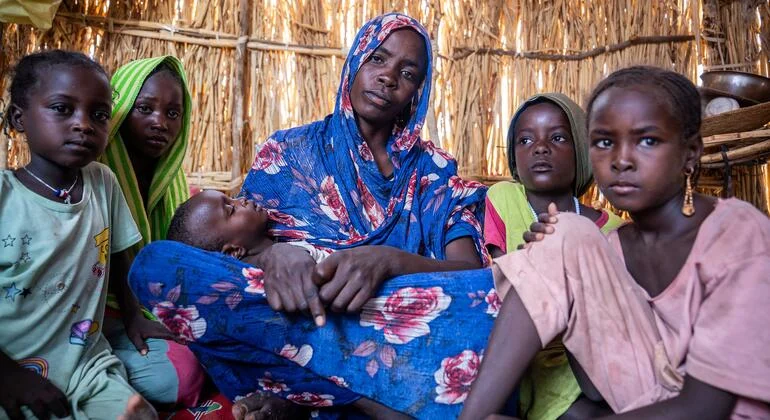
GENEVA – The fundamental post-World War II promise to protect those fleeing persecution is currently facing its most perilous test in decades. As conflicts multiply and displacement reaches record-breaking levels, the UN Refugee Agency (UNHCR) has issued a stark, desperate warning: the global humanitarian safety net is not just fraying—it is nearing total collapse.
In his inaugural keynote address to the UNHCR’s Executive Committee in Geneva this Monday, High Commissioner Salih delivered a sobering assessment of the agency’s capacity to fulfill its mandate. With staff levels decimated and funding streams drying up, the agency is no longer operating under the guise of "doing more with less." Instead, it is being forced to confront the reality that it is being asked to do the impossible.
The Breaking Point: A Crisis of Resources
The UNHCR, established in the aftermath of the Second World War, was founded on the bedrock principle that no individual fleeing danger should be returned to a site of persecution. For over 70 years, this commitment has been the gold standard of international humanitarian law. However, today, that pledge is being strained to the point of failure.
The agency is currently grappling with an "exceptionally difficult" fiscal environment. Since 2024, the UNHCR has been forced to shed 8,000 staff members, a move intended to streamline operations but which has, in practice, dismantled the agency’s frontline reach.
"There is a difference between doing more with less and being asked to do the impossible," High Commissioner Salih told the gathered delegates. "Efficiency has limits. There comes a point when greater efficiency cannot compensate for fewer resources. When funding falls below that point, the consequences are not abstract; they are borne by people who depend on it."
Chronology of a Mounting Emergency
The current crisis did not emerge in a vacuum. It is the result of a confluence of geopolitical instability and a growing trend of "donor fatigue" among wealthy nations.
- 2024 – The Staffing Exodus: Facing severe budget constraints, the UNHCR initiates a massive downsizing, resulting in the loss of 8,000 personnel. This reduction in workforce directly impacted the agency’s ability to maintain field offices and provide direct protection services in high-risk zones.
- Early 2026 – The Surge in Conflict: By the start of this year, the agency was forced to mobilize for 22 distinct emergencies across 18 countries. From the volatile Sahel region to the Horn of Africa and Yemen, the pace of displacement began to outstrip the agency’s physical and financial resources.
- Late 2026 – Security Council Warning: Last month, Commissioner Salih appeared before the UN Security Council, describing the conditions facing displaced populations as "genuinely, truly, inhumane."
- October 2026 – The Geneva Summit: During the Executive Committee meeting, the Commissioner formally declared that the agency has received less than one-third of its required funding for the current year, effectively signaling that the humanitarian response is functionally bankrupt.
Supporting Data: The Human Cost of Austerity
The statistics behind the funding gap reveal a human rights disaster in the making. In countries where the UNHCR serves as the final line of defense, the absence of funds has led to immediate, life-altering consequences for millions of people.
Regional Impacts
- Sudan: The lack of resources has led to the effective abandonment of over 50,000 survivors of conflict-related sexual violence. These individuals are now being denied critical specialized medical care, legal aid, and essential psychological trauma counseling.
- Chad: The protection of the most vulnerable—unaccompanied children and those separated from their families—has reached a critical juncture. Services specifically designed to safeguard these children from exploitation and trafficking are now largely under-resourced or non-functional.
- Ethiopia: The bureaucratic and logistical strain is evident in the halting of refugee registration for tens of thousands of people fleeing violence in South Sudan and Eritrea. Hundreds of thousands more remain in a state of legal limbo, awaiting verification and integration into national systems that simply do not have the capacity to process them.
The Scope of Dependency
Globally, nearly 14.5 million refugees currently reside in low- and middle-income countries. These individuals rely entirely on humanitarian assistance for their basic survival, including food, water, and shelter. With less than 33% of the required funding secured, these millions are being pushed toward the margins of survival.
Official Responses and Strategic Shifts
Despite the grim outlook, the UNHCR is attempting to pivot toward a more sustainable long-term model. Commissioner Salih highlighted an ambitious initiative launched earlier this year, which aims to cut the number of refugees living in "protracted displacement" by half by 2035.
However, the Commissioner was quick to clarify that this goal should not be confused with mere cost-cutting.
"We cannot claim success simply because assistance has been reduced or responsibility has been transferred to host countries," Salih argued. "Success is measured by whether people’s lives have genuinely improved and whether they have become self-reliant and active contributors to their communities. For those who still require humanitarian support, our responsibility remains."
The UNHCR is also navigating the growing frustration of "host nations." Countries that have opened their borders to refugees for decades are now expressing deep irritation at the lack of international burden-sharing. The perceived absence of global solidarity has created a volatile political climate where the safety of refugees is increasingly tied to the whims of domestic politics in host nations.
Implications: A Future at Risk
The implications of the current funding shortfall are profound and far-reaching. As the UNHCR retreats from its frontline positions, the void is being filled by insecurity and instability.
1. Increased Vulnerability for Women and Children
The most direct consequence of the funding cuts is a rise in protection risks. Women and girls are reporting higher instances of violence and exploitation, as the protective monitoring presence of the UN and its partners has been scaled back. Similarly, the loss of educational access for refugee children represents a "lost generation," where years of schooling are sacrificed to the exigencies of survival.
2. Erosion of International Law
The erosion of the agency’s capacity threatens to undermine the entire international framework for refugee protection. If the UNHCR cannot fulfill its role as a guarantor of human rights, the temptation for host countries to engage in "refoulement"—or the forced return of refugees to dangerous conditions—grows exponentially.
3. The Need for Empathy and Humility
In his closing remarks in Geneva, Commissioner Salih made an impassioned plea for a return to the values that underpin the international order. He urged global leaders to move away from the dehumanizing rhetoric that often surrounds the discourse on displacement.
"When we speak about refugees and displacement, we should do so with humility," Salih said. "None of us knows who may be forced to flee tomorrow, or who may be called upon to offer refuge."
As the year draws to a close, the UNHCR remains at a crossroads. Without a significant, immediate injection of capital from the international community, the agency’s ability to prevent a humanitarian catastrophe in the coming months remains in grave doubt. The "efficiency" that donor nations have long demanded has been pushed to its absolute limit, and the bill for that demand is now being paid in the lives and futures of the world’s most vulnerable people.
 Muslim
 Jia Lissa
 Pevita Pearce
