

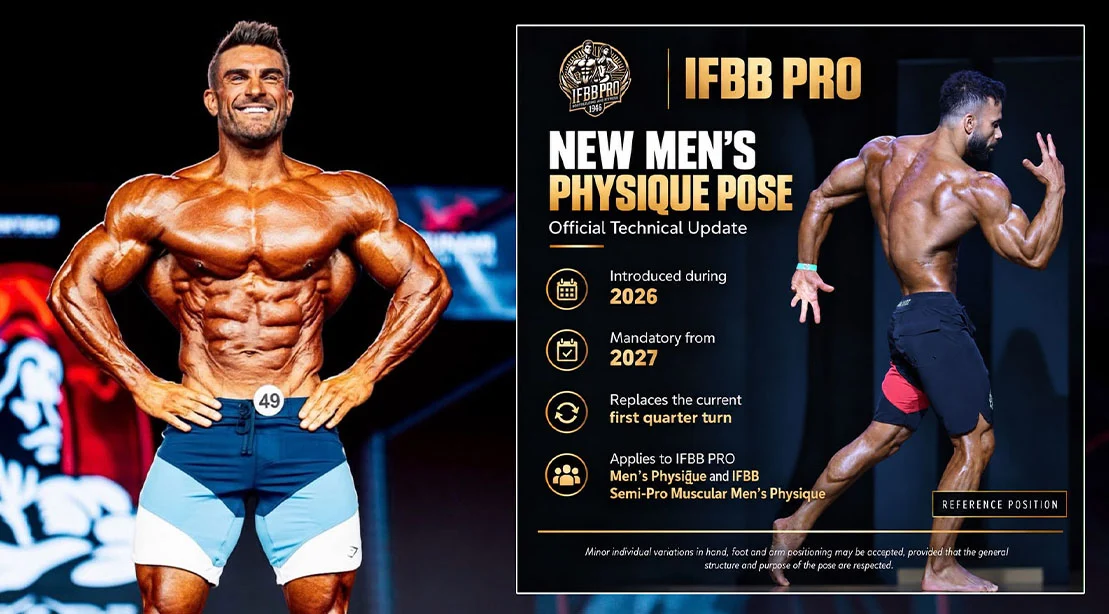
The Men’s Physique division of professional bodybuilding has reached an unprecedented zenith of popularity and competitive depth. Following the 2026 Olympia, where Ryan Terry cemented his legacy by securing a historic fourth title against a world-class lineup, the IFBB has turned its gaze toward the future of the sport. In an unexpected move aimed at refining the aesthetic standards of the division, the IFBB has announced a significant modification to the mandatory posing routine, set to take full effect in 2027.
This regulatory change represents a pivotal moment for athletes who don the iconic board shorts, shifting the competitive focus toward more dynamic, back-focused musculature. As the division continues to evolve, this new requirement is expected to separate the best from the rest, placing a higher premium on spinal erector development, latissimus dorsi width, and overall structural fluidity.
The Core Mandate: Understanding the 2027 Shift
On October 8, the IFBB official Instagram account sent shockwaves through the bodybuilding community with a brief but impactful bulletin: “Important: changes to the rules for the IFBB Pro (and Semipro) Men’s Physique poses.”
While the organization is currently phasing the change in to allow athletes ample time to adapt, the mandate will become a formal, obligatory component of all Men’s Physique competitions starting in the 2027 season. This is not merely a suggestion; it is a fundamental restructuring of the stage presentation that has defined the division since its inception.
The new mandatory pose, while yet to be given a formal nomenclature by the IFBB, is a three-quarter rear-focused turn. Unlike the traditional front-facing quarter turns that emphasize the "V-taper" from a frontal perspective, this new requirement forces athletes to expose their posterior chain, lat insertions, and mid-back detail in a way that has previously been reserved for the Classic Physique and Men’s Open divisions.
A Chronology of Men’s Physique Posing Standards
To understand the weight of this decision, one must look at the historical trajectory of the Men’s Physique category. Conceived as a more accessible, "athletic" alternative to the extreme mass of traditional bodybuilding, the division was initially predicated on a "beach-ready" aesthetic.
The Formative Years (2010–2015)
When the division was first introduced, the criteria were relatively simple: judges looked for a fit, healthy, and symmetrical physique. Posing was kept to basic quarter turns. The emphasis was heavily placed on the chest-to-waist ratio, clean abdominal lines, and a lack of excessive muscle mass.
The Rise of Hyper-Muscularity (2016–2022)
As the sport grew, the standard of what constituted a "Men’s Physique" athlete shifted. Competitors began displaying levels of leanness and muscle density that blurred the lines with the Classic Physique category. This era saw the introduction of more rigid, controlled poses to ensure the "board short" aesthetic remained distinct.
The Transition to Technicality (2023–2026)
With the dominance of athletes like Ryan Terry, the sport moved toward a requirement for extreme conditioning and high-level muscle maturity. The 2026 Olympia served as a showcase for this technical proficiency. The announcement of the new 2027 mandate is the logical conclusion of this trend—a move to ensure that the "back" of the physique is as well-developed as the "front."
Anatomy of the New Pose: Technical Breakdown
The new mandatory pose is a sophisticated test of both muscularity and stage presence. It requires a 270-degree rotation, placing the athlete at a three-quarter angle to the judges.
- The Silhouette: By utilizing a three-quarter rear turn, the athlete creates a dramatic diagonal silhouette. This forces the judge’s eye to travel from the rear deltoids down to the obliques and hamstrings.
- The Upper Body Mechanics: The athlete must extend one arm downward with fingers fanned, creating a line that accentuates the latissimus dorsi. Simultaneously, the opposite arm is bent upward with the hand raised, which serves to pop the triceps and rear deltoids.
- The Staggered Stance: One foot is placed behind the other, a classic bodybuilding technique that stabilizes the frame and allows for a deeper contraction of the glutes and hamstrings.
This pose is not just about muscle mass; it is about "flow." Judges will be looking for how the athlete transitions into this position. A clunky, uncoordinated transition could now be the difference between a podium finish and being relegated to the middle of the pack.
Supporting Data: Why the Change?
The rationale behind this shift is twofold: improving the spectator experience and ensuring the division maintains its integrity.
According to industry analysts, the Men’s Physique division has seen a 15% increase in viewership over the last three years. However, feedback from judges and fans suggested that the "same old" quarter turns were becoming repetitive. By introducing a pose that highlights the posterior chain, the IFBB is addressing the common critique that Men’s Physique athletes lack the back development of their counterparts in other divisions.
Furthermore, this change helps distinguish the division from "Fitness Modeling." By requiring a technical pose that highlights the rear deltoids and hamstrings, the IFBB is signaling that this is, first and foremost, a sport of bodybuilding, requiring the same level of anatomical knowledge and posing skill as any other category.
Official Responses and Fan Sentiment
The announcement has ignited a firestorm of discussion across social media platforms. The IFBB’s move to modernize the stage requirements has been met with a mix of excitement and trepidation.
"I like that," commented one prominent fitness influencer on Instagram. "It shows the lat sweep better than any of the current poses. It’s about time we stopped hiding the back development in this division."
Others have noted that this will require a significant shift in training methodologies. Athletes who have spent years focusing solely on their "mirror muscles" (chest, abs, front delts) will now need to dedicate serious volume to their posterior deltoids and spinal erectors to remain competitive in 2027.
"An interesting change," another observer noted. "Great to see posing getting more attention. It separates the guys who just go to the gym from the guys who actually understand their anatomy."
While some veteran competitors have expressed concern over the "slippery slope" of adding too many mandatory poses—which could lead to the division eventually looking like a traditional bodybuilding category—the consensus is that this move will elevate the overall quality of the stage product.
Implications for the Future of Men’s Physique
The implications of this change extend far beyond the stage.
1. Training Evolution
Coaches are already pivoting. We can expect to see an increased emphasis on "pull" movements in the off-season. The 2027 Olympia prep will likely include specific posing coaches focusing on the fluidity of this new three-quarter turn, as it requires a high degree of core control and balance.
2. Judging Criteria
Judges will now have a clearer metric for assessing the "completeness" of an athlete. If an athlete has a massive chest but a lagging back, this new pose will expose that weakness immediately. This will force a new standard of "total package" excellence.
3. The Divide Between Divisions
There is a long-term question of whether Men’s Physique is drifting too close to Classic Physique. If the IFBB continues to add mandatory poses that require more muscularity, the distinction between the two divisions may eventually rely solely on the type of trunks worn. However, for now, the IFBB seems committed to keeping the "Physique" identity intact while raising the bar for athletic standards.
Conclusion: A New Era
As the sport looks toward 2027, one thing is clear: the era of the static, one-dimensional posing routine is coming to an end. The IFBB’s decision to implement this new mandatory pose is a bold step toward a more technical and visually stimulating future.
For athletes, the message is simple: adapt or get left behind. Whether this change will truly revolutionize the division or merely add another layer of complexity remains to be seen. However, one thing is certain—the next time the Men’s Physique competitors take the stage, they will be bringing more than just a V-taper; they will be bringing a full-spectrum display of anatomy that will redefine the look of the modern champion.
As we look toward the next cycle of competition, the eyes of the fitness world will be fixed on how the athletes handle this new challenge. Will it favor the mass monsters, or will it reward the masters of symmetry and poise? Only time—and the judges—will tell.
 Nana
Nana
 Suro Senen
 Ali Ikhwan
