

Main Facts
Legendary singer-songwriter Joni Mitchell has officially become a United States citizen, capping off a remarkable personal and artistic migration that has spanned over half a century. The Canada-born architect of modern folk and pop shared the news via social media, describing her official naturalization as the culmination of “a journey that began 62 years ago.”
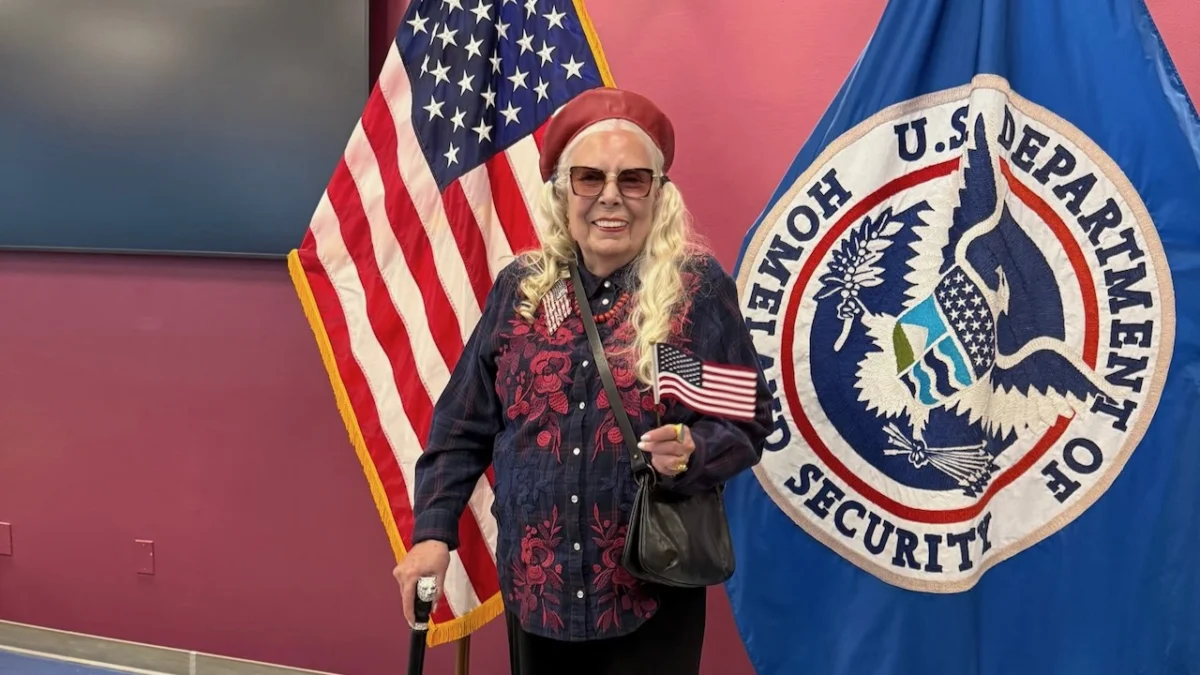
Accompanied by a video capturing the momentous occasion inside a Department of Homeland Security office, the footage shows Mitchell’s name being called as a new citizen, met with warm cheers and enthusiastic applause from a room of approximately two dozen onlookers and fellow applicants. Further celebrating the milestone, Mitchell posted a photograph of herself smiling proudly in front of an American flag while holding a small U.S. banner.
The decision by the 82-year-old icon to formalize her status as an American citizen after living in the country for more than six decades carries a distinct layer of cultural and political intrigue. While Mitchell has deeply embedded herself in the fabric of American society and art, her relationship with the nation’s political leadership has not been without friction. Notably, her path to citizenship arrives against a backdrop of outspoken political engagement, highlighting a complex dedication to the country’s democratic processes that transcends partisan figures.
The news of her citizenship also arrives during a busy period for the artist’s legacy. A high-profile biographical film chronicling her life and career is currently in development under the direction of filmmaker Cameron Crowe. Academy Award-winning actress Meryl Streep is slated to portray Mitchell in her later years, while persistent industry rumors point to Anya Taylor-Joy stepping into the role of a young Mitchell, though official confirmation regarding the younger casting choice remains pending.
Chronology
To understand the weight of Mitchell’s naturalization, one must trace a timeline that stretches from the prairies of western Canada to the sun-drenched canyons of Los Angeles, mapping a career that fundamentally altered the landscape of popular music.
1943–1964: Early Life in Canada
Born Roberta Joan Anderson on November 7, 1943, in Fort Macleod, Alberta, Canada, Mitchell spent her formative years navigating childhood illnesses, including a bout of polio at age nine that sparked her interest in the arts while she was bedridden. She developed a profound passion for painting and music, eventually teaching herself to play the ukulele and guitar. Before crossing the border, her musical explorations began taking shape in Canadian coffeehouses and folk clubs.
Mid-1960s: Crossing the Border and Detroit Beginnings
Mitchell’s migration to the United States began in earnest in the mid-1960s. Following her marriage to folk singer Chuck Mitchell, she relocated to Detroit, Michigan. The industrial Midwest served as her entry point into the vibrant, interconnected American folk revival circuit. Though her marriage was short-lived, the move proved pivotal in launching her professional trajectory, exposing her to broader audiences and fellow musicians across the border.
Late 1960s–Present: The California Years and Cultural Permanence
By the late 1960s, Mitchell had moved to Los Angeles, settling into the legendary Laurel Canyon music scene. This move anchored her creative output for the decades that followed. Southern California became the incubator for masterpieces like Ladies of the Canyon (1970) and Blue (1971). For more than sixty years, the U.S. remained her functional home, the place where she wrote, recorded, and shaped the American musical canon—even as she retained her Canadian citizenship.
October 2024: The Stage Outburst
At a rare, critically acclaimed live concert performance in October 2024, Mitchell made headlines when she offered a blunt and unfiltered assessment of American politics. While on stage, she shouted, “Fuck Donald Trump,” prompting widespread media coverage. She urged the audience to participate in the electoral process, remarking, “Everybody get out and vote. This is an important one. I wish I could vote. I’m Canadian. I’m one of those lousy immigrants.”
October 2026: Official U.S. Naturalization
More than a year after expressing her regret at being unable to vote in American elections due to her foreign status, Mitchell officially completed the naturalization process, stepping forward to take the oath of citizenship in a Department of Homeland Security office.
Supporting Data and Context
Joni Mitchell’s journey cannot be separated from her towering stature as one of the most influential artists of the 20th and 21st centuries. Her catalogue has continually received critical acclaim, cementing her place in music history.
- Critical Accolades: Consequence has prominently placed Joni Mitchell near the very top of its esteemed list of The 100 Best Vocalists of All Time, recognizing her three-octave vocal range, idiosyncratic phrasing, and emotional depth.
- The Laurel Canyon Migration: Mitchell was part of a legendary wave of Canadian artists—including Neil Young, Robbie Robertson, and later, voices like Leonard Cohen—who relocated to the United States during the turbulent 1960s, profoundly reshaping American rock, folk, and counterculture.
- The Biopic Project: The ongoing production led by Cameron Crowe highlights the enduring commercial and cultural appetite for Mitchell’s life story. With Meryl Streep attached to star, the project guarantees that Mitchell’s impact will continue to find new generations of admirers.
- Health and Resilience: Mitchell’s recent milestones, including her return to live performance following a severe brain aneurysm in 2015 and her subsequent naturalization, underscore a narrative of fierce personal and artistic resilience.
Official Responses and Public Reaction
The announcement of Mitchell’s citizenship immediately generated widespread public interest and digital celebration across social media platforms, drawing responses from fans, cultural commentators, and fellow artists.
While federal agencies like the Department of Homeland Security maintain strict confidentiality regarding individual naturalization cases and do not issue public statements regarding specific applicants, the viral video shared by Mitchell’s team provided an intimate look at the proceedings. The clip—featuring enthusiastic applause from fellow naturalization candidates in the office—highlighted the communal and emotional nature of the rite of passage.
Cultural critics noted the irony and poetry of her timing. For decades, Mitchell occupied a unique dual space: an undisputed pillar of American cultural identity who nevertheless remained legally a foreign national. Her 2024 declaration on stage that she was "one of those lousy immigrants" resonated deeply in a polarized political climate, serving as a reminder of the complex relationship foreign-born artists have with American civic life.
By choosing to naturalize in 2026—following sharp public critiques of conservative leadership—Mitchell’s decision has been interpreted by many observers as a proactive assertion of her stake in the American experiment. Rather than distancing herself from a political system she has publicly criticized, her decision to become a citizen equips her with the full democratic franchise she lamented lacking just two years prior.
Implications
Joni Mitchell’s formal adoption of U.S. citizenship carries several notable cultural, political, and personal implications:
1. The Power of the Ballot
Most immediately, naturalization grants Mitchell the legal right to vote in American elections. Given her vocal frustrations during her 2024 concert regarding her inability to cast a ballot, acquiring citizenship transforms her political commentary from observation to direct participation. For an artist whose work has frequently addressed social justice, environmental concerns, and personal freedom, the ability to vote represents the closing of a lifelong civic loop.
2. A Statement on Belonging in a Polarized Era
Opting to become a U.S. citizen during a politically charged era—and following public opposition to figures like Donald Trump—sends a nuanced message. It suggests a distinction between current political leadership and an enduring belief in the foundational ideals of the nation. Mitchell’s actions imply that her six-decade investment in American culture warrants a permanent, formal stake in its governance.
3. Cementing a Dual Legacy
While Mitchell’s birthplace remains Fort Macleod, Alberta, and Canada will forever claim her as one of its most brilliant native daughters, her naturalization firmly anchors her legal identity alongside her cultural one. She joins a long lineage of immigrant artists who helped define the American songbook, proving that national identity in the United States is frequently enriched by those who choose it later in life.
As she completes what she calls a "journey that began 62 years ago," Joni Mitchell ensures that her voice will not only continue to echo through her timeless recordings, but will now resonate with the full legal authority of an American citizen.
 Lina Hope
