

BROOKLYN, N.Y. — Last month, the Brooklyn neighborhood of Brownsville witnessed the realization of a monumental civic and cultural milestone. Three New York City agencies officially unveiled a state-of-the-art, $128 million multi-service center designed to anchor and uplift one of the borough’s most historically resilient communities.
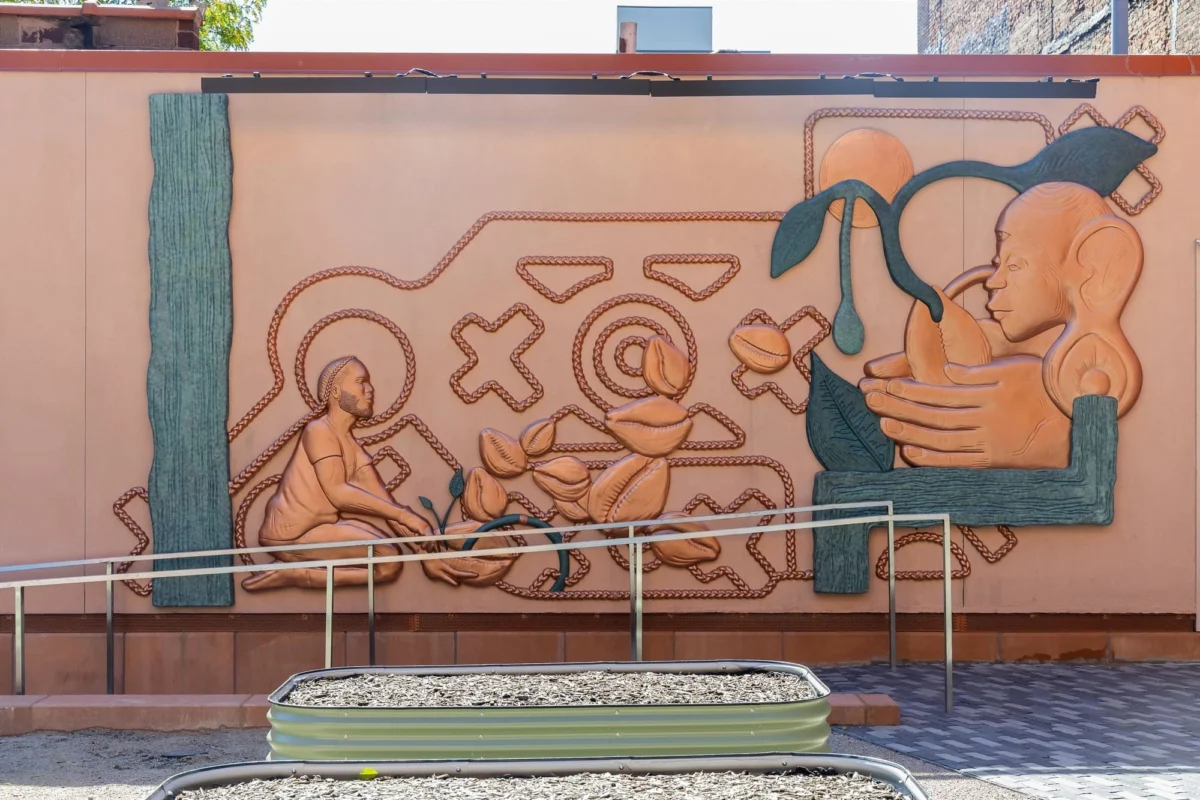
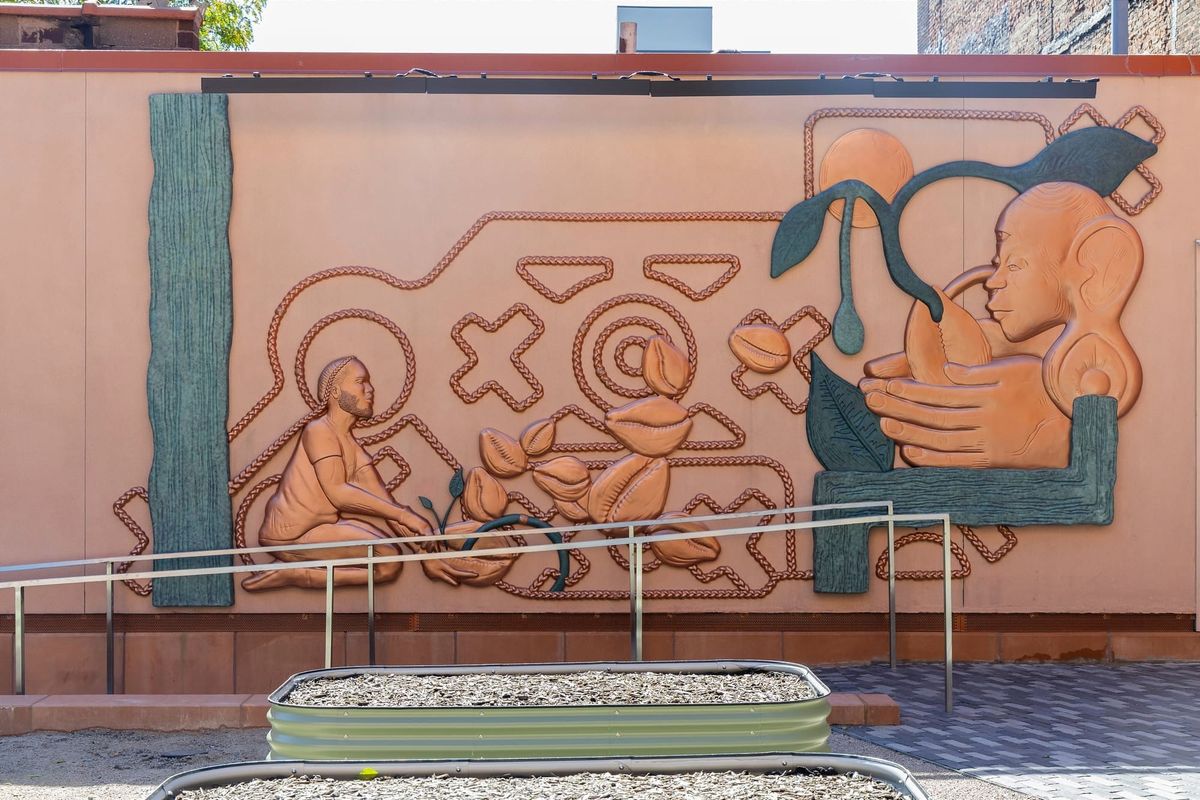
At the literal and metaphorical thresholds of this new architectural landmark stand four striking, vibrant public art installations. Titled I Am Protected (2026), the four-part commission was created by local artist and community educator Jazmine Hayes. Curated and funded through the New York City Department of Cultural Affairs’ (DCLA) renowned Percent for Art program, Hayes’s works greet visitors at every entryway, transforming functional civic thresholds into spaces of profound cultural affirmation, historical reflection, and radical care.
For Hayes—an East New York native who has dedicated her career to grassroots community engagement and youth arts education—the project is deeply personal.
"I genuinely want any child that walks through this door to be and feel protected," Hayes told Hyperallergic in a recent interview. "I want them to have affirmations of care, support, and community."
Main Facts: The Commission and the Architecture
The newly minted Brownsville Multi-Service Center represents a major capital investment by New York City, aimed at consolidating critical community resources under one roof to better serve local residents. Spanning a sprawling footprint, the $128 million facility brings together essential health, social, and cultural services designed to address historical inequities and provide accessible, high-standard infrastructure to Brownsville.
Central to the building’s welcoming ethos is Jazmine Hayes’s I Am Protected. The commission comprises four distinct visual narratives distributed across the facility’s various entryways:
- "In My Mother’s Garden," a standout piece in the series, uses rich iconography to explore themes of generational nurturing, domestic sanctuary, and botanical resilience.
- The remaining components integrate motifs drawn from the rich cultural tapestry of Brooklyn, honoring the neighborhood’s legacy of grassroots organizing, Black artistic expression, and familial endurance.
Executed in durable, light-filtering mediums designed to interact dynamically with changing daylight, the installations serve as both visual wayfinding and psychological armor. They actively counter the clinical, sterile aesthetic traditionally associated with municipal and social service buildings, replacing it with an environment of warmth, dignity, and visual poetry.
Chronology: From East New York Roots to Brooklyn Landmarks
To understand the weight and resonance of I Am Protected, one must trace the trajectory of Jazmine Hayes’s artistic practice and her deep-seated ties to eastern Brooklyn.
- Formative Years: Raised in adjacent East New York, Hayes developed an intimate, lived understanding of the systemic challenges, vibrant subcultures, and tight-knit community networks shared across Brooklyn’s historically marginalized neighborhoods. Her upbringing deeply informed her artistic philosophy, which posits that art should not merely be viewed in sequestered white-cube galleries, but should live where people breathe, struggle, and celebrate.
- 2025 – You Deserve Ease and Joy: Hayes’s footprint in Brownsville began to crystallize significantly the year prior to the multi-service center’s opening. In 2025, she completed You Deserve Ease and Joy, a celebrated public art project commissioned for the New York City Housing Authority’s (NYCHA) Brownsville Houses, realized in partnership with the nonprofit ArtBridge. That project received widespread acclaim for its gentle, restorative imagery, establishing Hayes as an artist capable of translating complex community narratives into accessible public healing.
- The DCLA Engagement: Building upon the success of her work at Brownsville Houses, the Department of Cultural Affairs approached Hayes regarding the Percent for Art opportunity at the forthcoming multi-service center. Recognizing the scale and civic importance of a $128 million facility, Hayes immediately accepted, viewing it as an unprecedented canvas to scale up her vision of protective, community-centered public art.
- October 2026 – The Grand Unveiling: Last month, alongside city officials—including DCLA Commissioner Diya Vij and Percent for Art Program Director Sergio Pardo López—Hayes cut the ribbon on I Am Protected, officially opening the installations to the public alongside the broader multi-service facility.
Supporting Data: The Mechanics of Public Investment
The realization of I AmgetProgress and the Brownsville Multi-Service Center is underwritten by significant municipal policy frameworks and financial allocations:
- The $128 Million Capital Investment: Distributed across multiple city departments—including the NYC Department of Design and Construction (DDC)—the facility represents one of the largest municipal investments in Central Brooklyn’s public infrastructure in recent years. It is engineered to meet modern sustainability standards while maximizing spatial efficiency for social service delivery.
- The Percent for Art Mandate: Established in 1982, New York City’s Percent for Art law requires that 1% of the budget for eligible city-funded construction projects be allocated to the commissioning of public artwork. This program has resulted in hundreds of site-specific commissions across the five boroughs, democratizing art access and embedding cultural equity into the physical fabric of the city.
- Demographic Context: Brownsville has historically faced severe disparities in infrastructure investment, health outcomes, and economic mobility compared to wealthier tracts of New York City. Capital projects like the multi-service center—paired with intentional cultural programming—are vital statistical and material interventions aimed at reversing decades of municipal neglect.
Official Responses: Voices from the Unveiling
The unveiling ceremony brought together city leadership, artists, and community members, all of whom emphasized the profound intersection of architecture, public funding, and community-led design.
DCLA Commissioner Diya Vij, who was present at the ribbon-cutting alongside Program Director Sergio Pardo López, underscored the vital role that artists like Hayes play in shaping the identity of civic spaces.
"Public art is not an afterthought in New York City; it is the heartbeat of our civic architecture," Vij noted during the walkthrough. Through initiatives like the Percent for Art program, the city aims to ensure that major capital investments are infused with the cultural specificity, history, and heart of the communities they serve.
Artist Matthew Lapiska, documenting the event for the NYC Department of Design and Construction (DDC), captured the collaborative spirit of the unveiling, photographing Hayes standing flanked by municipal leaders beneath her vibrant installations.
For Hayes, however, the ultimate metric of success is not measured in municipal accolades, but in the micro-interactions of everyday life inside the building.
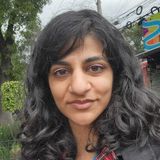
"I genuinely want any child that walks through this door to be and feel protected," Hayes reiterated to Hyperallergic. "When you come from neighborhoods like East New York and Brownsville, the world often tries to tell you who you are before you get to decide for yourself. These pieces are reminders: You belong here. You are cared for. Your imagination is safe."
Implications: Art as Infrastructure in Changing Neighborhoods
The deployment of I Am Protected within a $128 million municipal hub raises important conversations about the evolving role of public art in gentrifying and historically disinvestment-plagued urban centers.
As Brooklyn experiences relentless demographic and economic shifts, large-scale public developments frequently spark anxiety regarding displacement, cultural erasure, and top-down municipal planning that ignores local voices. By commissioning an artist who is not only a local native but a dedicated community educator—someone who understands the delicate fabric of Brownsville and its sister neighborhood, East New York—the city modeled a different approach: one of collaborative stewardship.
Hayes’s work directly addresses the physical and psychological toll of displacement and community disruption. By centering themes of botanical growth (In My Mother’s Garden), ancestral safety, and unapologetic youth joy, I Am Protected acts as a cultural anchor. It ensures that as the physical landscape of Brownsville modernizes, the soul, memory, and dignity of its generational residents remain visible, honored, and fiercely protected.
Ultimately, the project transcends traditional public art. It functions as a form of social infrastructure—a visual sanctuary proving that civic buildings can be more than mere offices of bureaucracy; they can be spaces that nurture the human spirit, fortify community resilience, and offer a lasting embrace to every child who walks through their doors.
 Asep Darmawan
 Laily UPN
 Muslim
