

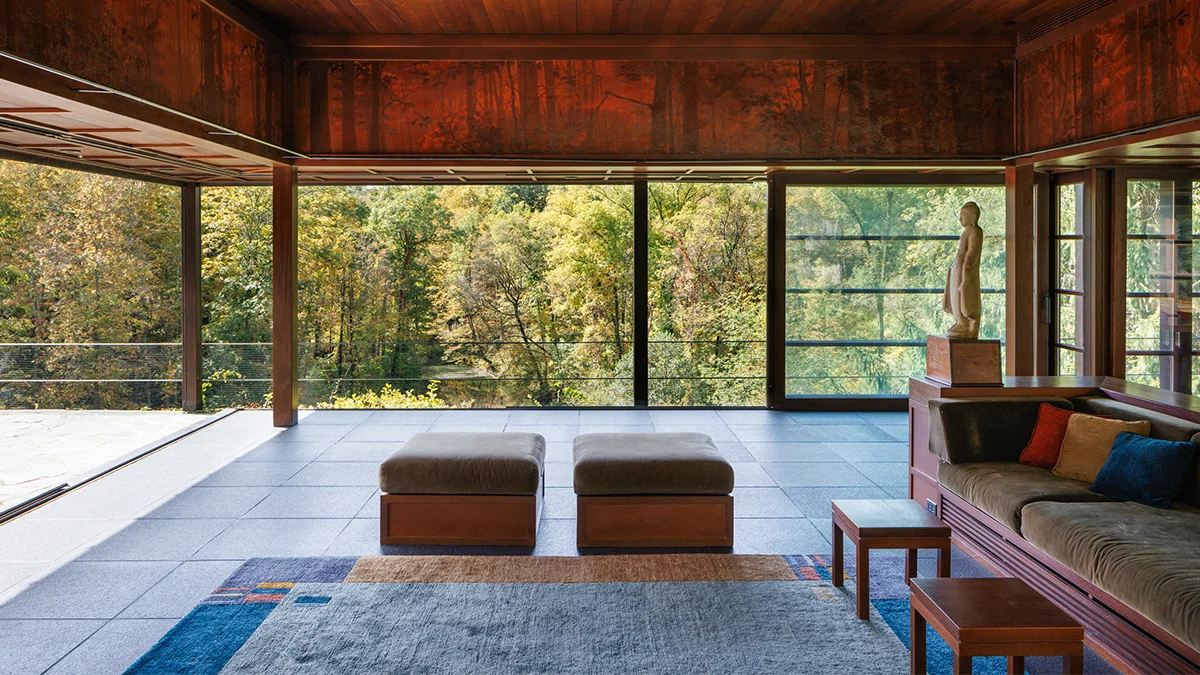
In the verdant heart of Rhinebeck, New York, where the rolling hills of the Hudson Valley meet the rhythmic flow of the Landsman Kill, stands a residence that defies the conventional boundaries between interior living and the raw, untamed wilderness. Known simply as the "Waterfall House," this 21-acre estate is more than a luxury residence; it is a profound testament to the late architect Steve Mensch’s lifelong obsession with the intersection of light, landscape, and form. Currently listed for $8.5 million, the property represents a rare opportunity to acquire a work of art that has been meticulously curated over decades to serve as a sanctuary for the soul.
The Genesis of a Modernist Sanctuary
The story of the Waterfall House began in 1995, when Steve Mensch first encountered the rugged site. A Cornell University-educated architect with a discerning eye for historical significance—notably having renovated the Egyptian Revival landmark in Ithaca that would later become the home of astronomer Carl Sagan—Mensch was struck by the dramatic potential of the Landsman Kill.
Rather than imposing a singular, sprawling mansion upon the landscape, Mensch spent months inhabiting the property in a modest existing cottage. With nothing more than a cot and a drafting table, he observed the shifting seasons, the movement of the sun, and the way the topography dictated the flow of the water. This prolonged period of gestation led to a design philosophy that favored a decentralized, immersive experience. Instead of one massive structure, Mensch developed a quartet of copper-roofed buildings, nestled into the forest canopy and connected by a series of winding stone paths and covered walkways. The result is an architectural campus that feels as if it were grown from the earth rather than built upon it.

Chronology: From Private Vision to Iconic Landmark
The evolution of the Waterfall House is a journey spanning over a quarter-century. Following his initial site study in the mid-1990s, Mensch began the painstaking process of construction. His design language—a sophisticated blend of Modernist principles fused with the serene, organic sensibilities of Japanese and Balinese architecture—was refined over years of lived experience.
By the early 2010s, the property had gained a reputation among local real estate circles as an architectural marvel. Delyse Berry, the founder of the Hudson Valley-based real estate and design firm Upstate Down, first approached Mensch about managing rentals for the estate roughly 13 years ago, long before she had obtained her formal real estate license. Her connection to the property proved enduring; she eventually assumed control of the listing, witnessing firsthand how the estate evolved from a private family home into a coveted retreat for those seeking solace in nature.
The property’s allure even drew the attention of high-profile figures. Notably, comedian and actress Amy Schumer resided on the estate while filming her 2020 docuseries, Expecting Amy. The quiet, secluded nature of the property provided the perfect backdrop for her creative process, underscoring the versatility of the space—equally capable of serving as a family sanctuary, a creative studio, or a high-end retreat. Following Mensch’s passing in 2021 at the age of 78, the estate has now been brought to market, marking a new chapter for one of the Hudson Valley’s most unique architectural legacies.

Architectural Anatomy: Where Structure Meets the Elements
The Waterfall House is comprised of four distinct structures, each offering a unique vantage point of the surrounding natural beauty.
The Main House
The primary residence spans 3,602 square feet, featuring a thoughtful layout that prioritizes the visual connection to the water. Mensch took the bold step of flipping the traditional residential floor plan: the kitchen and living areas are situated on the upper level, where retractable glass walls seamlessly slide away to dissolve the boundary between the interior and the exterior environment. This orientation ensures that the sound of the 60-foot waterfall is an omnipresent companion to daily life. The lower level houses the private quarters, including the primary suite, two additional bedrooms, and a media room, all designed to feel grounded and intimate.
The Guesthouses and Studio
Complementing the main house are two separate guesthouses. The larger of the two, encompassing approximately 875 square feet, features a cozy sleeping nook, a modern bathroom, and a covered porch that provides a serene view of the river flowing upstream. The second guesthouse, a more compact 520-square-foot structure, offers a self-contained living experience with a bedroom, kitchen, living area, and fireplace.

Perhaps the most evocative structure on the property is the 1,800-square-foot art and architecture studio. Tucked deep within the woods and accessed via a bridge, the studio serves as a dedicated space for creation. With its own bedroom and bathroom, it functions as an ideal refuge for artists, writers, or those simply seeking a distraction-free environment to pursue their passions.
Supporting Data: The Value of Location and Legacy
The Rhinebeck area has long been a bastion for the cultural and intellectual elite, and the Waterfall House occupies a prime position within this exclusive geography. Despite its profound seclusion, the estate is located just five minutes from the village of Rhinebeck, with its vibrant mix of boutique shops, fine dining, and cultural venues. Furthermore, its proximity to the Rhinecliff Amtrak station—less than 10 minutes away—offers a direct link to New York City, making it a viable primary residence for those who require connectivity to the metropolis without sacrificing the tranquility of the country.
At an asking price of $8.5 million, the property is positioned within the upper echelon of the Hudson Valley market. It stands alongside other high-profile listings in the region, such as the nearby estate formerly owned by architect Gil Schafer (listed at $6.5 million) and the $19.5 million "Sylvan Rock" estate designed by Aston Martin. However, the Waterfall House holds a distinct edge: it is a singular, custom-built expression of an architect’s life’s work, offering a level of intimacy and integration with the land that mass-market luxury properties struggle to replicate.

Official Perspectives: A Legacy Preserved
Representatives for the listing emphasize that the Waterfall House is not merely a collection of rooms, but an "experience." The deliberate decision to keep the waterfall in view from almost every angle of the living spaces was a design choice intended to promote wellness and mindfulness.
"Steve Mensch didn’t just build a house; he built a dialogue with the river," notes a spokesperson close to the sale. "Every stone path, every cantilevered roof, and every window placement was a calculated move to harmonize the human footprint with the existing forest. It is a rare thing to find a property where the architect has lived for decades, constantly refining the experience until it feels perfect."
Implications for the Hudson Valley Market
The listing of the Waterfall House serves as a bellwether for the evolving demand in the Hudson Valley real estate market. Post-2020, there has been a definitive shift in buyer preferences toward properties that offer privacy, environmental connectivity, and spaces designed for multifaceted use—work, living, and recreation.

As inventory in the region remains competitive, estates that possess a unique architectural pedigree are seeing heightened interest. The Waterfall House is expected to attract buyers who value the "slow living" movement, those who seek an escape from the frantic pace of urban life, and individuals who appreciate the historical weight of a home designed by a visionary architect.
Ultimately, the Waterfall House is a reminder of the power of residential design. By choosing to prioritize the natural world over the vanity of scale, Steve Mensch left behind a legacy that invites future owners to slow down, look out the window, and listen to the water. As it moves from the hands of the Mensch family to its next steward, the estate stands ready to continue its life as a sanctuary for those who recognize that the greatest luxury is not found in ornamentation, but in the quiet, breathtaking intersection of nature and design.
 Jia Lissa
 Ali Ikhwan
 Laily UPN
