

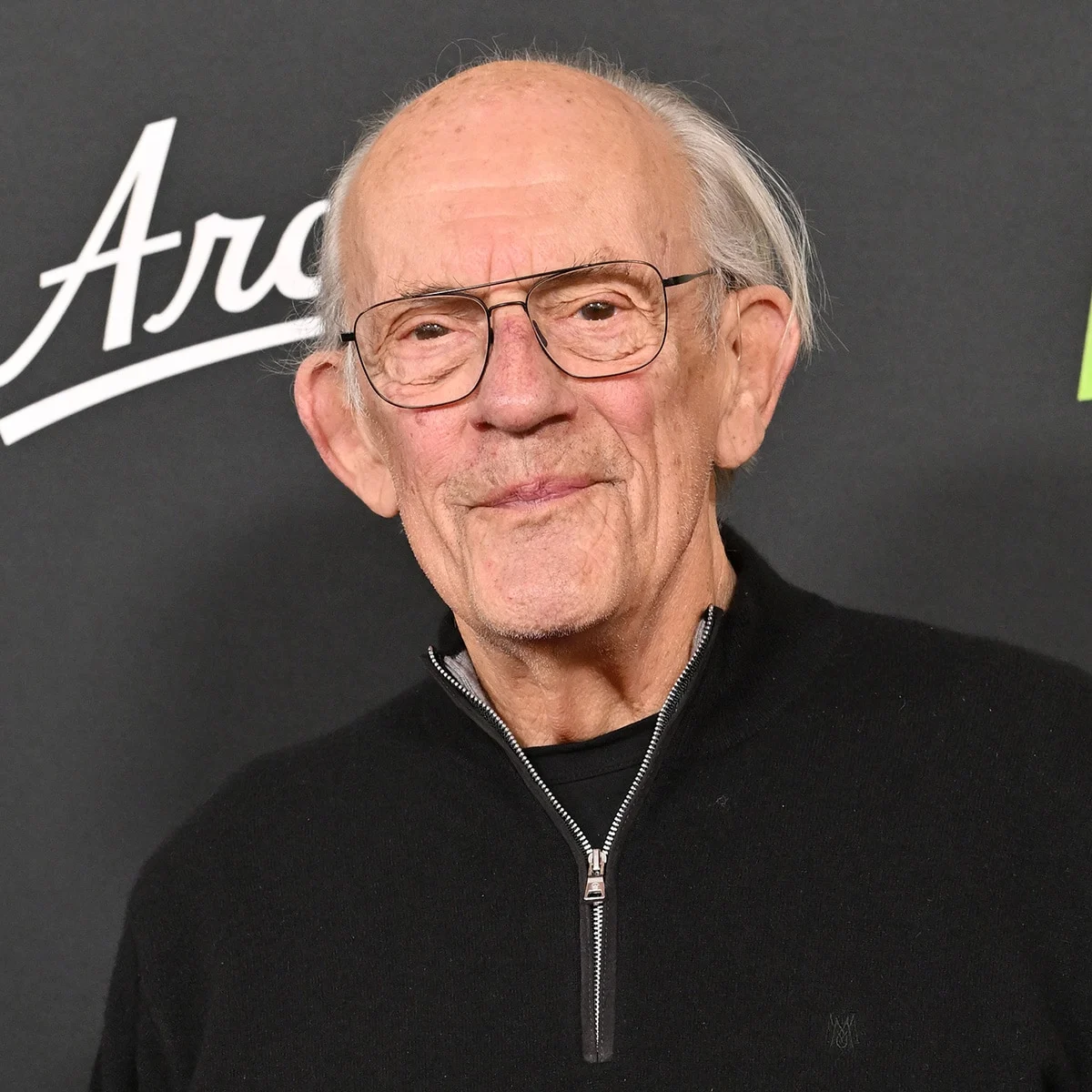
In the annals of cinematic history, few characters have achieved the cultural ubiquity of Dr. Emmett “Doc” Brown. As the frantic, wild-haired scientist who famously told Marty McFly, “If my calculations are correct, when this baby hits 88 miles per hour, you’re gonna see some serious sh–t,” Christopher Lloyd cemented his status as a sci-fi icon. Now, as the actor marks his 88th birthday, the man behind the goggles is proving that his most enduring lesson wasn’t learned in a laboratory, but in the heart.
A Legacy Beyond the Flux Capacitor
On October 22, the legendary actor took to X (formerly Twitter) to address his fans and commemorate his 88th year. In a post that perfectly balanced his trademark wit with profound sincerity, Lloyd wrote: “Today I turn 88… I’ve seen some serious s–t. The most serious of it all is love.”
For an actor who has graced the silver screen and Broadway stage for over 65 years, navigating roles ranging from the eccentric Uncle Fester in The Addams Family to the villainous Judge Doom in Who Framed Roger Rabbit, this birthday reflection served as a poignant reminder of the person behind the persona. Despite a career defined by high-concept science fiction and dark comedies, Lloyd emphasized that his relationships with his family, friends, and his vast global fanbase remain his most significant accomplishments.
“I love my family, my friends and my wonderful fans,” Lloyd added. “The power of love remains.”
The Man Behind the Doc: A Personal Chronology
Born in 1938, Christopher Lloyd’s journey to becoming a Hollywood staple was not an overnight success. Before he ever stepped into the DeLorean, he honed his craft on the stage, building a reputation as a versatile character actor.
His life took a significant personal turn in 2016 when he married Lisa Loiacono, a real estate agent who had helped him sell his home. This chapter of his life has been characterized by a quiet contentment, a stark contrast to the whirlwind of his mid-career peak in the 1980s.
The Path to 88
- Early Career: Lloyd spent decades in theater, developing the intense, physical acting style that would later define Doc Brown.
- The 1980s Explosion: This decade saw his transformation into a pop-culture titan with Back to the Future (1985), Star Trek III: The Search for Spock (1984), and Clue (1985).
- Modern Era: Beyond his iconic roles, Lloyd has remained active, including his recent marriage to Loiacono and continued engagement with the fan community through social media and conventions.
Behind the Scenes: The 1.21 Gigawatts of Back to the Future
The success of Back to the Future is the stuff of Hollywood legend, yet the journey to the screen was fraught with challenges that almost prevented the film from existing at all.
Development and Rejection
The project began when writer-producer Bob Gale discovered his father’s high school yearbook. Reflecting on the experience, Gale noted, “I wondered whether I would have been friends with my dad in high school.” This simple curiosity sparked the script, which was subsequently rejected by over 40 studios. Disney, famously, dismissed the pitch, citing the "incestuous" nature of the mother-son subplot. Even the film’s title faced resistance, with studio head Sid Sheinberg unsuccessfully pushing for the name Spaceman From Pluto.
The Marty McFly Shuffle
One of the most famous pieces of Hollywood trivia involves the casting of Marty McFly. While Michael J. Fox was the original choice, his commitment to the hit sitcom Family Ties initially made his participation impossible. The production cast Eric Stoltz in the role and filmed for five weeks before director Robert Zemeckis realized the chemistry was missing.
Recalling the difficult decision to recast the lead, Zemeckis later admitted, “It was the hardest meeting I’ve ever had in my life and it was all my fault. I broke his heart.” The decision to reshoot those scenes added $4 million to the budget—a massive gamble at the time. To accommodate Fox’s schedule, the team worked around the clock, with the actor often moving from the Family Ties set at 6:30 p.m. to the Back to the Future set until 2:30 a.m., averaging only five hours of sleep per night.
Christopher Lloyd’s Hesitation
Ironically, the man who became the definitive Doc Brown almost didn’t take the part. Lloyd initially hoped to perform in a play in New York. He credits his wife at the time, Carol, for convincing him to at least meet with the production team, reminding him of his own rule: never turn down an opportunity without checking it out first. Once on board, he pulled inspiration from two disparate sources: Albert Einstein and the conductor Leopold Stokowski, blending their physical traits into the iconic, hunched, white-haired scientist we know today.
Supporting Data: By the Numbers
The production of Back to the Future was a feat of engineering and endurance. The impact of the film is measurable in both its technical choices and its cultural footprint:
- Height Difference: Doc’s signature hunched-over stance was partially a calculated choice to mitigate the seven-inch height difference between Lloyd and Michael J. Fox.
- The DeLorean vs. The Fridge: Early drafts of the script featured a refrigerator as the time machine. The idea was scrapped because Zemeckis feared children might accidentally trap themselves inside refrigerators while trying to replicate the scene.
- Stoltz’s Final Cameo: Despite being recast, Eric Stoltz remains in the film; he is the actor performing the punch to Biff Tannen’s jaw in the diner scene.
- Legal Battles: Crispin Glover, who played George McFly, did not return for the sequels. He later sued the studio for $760,000, alleging they used a mold of his face on another actor to trick audiences into thinking he was involved.
Official Responses and Fan Engagement
The reaction to Lloyd’s 88th birthday announcement on X has been overwhelmingly positive, highlighting a generational bridge between the actor and his audience. One fan summarized the sentiment of many, writing, “Tough to believe I can reply directly to Christopher Lloyd in this day and age to directly wish him a Happy Birthday and thank him. Happy Birthday, Doc. You made my childhood better.”
This accessibility is a hallmark of Lloyd’s later career. While many stars of his caliber retreat from public life, Lloyd has embraced the digital age, using his platform to express gratitude for the fans who have supported his work for over half a century.
The Implications of a Lasting Legacy
As the Back to the Future musical concludes its runs and the original films continue to be discovered by new generations, the question of a fourth film frequently arises. However, the creators remain firm. Bob Gale and Robert Zemeckis have stated repeatedly that they would only proceed if they could craft a story they could pitch with a “straight face.” To date, that standard has not been met, preserving the sanctity of the original trilogy.
The implications of Christopher Lloyd’s birthday reflection go beyond mere nostalgia. In an industry obsessed with the “next big thing,” Lloyd’s focus on the “power of love” serves as a grounding force. He stands as a testament to the idea that while professional accolades and “1.21 gigawatts” of star power are fleeting, the genuine connections one fosters—with family, friends, and the public—are the true measure of a life well-lived.
At 88, Christopher Lloyd isn’t looking back at the past with regret or trying to speed into the future. He is simply present, enjoying the life he has built, and perhaps, acknowledging that while time travel makes for great cinema, the most "serious" work we do is the love we share in the present moment.
 Sagoh
 Siti Muinah
 Nana
