

HOUSTON — For contemporary visual artists, the physical environment in which they create is rarely just a backdrop; it is an active participant in the creative process. High ceilings invite vertical ambition, cramped quarters breed intricate miniature studies, and the ambient noise of a city can either fracture focus or fuel inspiration.
In the 360th installment of A View From the Easel—an ongoing series by Lakshmi Rivera Amin exploring the intimate intersections of artists and their workspaces—Houston-based painter and installation artist Gerardo Rosales opens the doors to his studio. Over the past two years, Rosales has anchored his practice within a sprawling, 300-plus-unit artist complex in Texas’s largest city. Yet, his journey to this physical haven reveals a narrative familiar to many contemporary creatives: a continuous balancing act between financial pressures, the pursuit of community, and the profound ways that square footage dictates artistic scale.
Main Facts: The Anatomy of Rosales’s Houston Studio
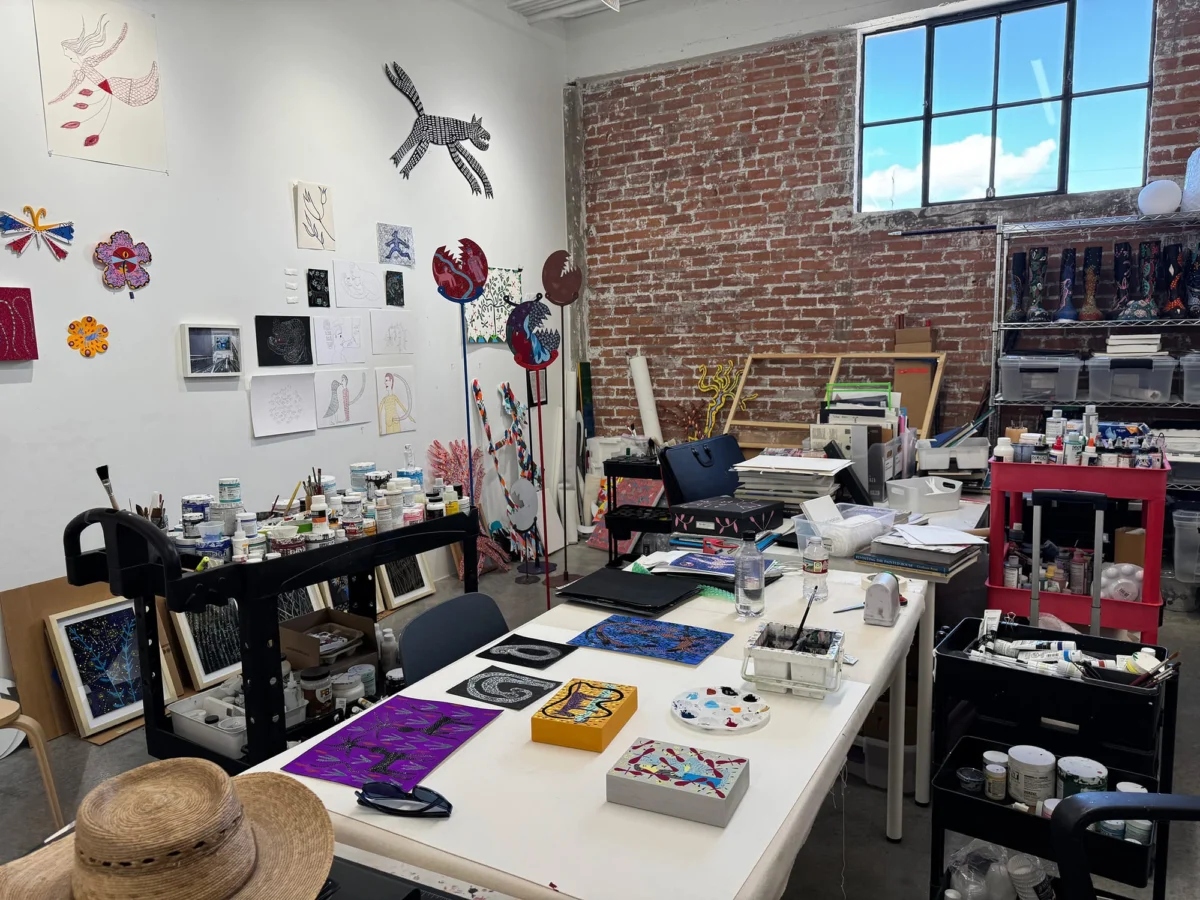
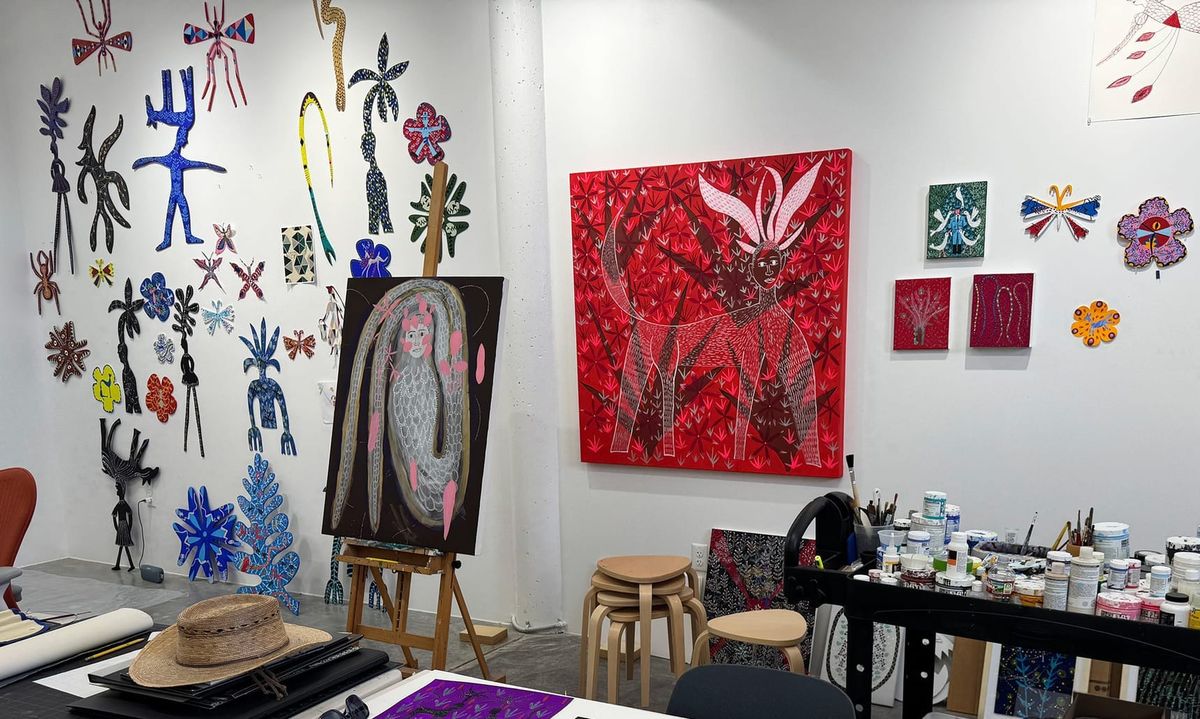
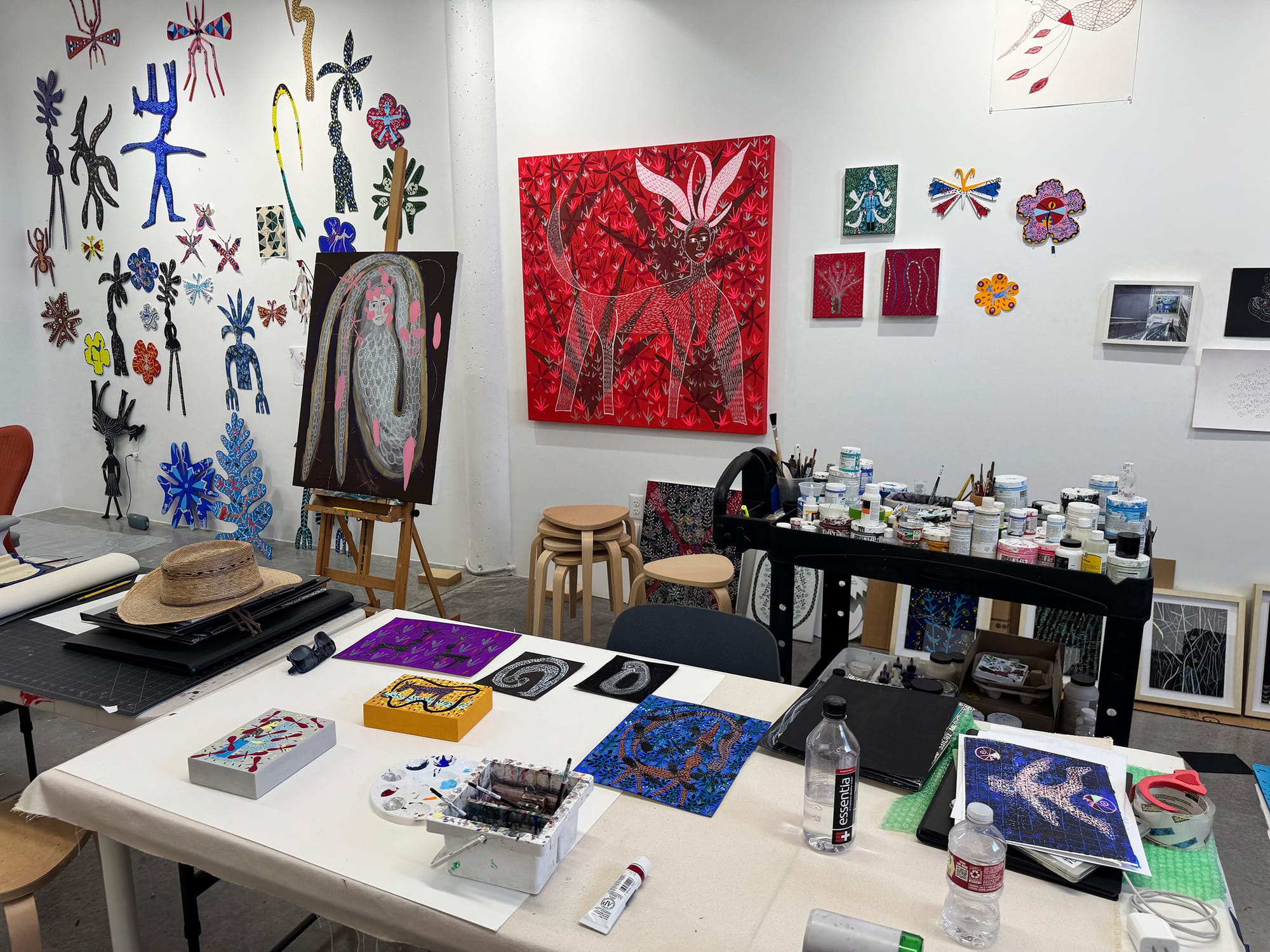
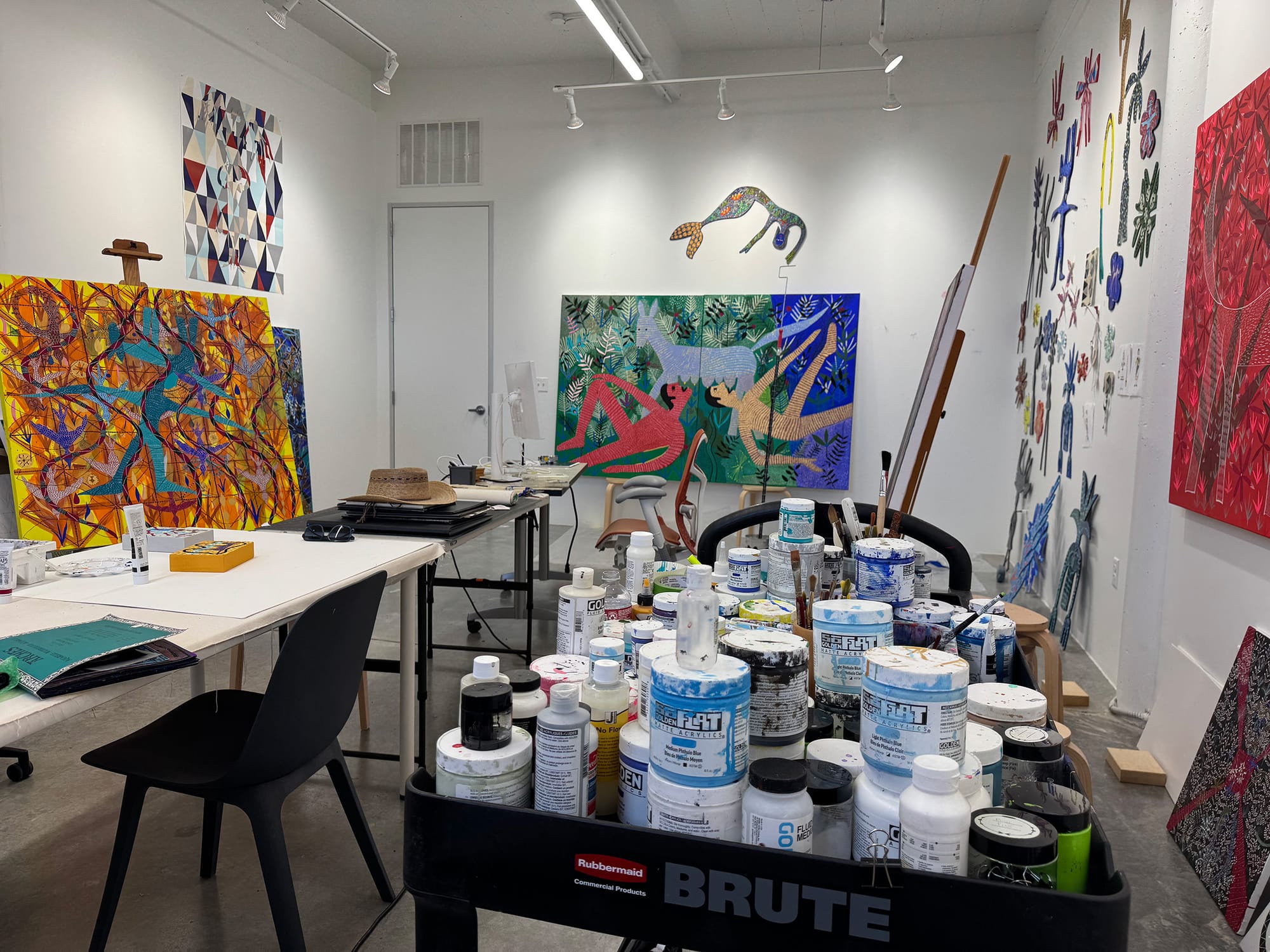
Operating out of a voluminous studio characterized by towering walls and abundant natural light, Rosales utilizes his workspace as both a messy laboratory for large-scale painting and a contemplative sanctuary.
- Location: Houston, Texas, housed within a massive multi-artist complex comprising over 300 studios.
- Tenure: Two years in the current dedicated studio space (though his broader Houston-based career spans decades).
- Practice Scale: Produces monumental paintings measuring up to 96 by 120 inches, alongside expansive wall paintings and site-specific installations.
- The Dual-Workspace Model: Rosales splits his preparatory work between his home—where he handles digital drawing, sketching, and conceptual planning—and his dedicated studio, reserved for messy paint applications and physical assembly.
- Auditory Atmosphere: An eclectic soundtrack accompanies his nocturnal sessions, ranging from Gregorian chants and the vocal stylings of Chaka Khan to Brazilian icon Caetano Veloso, paired with literary audiobooks such as James Baldwin’s Giovanni’s Room and Reinaldo Arenas’s Before Night Falls.
Chronology: From Living Room Installations to Monumental Walls
The trajectory of Rosales’s career offers a compelling case study in environmental determinism within the visual arts. Space does not merely accommodate an artist’s vision; frequently, it unlocks it.
2000–2015: The Domestic Constraint and Conceptual Ingenuity
For a crucial fifteen-year block of his career, Rosales lacked access to a dedicated industrial or commercial studio space. Instead, he operated out of his domestic living room.
Working within the physical constraints of a residential home fundamentally shaped his output. Constrained by domestic square footage and the practicalities of domestic living, Rosales focused primarily on intimate works: drawings and small-scale paintings. However, true to the adaptive nature of creative minds, this limitation birthed a distinct methodology. Rather than creating massive physical objects at home, Rosales engineered works designed to be modularly assembled later. He produced components that could be transported to galleries and assembled on-site into large, immersive installations.
2016–Present: The Expansion of Scale
The turning point in Rosales’s material practice arrived around 2016, when he finally gained access to larger, uninhibited industrial spaces. Freed from the protective boundaries of a living room rug, his canvases immediately expanded.
He transitioned into producing monumental paintings, with dimensions scaling up to a commanding 8:10 ratio (96 by 120 inches). This newfound spatial freedom also catalyzed his entry into large-scale wall paintings, permanently altering his portfolio. The studio ceased to be merely a room where things were made; it became a machine that dictated how big those things could become.
Supporting Data: The Logistics and Rhythms of Contemporary Studio Life
Life inside a large-scale arts complex is rarely uniform. For Rosales, the daily routine defies rigid scheduling, pivoting instead on the rhythm of the clock and the isolation of the midnight hour.
The Nocturnal Workflow
Rosales operates without a strict, punch-clock schedule. His workflow is bifurcated:

- The Domestic Desk: Digital and manual sketching takes place at home.
- The Industrial Floor: Heavy paint application, chaotic layering, and physical construction happen exclusively at the studio.
Notably, Rosales finds his most potent creative flow late at night. When the hustle and bustle of the massive Houston complex settles down, the silence allows his work to progress unhindered. "I like working in my studio at night because it is quieter and my work flows better," he notes.
A Soundtrack of Contrast
The cognitive environment of the studio is as carefully curated as its visual palette. Rosales’s eclectic auditory choices create a rich intellectual backdrop for his hands:
- Musical Selections: Gregorian chants provide a meditative, architectural drone; Chaka Khan infuses rhythmic energy; Caetano Veloso offers lyrical complexity.
- Literary Companions: Rather than talk radio or commercial broadcasts, Rosales immerses himself in deep narratives. Having recently completed Reinaldo Arenas’s harrowing memoir Before Night Falls, he is currently navigating the psychological depths of James Baldwin’s seminal 1956 novel, Giovanni’s Room.
Official Responses and Reflections: The Artist’s Perspective
When asked to evaluate his current professional ecosystem, Rosales offers a candid assessment that highlights both the privileges and the isolation inherent to contemporary artist compounds.
The Benefits of Physical Infrastructure
The advantages of Rosales’s current setup are clear and pragmatic. The studio’s towering walls grant him the verticality required for his installations, while the natural light enhances color accuracy. Furthermore, its geographic placement in Houston affords him immediate proximity to essential infrastructure: art supply stores are within reach, and local coffee shops provide a bridge to the outside world.
The Paradox of the Massive Art Complex
One might assume that housing more than 300 artists under one roof would create a vibrant, collaborative utopia. For Rosales, however, reality presents a paradox. Despite the physical density of creators around him, he describes his day-to-day operation as largely independent.
"My studio is in a very large artist studio complex in Houston… Having said that, I normally work independently and I don’t feel part of an art community where I am at the moment. I have artist friends in the city whom I meet occasionally to talk about art, our work, and life in general."
Furthermore, Rosales points to economic and social pain points that many urban artists will recognize. When asked what he wishes were different, his response highlights two persistent challenges:
- Affordability: The financial burden of maintaining commercial studio space in a growing metropolitan hub.
- Community Integration: A desire for a smaller, tighter-knit community of like-minded peers, facilitating cross-disciplinary collaboration, knowledge exchange, and mutual growth.
On Materials: The Philosophy of the Unknown
This desire for evolution extends directly into Rosales’s material choices. Eschewing the comfort of a signature medium—be it oil, acrylic, charcoal, or found objects—Rosales maintains a philosophy of perpetual discovery.
"I don’t have a favorite material. I like to experiment and use different materials depending on what is most appropriate for each project," Rosales reflects, capturing the ethos of his entire practice with a single axiom: "I often say that my favorite material is the next one, the one I haven’t worked with yet."
Implications: What Rosales’s Space Tells Us About Modern Art Infrastructure
The profile of Gerardo Rosales’s studio touches on broader systemic realities within the American art landscape:
- The Gentrification and Commercialization of Workspace: As urban centers like Houston expand, independent artists are frequently funneled into massive, managed facilities. While these complexes solve the basic problem of square footage, they often fail to cultivate organic community, operating instead as vertical industrial parks rather than bohemian hubs.
- The Solitary Nature of Large-Scale Production: Paradoxically, as artists gain the physical space required to make bigger, more ambitious works, they often require greater isolation to execute them. The solitary midnight hours in the studio stand in stark contrast to the networked, socialized expectations of the contemporary art market.
- Material Agnosticism as Survival: In an era where supply chains fluctuate and trends shift rapidly, Rosales’s refusal to anchor his identity to a single material demonstrates a resilient artistic philosophy—one driven by conceptual necessity rather than material branding.
As A View From the Easel continues its documentation of creative workspaces, Rosales’s studio serves as a poignant reminder that art is forged not just in the mind of the creator, but in the fragile negotiation between square footage, economic realities, and the relentless pursuit of the next unknown material.
 Neng Nana
 Ali Ikhwan
 Basiran
