

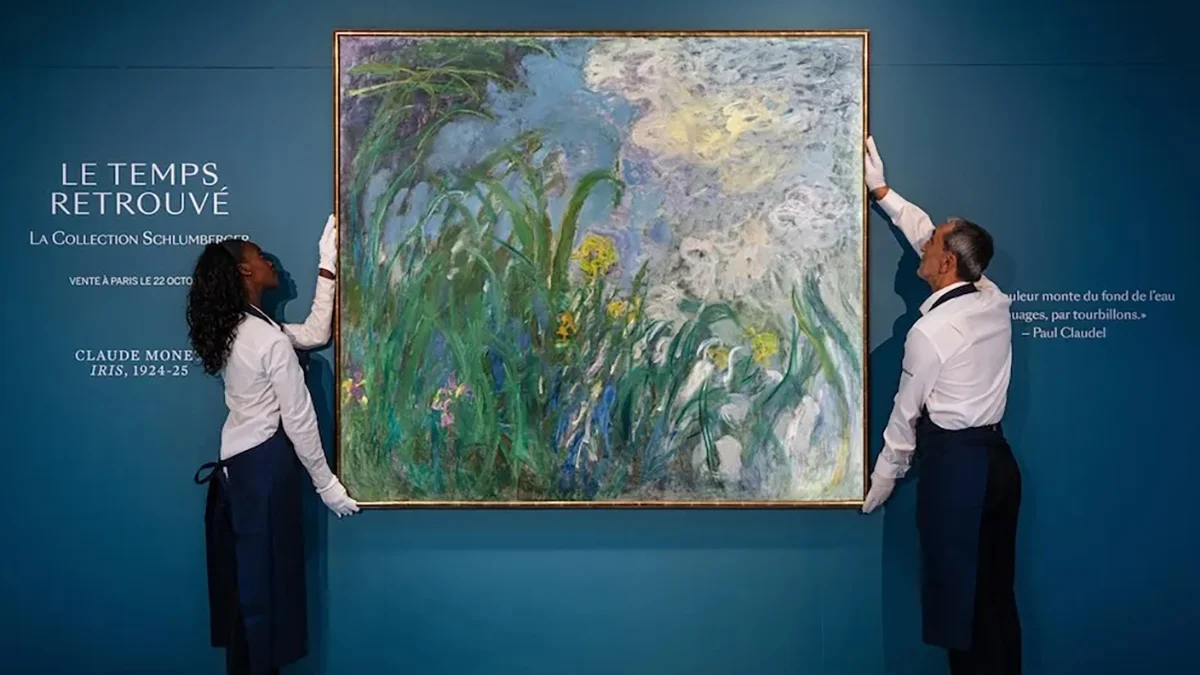
In a landmark evening that has sent tremors through the international art market, a rare masterpiece by Claude Monet, Iris, has officially etched its name into history. Selling for €50 million ($56.2 million) at Sotheby’s in Paris this past Thursday, the painting has set a new high-water mark as the most expensive work of art ever sold at public auction on French soil.
The sale was the centerpiece of a highly anticipated auction featuring works from the esteemed collection of Jeanne Schlumberger. The event not only underscored the enduring, almost mystical allure of Impressionism but also solidified Paris’s status as a formidable titan in the global art trade, proving that the city remains the spiritual and commercial heart of the movement that changed the course of art history.
The Bidding Frenzy: A 45-Minute Marathon
The atmosphere in the Sotheby’s Paris salesroom was electric as the auction commenced. When the bidding for Iris opened, it was immediately clear that the piece was destined for greatness. What followed was a grueling 45-minute standoff involving six determined collectors, each vying to secure a defining work from the Impressionist master’s late period.
The momentum was palpable, with bids flying across the room and through digital channels. The final hammer price far exceeded the pre-sale expectations, which had estimated the work’s value between €22 million and €30 million. Ultimately, the painting was secured by an anonymous private collector in Asia, represented on the phone by Jen Hua, Sotheby’s deputy chairman. The final price of €50 million, inclusive of buyer’s premium, represents a significant premium, signaling a robust appetite for blue-chip art among global investors.
A Legacy Preserved: The Schlumberger Collection
The provenance of Iris—and indeed the entire collection offered on Thursday—adds a layer of historical weight to the sale. The works were once part of the private holdings of Jeanne Schlumberger, a patron of the arts whose family built their fortune in the oil services industry.
The collection was a testament to Schlumberger’s foresight. Beginning in the 1950s, she forged a close working relationship with the famed art dealer Katia Granoff. At that time, Monet’s late-career canvases were not the global commodities they are today; many were still languishing in the artist’s studio. In 1958, Schlumberger played a pivotal role in financing Granoff’s acquisition of works directly from Michel Monet, the artist’s son. This savvy investment granted Schlumberger access to a treasure trove of canvases that, decades later, have been recognized as some of the most profound expressions of Monet’s genius.
The success of the evening was absolute: every single lot offered from the Schlumberger collection found a buyer, culminating in a total of €74.4 million ($83.7 million). This figure stands as the highest ever achieved for a fine art auction at Sotheby’s Paris, with nearly 75% of the lots sold exceeding their high-end estimates.
Monet’s Dominance: A Quartet of Masterpieces
While Iris was the evening’s undisputed star, it was supported by a suite of other Monet canvases that demonstrated the depth of the collection. The secondary market for Monet is often defined by scarcity, yet this auction presented a rare opportunity to acquire four distinct works from the same source.
- Saule pleureur ou L’Arbre de feu: This poignant depiction of the weeping willows at Monet’s Giverny estate commanded €9.7 million ($10.9 million).
- La Seine à Vernon, Arbres (1894): This atmospheric landscape sold for €4.3 million ($4.8 million).
- La Maison à Travers les Roses: A charming example of his garden series, this piece fetched €2.5 million ($2.9 million).
These four works, having remained in private hands for decades, offered collectors a rare glimpse into the intimate, domestic world of the master. Their transition from the Schlumberger family collection to the global stage marks the end of a long, quiet era for these paintings.
National Treasures and the Role of the State
Not all the treasures from the Schlumberger collection were destined for the auction block. The sale was notably missing three early paintings by Paul Cézanne. Shortly before the event, Sotheby’s announced that these works had been withdrawn from the auction.
The withdrawal followed intense negotiations between the Schlumberger family and the city of Aix-en-Provence, the birthplace of Cézanne. The French government had recently designated the works as "French national treasures," a status that grants the state the right of first refusal and prevents their permanent export. The city of Aix-en-Provence, with the backing of the French Ministry of Culture, now intends to acquire these paintings for the Musée Granet. This outcome is a triumph for French cultural preservation, ensuring that the legacy of Cézanne remains rooted in the landscape that inspired his most iconic works.
Beyond Impressionism: Broader Market Records
The evening was not defined by Monet alone. The auction served as a barometer for the broader market, highlighting a healthy appetite for French Modernism and sculpture.
Pierre Bonnard’s La Cueillette des Prunes, a vibrant scene that had not been exhibited publicly since 1956, saw a dramatic bidding war that pushed its final price to €2.5 million ($2.9 million). This result was more than triple its €800,000 high estimate and set a new auction record for the artist within France.
Furthermore, a delicate work on paper by the Symbolist painter Gustave Moreau, titled Rêve d’Orient, brought in €1.4 million ($1.6 million), establishing a new record for a drawing by the artist. Sculpture also enjoyed a moment in the spotlight, with a bronze cast of Camille Claudel’s La Valse (1905) selling for €832,000 ($935,000)—more than double its low estimate. These results confirm that the market for French masters remains resilient, even as global economic conditions shift.
Implications for the Global Art Market
The historic results of the Schlumberger sale have several implications for the art world. First, it reaffirms that Paris is successfully reclaiming its position as a primary hub for the international art trade. By facilitating a sale of this magnitude, Sotheby’s Paris has demonstrated that it can attract top-tier global capital, effectively competing with the traditional powerhouses of London and New York.
Second, the "Monet effect" remains the most reliable engine of the Impressionist market. The fact that the evening’s total was driven so heavily by a single artist speaks to the enduring, universal appeal of his work. As these paintings transition from long-held private collections into the hands of a new generation of collectors, we are witnessing a "changing of the guard" in the art world.
Finally, the government’s intervention regarding the Cézanne works signals a tightening of regulations surrounding the movement of cultural heritage. For collectors, this serves as a reminder that the acquisition of historically significant art comes with the evolving responsibilities of stewardship.
As Sotheby’s Paris turns its attention to its subsequent auctions—focused on modern art and Surrealism—the success of the Schlumberger sale provides a robust foundation. For the art market, the message is clear: when provenance is impeccable and masterpieces are fresh to the market, the appetite of collectors remains bottomless. The record-breaking sale of Iris will be remembered as a milestone, a moment where history, commerce, and beauty converged in the heart of Paris.
 Lina Hope
 Jia Lissa
 Ali Ikhwan
