

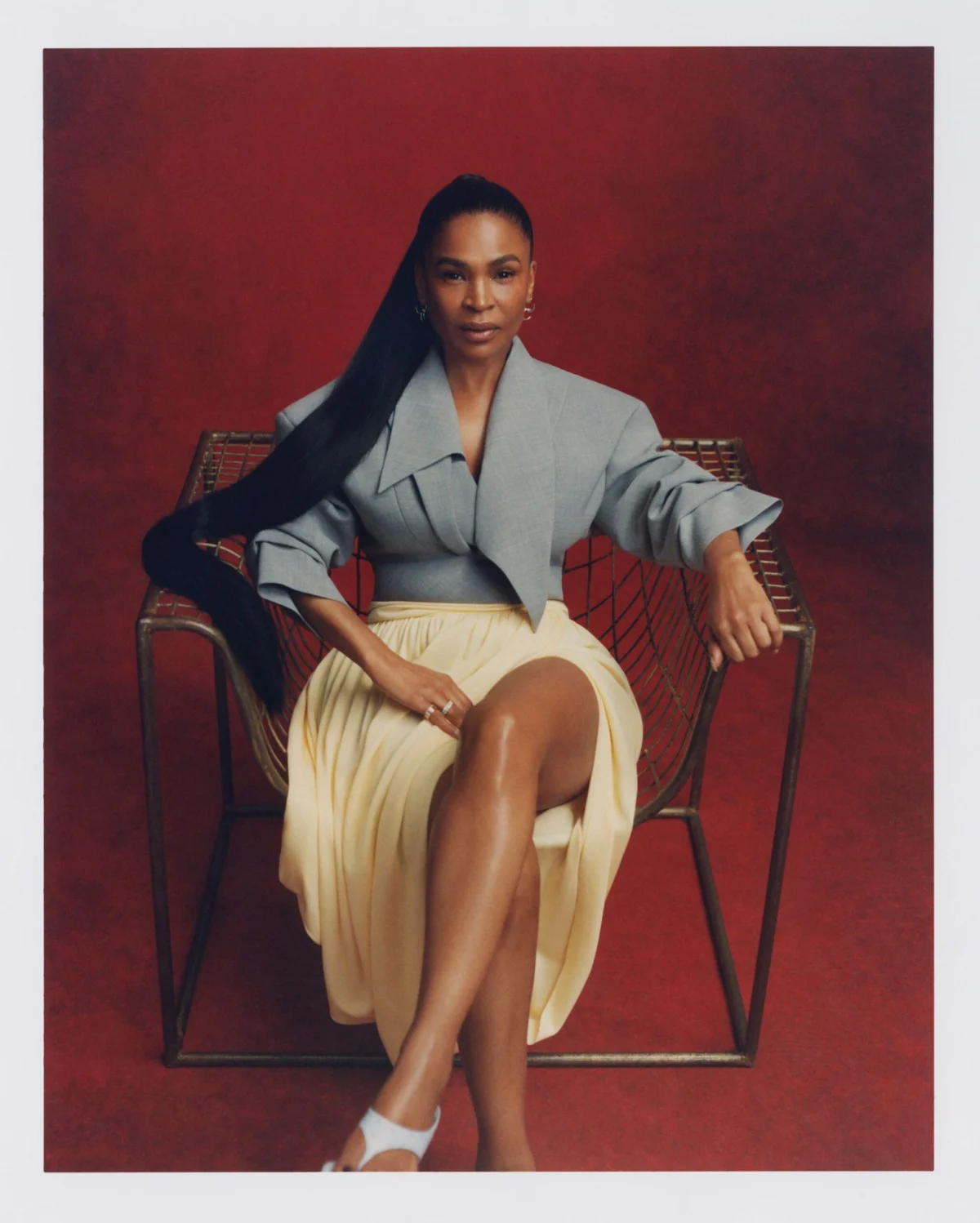
Main Facts: Stepping Back Into the Light
There is a specific kind of vertigo that comes with leaving a movie theater in the middle of the day. The world outside is suddenly too bright, too loud, and slightly unreal. You have spent the last two hours immersed in someone else’s carefully constructed reality, and returning to the afternoon light feels disorienting—the movie still clinging to you like perfume.
It is in this exact state of cinematic post-hypnosis that I meet acclaimed actress Nia Long for an early lunch in a quiet corner at West Hollywood’s iconic Chateau Marmont.
I have just screened Michael—Antoine Fuqua’s anticipated Michael Jackson biopic slated for an April release—a month ahead of its premiere. The film’s emotional reverberations are still fresh, heightening the surreal nature of sitting across from Long, who plays the Jackson family matriarch, Katherine Jackson. Dressed chicly yet low-key in an oversized blazer, wide-leg jeans, and a Miu Miu baseball cap pulled low, Long cuts a figure of effortless coolness. Yet, sitting before me, she carries the heavy, resonant gravity of the woman I had just watched on screen, creating a strange, compelling doubling effect of art and reality.

At 55, Long is operating at a fascinating apex of her career. With a major role in a blockbuster biopic, an upcoming romantic dramedy reunion with Love Jones co-star Larenz Tate, an ongoing ambassadorship with Estée Lauder, and a deeply anticipated upcoming memoir, Long is not merely resting on her legendary 1990s iconography. She is actively redefining what longevity, grace, and autonomy look like for a Black woman navigating the shifting tides of Hollywood.
Chronology: From Brooklyn Roots to Cinematic Royalty
To understand Nia Long’s current creative renaissance, one must trace a trajectory that spans over three decades of cultural impact.
Long’s story begins in Brooklyn, born into a Trinidadian household within a tightly knit, predominantly Black neighborhood. Her foundational years, however, took an unexpected detour when she spent six years of her childhood in Iowa City while her mother pursued higher education. That Midwestern dislocation—where she found herself isolated from other Black children—forced an early, complex reckoning with identity and beauty.

“In writing this memoir, I realized the impact that experience had on my own view of beauty,” Long reflects, discussing the grueling, therapeutic, two-year process of penning her first book. “And my own self-acceptance of being a pretty brown-skinned little girl growing up in Iowa. I thought I was beautiful because my mother said it and my family said it, but the world told me something different.”
Returning to the coasts, Long eventually broke into television and film, cementing herself in the cultural lexicon as the platonic ideal of ’90s cinematic royalty. Whether playing Nina in Love Jones, Jordan in The Best Man, or Lisa Wilkes on The Fresh Prince of Bel-Air, Long’s presence became synonymous with a specific cultural frequency: effortless style, sharp intellect, and undeniable warmth.
Yet, the transition from being a beloved ’90s icon to a respected industry veteran was hard-won. Long notes the irony of her current role as a global face for Estée Lauder: “I didn’t feel beautiful until Black Hollywood said I was beautiful.”

Over the subsequent decades, Long navigated Hollywood’s notoriously fickle landscape with intentionality, balancing high-profile studio releases with independent cinema. Her recent years have brought both profound professional highs and intense public scrutiny—most notably weathering a high-profile public breakup in 2022 resulting from a well-publicized cheating scandal involving her ex-partner. Rather than retreating, Long managed the intense media storm with an unflinching commitment to self-preservation, emerging on the other side with a healthy co-parenting dynamic and a renewed sense of personal clarity.
Now, with her eldest son in his twenties and her fourteen-year-old youngest son increasingly independent, Long has entered a prolific new chapter. She has wrapped shooting on Don’t Ever Wonder, a romantic dramedy directed by Eugene Ashe exploring empty-nest syndrome and second acts in love. Simultaneously, she has immersed herself in the deeply transformative work of portraying Katherine Jackson in Michael.
Supporting Data & Artistic Insight: The Architecture of Restraint
On screen, Long’s portrayal of Katherine Jackson relies on a masterclass in minimalism. In her introductory scene—observing her young sons rehearse—the camera holds on Long’s face for several beats. She speaks almost not at all. Paired against Colman Domingo’s bombastic performance as Joe Jackson and Jaafar Jackson’s uncanny channeling of his late uncle Michael, Long’s performance proves that silence can be load-bearing.

In person, however, Long is the antithesis of restrained. She is blunt, deeply emotionally intelligent, and possesses a dry, disarming sense of humor. Over an order of salmon with a side of mustard, she discusses her approach to the craft.
“My commitment to work is not for accolades or attention, or even to be famous, quite honestly,” she says. “But I do think because of my commitment to truth and purpose, there is a thing—and I don’t know what that thing is—that people see in my work. And it makes them feel good. It makes them feel inspired. It makes them feel like they know me.”
When asked about the strategic elements of her career, Long laughs, noting that her financial acumen is where her true calculation lies: “The only strategy I have in this game is my bank account. Let’s strategize how we’re going to make money and create generational wealth. That is where I’m strategic.”

Once a project begins, however, her strategy shifts entirely to protection and authenticity. “I work hard to make sure that when I represent us, it’s not just someone putting their agenda on me. Whether it’s my hair, my makeup, my wardrobe, my lines.”
This unyielding pursuit of truth heavily informed her channeling of Katherine Jackson. The defining word Long uses to describe the Jackson family matriarch—and, implicitly, her own life philosophy—is grace.
“There have been moments in my life where I’ve been required to be more graceful than I’ve ever had to be in the past,” Long shares. “And that requires a sense of really being able to dig deep into some sort of self-examination. Like, what do I stand for? What’s important to me, ultimately, regardless of Hollywood, the noise? And number one, for me personally, my children come before anything.”

Official Responses and Reflections: Navigating the Noise
Long’s perspectives on personal autonomy and healing extend far beyond her filmography. During our lunch, as we touch upon the universal turbulence of major life transitions and heartbreaks, Long offers advice rooted in her own hard-won resilience following her 2022 public split.
Reflecting on the public groundswell of support she received, Long maintains a grounded, nuanced perspective.
“I’m proud of myself for giving so much grace. For being able to say people make mistakes and things happen. It’s life. When the stakes are high, the news is big. I can’t do anything about that, but I don’t have to protect my ego in any of this,” she states matter-of-factly.

She advises writing out unexpressed grievances to an ex without sending them, emphasizing that emotional recovery is an internal metric.
“It’s not about another person’s behavior. It’s about your bottom line and the magnitude in which you’re committed to self-love,” Long explains. “I don’t think it’s healthy to hold onto things because then you’re just walking around with this burdensome energy… You don’t have to respond to the noise with the undercurrent of your own trauma.”
This philosophy bleeds into how she perceives aging in an industry obsessed with youth. Rejecting the backhanded comfort of tropes like “Black don’t crack,” Long embraces the physical realities of turning 55.

“I’m 55. I got hormonal stuff going. Your body shifts, changes. It’s a whole new body,” she notes without a shred of wistfulness, happily indulging in truffle parmesan fries ahead of a high-stakes press tour. “I don’t deprive myself of anything that I want. I find the balance.”
Implications: Redefining Freedom on Her Own Terms
As our plates are cleared and Long prepares to head home to host a pizza night for her youngest son and his friends, our conversation circles back to the core concept of freedom. For a woman whose image has been consumed, celebrated, and analyzed by the public for decades, true freedom is remarkably unpretentious.
“Being able to do what you want to do when you want to do it, because it serves your spirit, not what everyone else thinks you need to be or should be,” she defines.

That type of freedom, Long emphasizes, does not require an audience or a Hollywood stage. It can be found in the quiet corners of everyday life—even if it’s just making a pizza in your own kitchen.
As Nia Long steps into the release of Michael, prepares her literary debut, and continues to champion authentic storytelling, her legacy is no longer just about the cultural touchstones of her past. It is a masterclass in how to author one’s own narrative, proving that the most powerful performances happen when an artist refuses to compromise her truth.
 Reynand Wu
 Iffa Jayyana
 Lina Irawan
