

By Duaa Shah
Feature / Legal & Human Rights
Main Facts
In an era defined by record-breaking displacement and mass atrocities, an unlikely intersection of disciplines is reshaping the pursuit of international justice: the union of visual art and the legal system. For refugees fleeing genocide and individuals enduring state-sponsored persecution, creative expression has long served as a vital therapeutic outlet—a psychological sanctuary amid unimaginable trauma. However, a growing body of legal experts, human rights investigators, and international tribunals is recognizing these canvases, sketches, and sculptures as something more. They are increasingly being deployed as tangible evidence, helping to corroborate survivor testimony, bridge language and literacy barriers, and document core international crimes in courts of law.
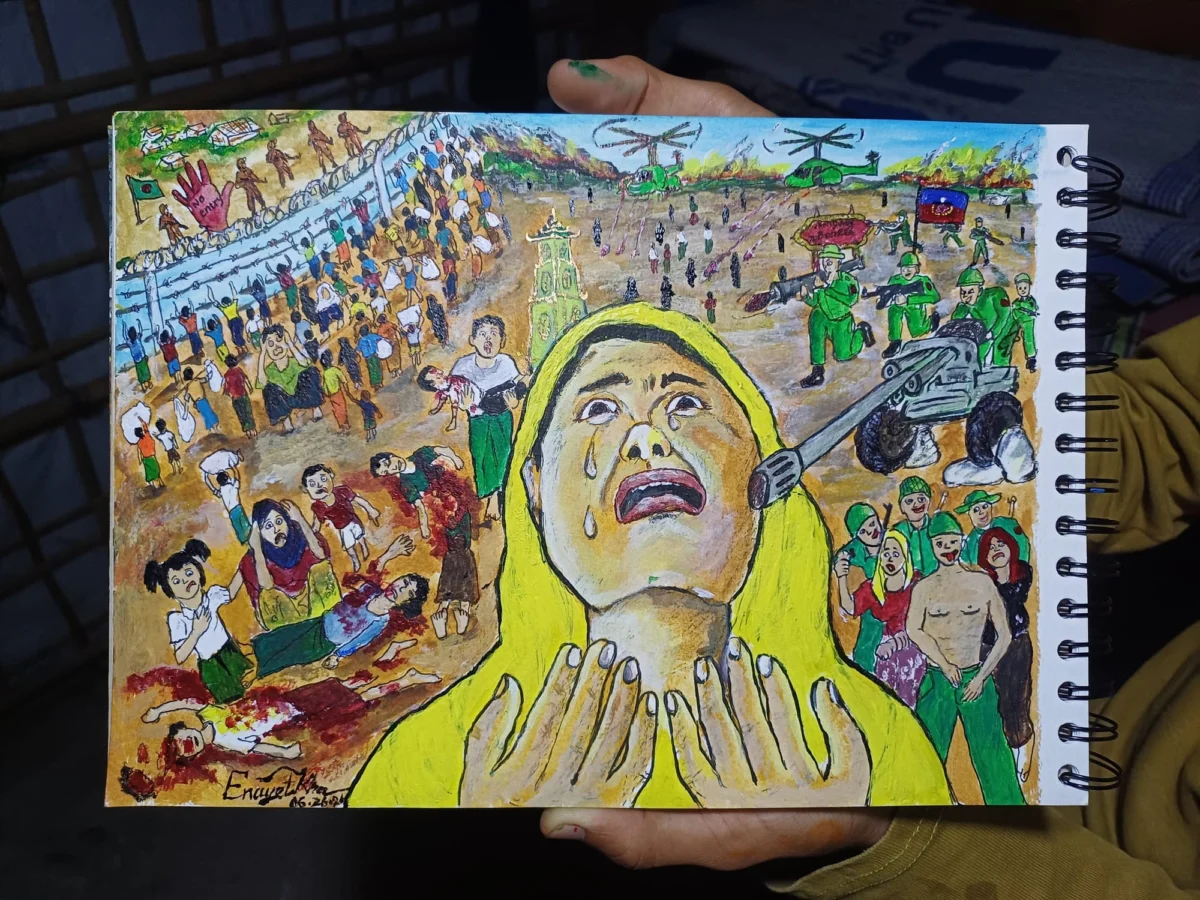
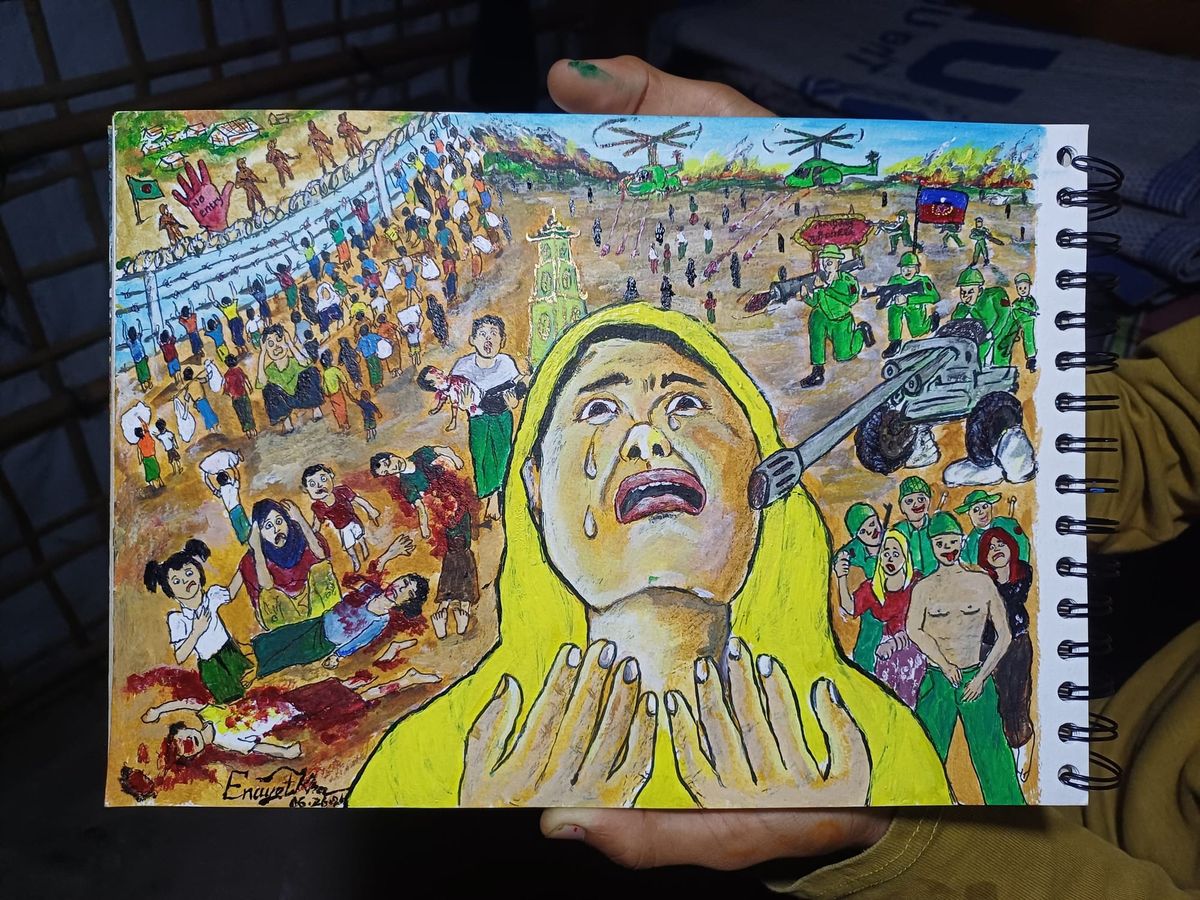
This paradigm is perhaps best embodied by the work of Enayet Khan, a Rohingya artist who fled the scorched earth of Myanmar in 2017. Today, Khan’s vivid, haunting paintings—depicting burning villages, summary executions, and families fleeing under a hail of gunfire—do not merely hang in galleries; they serve as historical records and legal markers of genocide. Khan’s establishment of the Rohingya Art Club (RAC) in the sprawling refugee camps of Cox’s Bazar, Bangladesh, underscores a broader global phenomenon: marginalized populations are painting their truths into existence, utilizing visual storytelling as a form of both political resistance and legal corroboration.
With a record 117.8 million people forcibly displaced worldwide—a staggering metric that has climbed for 12 consecutive years—the international justice system is facing an unprecedented surge in demand. Concurrently, investigations into war crimes, crimes against humanity, and genocide have accelerated, particularly within the European Union, where new cases surged by 44% between 2016 and 2021. As survivors turn to institutions like the International Criminal Court (ICC) and the International Court of Justice (ICJ) in record numbers, legal advocates are realizing that traditional, text-heavy investigative methods must evolve. In environments marked by high illiteracy rates, systemic trauma, and the deliberate destruction of documentation, art is emerging as a critical evidentiary frontier.
Chronology
To understand how creative expression transitioned from a purely private coping mechanism into a formidable legal instrument, one must trace the timeline of modern displacement, international jurisprudence, and grassroots artistic mobilization.
- 1982: The government of Myanmar passes a discriminatory citizenship law that effectively strips the Rohingya Muslim minority of their citizenship, rendering them one of the largest stateless populations in the world and laying the groundwork for decades of systematic persecution.
- 2016–2021: Across the European Union, investigations into core international crimes surge significantly, marking a 44% increase as war crimes units expand their capacity to handle cross-border atrocities and testimony from newly arrived displaced populations.
- August 2017: A brutal military crackdown by Myanmar’s armed forces forces nearly one million Rohingya to flee across the border into Bangladesh. Enayet Khan and his family endure a harrowing three-day trek through forests and burning villages, eventually settling in the overcrowded camps of Cox’s Bazar.
- Post-2017: In the wake of the genocide, Khan turns to painting to process his trauma. Recognizing the profound psychological and communicative value of art among his fellow refugees, he founds the Rohingya Art Club, institutionalizing visual storytelling within the camps.
- Recent Years: Legal Action Worldwide (LAW), led by executive director Antonia Mulvey, incorporates refugee-created artwork directly into legal dossiers submitted to international bodies, including the International Court of Justice (ICJ), marking a formal operational shift in how international courts handle trauma-based evidence from low-literacy populations.
- Present Day: Global forced displacement crosses an unprecedented milestone of 117.8 million people. The ICC and various ad-hoc tribunals face a historic backlog and surge in demand for accountability, prompting legal practitioners to systematically integrate non-textual evidence—such as drawings, paintings, and creative writing—into criminal investigations.
Supporting Data
The integration of refugee and incarcerated art into legal frameworks is underscored by a sobering landscape of global crisis, demographic displacement, and institutional capacity-building:
- 117.8 Million: The record number of forcibly displaced people worldwide, a figure that has risen continuously for 12 straight years due to protracted conflicts, climate shocks, and systemic political violence.
- 44% Increase: The surge in new investigations of core international crimes (genocide, war crimes, and crimes against humanity) handled by European Union member states between 2016 and 2021.
- Nearly 1 Million: The population of Rohingya refugees concentrated in the Cox’s Bazar district of Bangladesh, representing one of the densest refugee populations globally and the primary community driving grassroots artistic documentation projects like the Rohingya Art Club.
- Decades of Statelessness: More than four decades of institutionalized disenfranchisement faced by the Rohingya people following the 1982 Citizenship Law, which fundamentally altered their legal standing and stripped them of basic human rights prior to the 2017 genocide.
Official Responses
The intersection of art and international law has drawn nuanced commentary from legal scholars, human rights investigators, and international magistrates who grapple daily with the evidentiary challenges of mass atrocities.
Antonia Mulvey, executive director of Legal Action Worldwide (LAW) and a former United Nations investigator, played a pivotal role in collecting refugee artwork as formal evidence in the landmark Rohingya genocide case before the International Court of Justice. Reflecting on the logistical and human realities of gathering testimony, Mulvey highlighted the unique barriers investigators face in displaced communities.
"The high illiteracy rate among Rohingya people, especially women and children, makes it exceptionally difficult to record traditional written statements," Mulvey noted. "In those contexts, drawings became a vital way to convey their testimonies, bypass linguistic and literacy hurdles, and capture the granular reality of mass atrocities in a manner that words alone often fail to do."
International legal bodies, while historically tethered to forensic reports, ballistics, and documentary paper trails, are increasingly forced to adapt to the realities of modern conflict. The International Criminal Court (ICC) has publicly characterized the current global demand for accountability as "unprecedented," noting that conventional investigative units must innovate to capture the lived experiences of survivors who possess neither legal documentation nor the literacy required to file formal written depositions.
Furthermore, human rights organizations such as Human Rights Watch (HRW) have continually emphasized that documenting crimes against stateless and incarcerated populations requires unconventional methodologies. By validating art as a legitimate form of experiential testimony, legal advocates are slowly dismantling rigid evidentiary hierarchies that have historically disadvantaged marginalized groups.
Implications
The recognition of art as both therapy and legal evidence carries profound implications for the future of human rights advocacy, international criminal law, and the psychological recovery of displaced and incarcerated populations.

1. Re-engineering Evidentiary Standards
For decades, international courts have relied heavily on forensic pathology, intercepted communications, eyewitness testimony, and official bureaucratic records. However, perpetrators of mass atrocities—mindful of accountability—frequently destroy administrative paper trails or target intellectuals, journalists, and record-keepers. When state apparatuses systematically erase the written word, visual art created by survivors fills the evidentiary void. Canvases that capture the architectural layout of a detention center, the insignia on a soldier’s uniform, or the chronological progression of a village massacre provide investigators with invaluable spatial and situational coordinates.
2. Overcoming Literacy and Linguistic Barriers
In many marginalized refugee populations and prison systems, formal education is a luxury denied by systemic oppression. When victims are unable to read, write, or speak the dominant languages of international tribunals, the traditional affidavit becomes an exclusionary barrier to justice. Art democratizes the legal process. A drawing of an execution site or a burning home transcends syntax and vocabulary, offering a universal visual language that investigators, prosecutors, and judges can readily interpret and cross-examine.
3. Mitigating Retraumatization Through Expressive Testimony
The legal process of recounting mass violence is notoriously grueling. Survivors are frequently forced to testify repeatedly, detailing the most horrific moments of their lives under intense cross-examination, which can lead to severe retraumatization. Art therapy offers a dual-purpose mechanism: it allows survivors to externalize their trauma in a controlled, therapeutic environment before ever stepping into a courtroom. The resulting artwork acts as a proxy witness, allowing the survivor to present their truth to the world without being forced to verbally relive every agonizing second of their abuse.
4. Preserving Cultural Memory Against Erasure
Genocide and systemic incarceration are rarely just about physical annihilation; they are designed to erase culture, identity, and historical memory. When artists like Enayet Khan paint the destruction of their ancestral homes, they are engaging in an act of preservation that resists oblivion. These works ensure that the perpetrators cannot rewrite history with impunity. Long after refugee camps are dismantled or prison walls are torn down, these visual archives remain as permanent, unalterable indictments of tyranny—proving that while physical structures can be reduced to ash, human creativity and the demand for justice cannot be so easily extinguished.
 Muslim
 Dwi Wanna
 Neng Nana
