

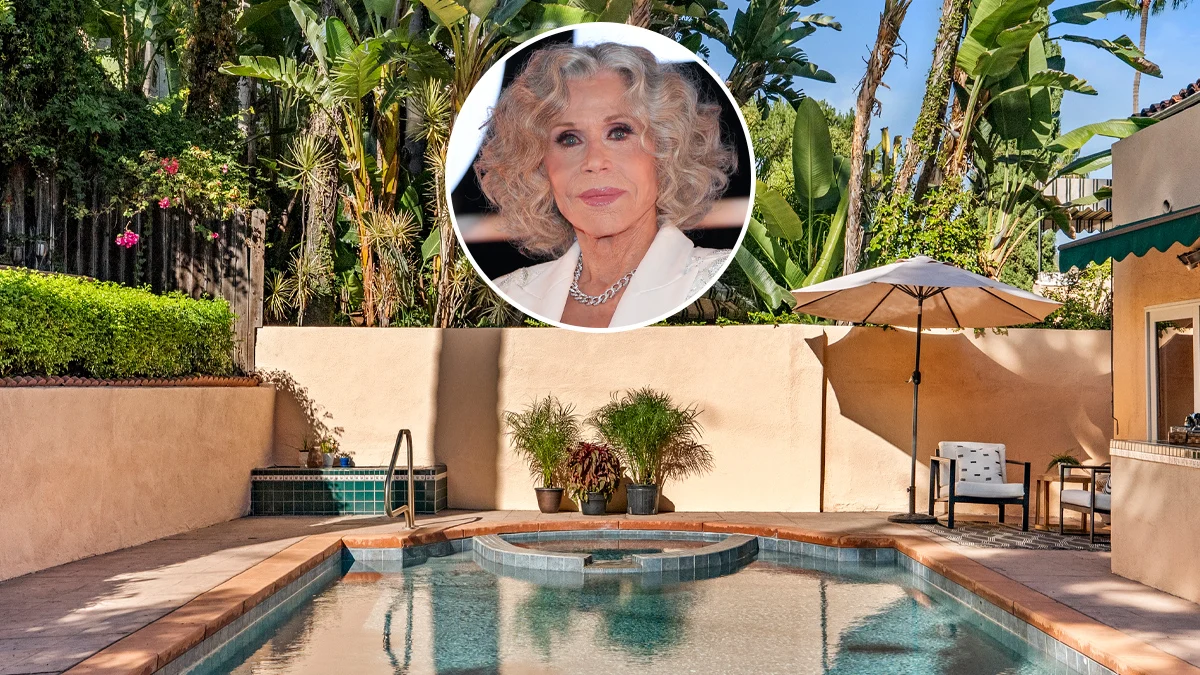
In the storied hills of Los Angeles, where the architecture often mirrors the dramatic lives of those who inhabit it, few properties possess a narrative as compelling as the Mediterranean Revival villa at 2001 Holly Hill Terrace. This residence, currently listed for $1.995 million, is far more than a prime piece of real estate in the prestigious Whitley Heights Historic Preservation Zone. It is a time capsule of 20th-century American culture, having served as the private residence of Jane Fonda during two of the most transformative and volatile decades of her life.
A Legacy Etched in Controversy and Stardom
To understand the weight of this home, one must understand the woman who lived there. Jane Fonda’s tenure at the Holly Hill estate coincided with her metamorphosis from a Hollywood starlet into a global lightning rod for political activism.
When Fonda first moved into the hillside villa, she was the face of the 1968 psychedelic sci-fi cult classic Barbarella. Directed by her then-husband, Roger Vadim, the film became an unintended touchstone for the era’s sexual revolution. While the film cemented Fonda’s status as a sex symbol, it also placed her at the center of a national debate regarding the objectification of women and the shifting boundaries of censorship in cinema.

However, the quiet, lush privacy of the Hollywood Hills provided little refuge from the turbulence of the outside world. As Fonda’s activism intensified, she found herself increasingly in the crosshairs of the federal government. Her marriage to radical activist Tom Hayden followed her union with Vadim, and during both chapters, the walls of this villa held the echoes of a woman who was systematically targeted by the U.S. intelligence community. It was later revealed that during her residence at the property, the FBI tapped her phone lines, while the CIA engaged in the covert interception of her mail. The house became a silent witness to a period where Fonda’s private life was effectively under siege by the very government she sought to challenge.
The most infamous chapter of this era—the 1972 visit to Hanoi, North Vietnam—left an indelible mark on her reputation. When photographs surfaced of the actress laughing while perched atop a North Vietnamese anti-aircraft gun, the moniker "Hanoi Jane" was born. The backlash was seismic, and for decades, the incident served as a focal point for American polarization. That this home remained a sanctuary for Fonda throughout these tumultuous years adds a layer of historical gravitas to its current sale.
A Chronology of a Hollywood Landmark
The property’s history is as multifaceted as the city itself. Built in 1924, the home is a quintessential example of the Mediterranean Revival style that defined early Hollywood architecture.

- 1924: The construction of the villa in the burgeoning Whitley Heights area, an enclave favored by the elite of the silent film era.
- The 1960s and 1970s: The period of Jane Fonda’s residency. It was during these years that the home saw the intersection of high-profile filmmaking and radical political organizing.
- 1985: The property was acquired for approximately $234,000 by character actors Bryan and Jo Deodato Clark. The irony of this transaction is noted by historians: Bryan Clark frequently played authority figures, including the role of President Ronald Reagan—a man whose politics stood in direct opposition to those of Fonda.
- Present Day: The residence hits the market for $1.995 million, listed by Edward Piechocki of Douglas Elliman, drawing attention from preservationists and celebrity-home enthusiasts alike.
Supporting Data and Architectural Nuance
The residence is a testament to the enduring appeal of the Hollywood Hills. Spanning roughly 4,200 square feet across three levels, the home is tucked away at the end of a private cul-de-sac, offering a level of seclusion that is increasingly rare in the modern Los Angeles landscape. The structure sits on just under a quarter-acre of land, utilizing a terraced design that maximizes the dramatic canyon views.
Architectural Highlights:
- Living Spaces: The interior features a grand, fireside living room that transitions seamlessly into a family room, perfect for the quintessential California indoor-outdoor lifestyle. This area opens directly onto a red-brick patio that overlooks the lush canyon.
- Dining and Kitchen: The formal dining room is a masterclass in period detail, featuring multi-paned French doors flanked by elegant, stained-glass sidelights. The kitchen has been thoughtfully remodeled to blend the original charm of the home with modern functionality, featuring warm wood cabinetry, high-end stainless steel appliances, and a casual breakfast bar.
- Primary Suite: Occupying the uppermost level, the primary retreat serves as a private oasis. It includes a dedicated office space, a balcony with sweeping vistas, and a spa-inspired bathroom where an oval soaking tub rests atop a serene bed of river rocks.
- Guest Accommodations: Recognizing the needs of a modern homeowner, the lower level houses a self-contained guest suite, complete with its own entrance, kitchen, and laundry facilities.
The exterior grounds are equally impressive. The terraced hillside incorporates a freeform pool and a spillover spa, surrounded by a expansive tiled sundeck and an elevated lounging deck. With mature fruit trees and built-in grill stations, the home remains an entertainer’s paradise, much as it was during the star-studded parties of the mid-20th century.
Official Designations and Preservation
Beyond its celebrity provenance, the property is a protected piece of Los Angeles history. It is under the oversight of the Los Angeles Conservancy, which holds an easement protecting the historic facade of the home. This ensures that the exterior character of the villa—its stucco charm and Mediterranean silhouette—will remain unchanged for future generations.

Furthermore, the residence is enrolled in the Mills Act. For potential buyers, this is a significant financial incentive. The Mills Act is a state-sponsored program that offers substantial property tax relief to owners of designated historic structures in exchange for a commitment to maintain and preserve the building’s historic integrity. This designation underscores the property’s status as a landmark, rather than just a dwelling.
Implications: The Intersection of History and Real Estate
The listing of the former Jane Fonda estate arrives at a time when the market for "celebrity provenance" is reaching new heights. However, this property offers more than just a link to a famous name; it offers a link to a specific era of American social evolution.
The juxtaposition of the home’s serene aesthetic with the chaotic, politically charged life of its most famous resident creates a fascinating tension. It invites the buyer to consider the role of the home as a refuge—a place where, despite the FBI surveillance and the public outcry of the 1970s, the occupant was able to cultivate a private existence.

For the real estate investor or the architecture enthusiast, 2001 Holly Hill Terrace represents a rare opportunity. It is a fully functional, modern home that doubles as an architectural monument. As cities like Los Angeles continue to develop and densify, the preservation of these historical villas becomes an increasingly vital task. Through the protective framework of the Mills Act and the vigilance of the Los Angeles Conservancy, this property will continue to stand as a silent witness to the history that was made within its walls.
Whether the next owner is drawn by the allure of the Hollywood Hills, the history of the feminist movement, or simply the architectural elegance of the 1920s, the house at 2001 Holly Hill Terrace remains a vital link to the past. In a city that is constantly reinventing itself, this home serves as a reminder that the stories of the past are etched not only in books and films, but in the very foundations of the homes we inhabit.
 Laily UPN
 Raul Delapena Setiawan
 Pevita Pearce
