

Executive Summary: A Clarion Call for Diplomatic Restraint
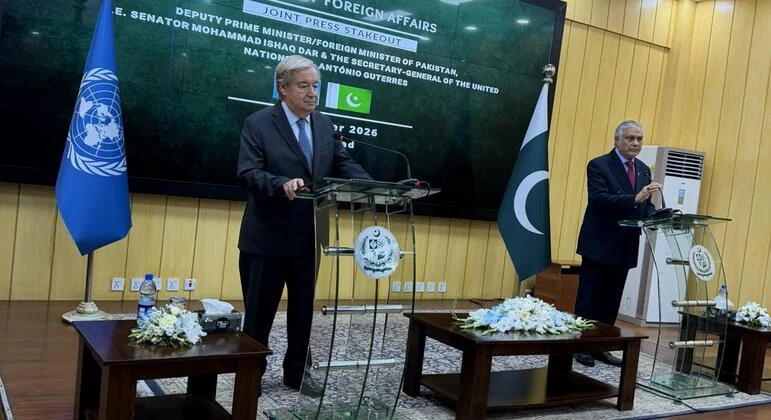
In a high-stakes diplomatic visit to Islamabad, United Nations Secretary-General António Guterres has issued a stern, unequivocal demand for an immediate cessation of hostilities between the United States and Iran. Speaking from the Pakistani capital, Guterres underscored the perilous state of global stability, urging all belligerents to abandon military brinkmanship in favor of restored diplomatic channels.
The Secretary-General’s intervention comes at a critical juncture, as the world faces the compounded threats of regional war, the paralysis of vital maritime trade corridors, and an escalating climate emergency. Guterres specifically called for the full restoration of navigational rights and freedoms in the Middle East’s most vital waterways, emphasizing that international law must remain the bedrock of global order. His visit served not only as a warning against the current conflict but as a testament to the essential role of regional mediators in navigating the complexities of modern geopolitical strife.
Chronology of the Conflict: From Skirmishes to Regional Paralysis
The current crisis traces its roots to late February, when a series of joint strikes by United States and Israeli forces targeted Iranian military infrastructure. This maneuver, intended to degrade regional proxies, ignited a rapid and dangerous escalation.
- Late February: Initial US-Israeli strikes occur, prompting an immediate strategic shift from Tehran.
- March–April: Iran initiates counter-attacks targeting strategic assets in various Gulf states and Jordan. The most significant move involved the tactical blockade of the Strait of Hormuz.
- May–June: Maritime commerce across the region grinds to a halt. The blockade creates a global supply chain bottleneck, stranding hundreds of merchant vessels and their crews.
- 17 June: The breakthrough "Islamabad Memorandum of Understanding" is signed, brokered through the persistent mediation efforts of the Pakistani government, establishing a tentative ceasefire and a framework for future dialogue.
- Present Day: While the ceasefire holds, the situation remains volatile as localized fighting spills into Yemen, specifically centering on the control of the Bab al-Mandab Strait.
The blockage of the Strait of Hormuz—the world’s most critical artery for crude oil, liquified natural gas (LNG), and fertilizers—has sent shockwaves through global markets. With ships trapped at sea for months, the economic fallout is being felt from European manufacturing hubs to Asian energy markets, further complicating an already fragile global post-pandemic recovery.
The Geopolitical Landscape: Yemen and the Red Sea Front
The conflict has morphed into a multi-theater engagement, with the Red Sea coast serving as a secondary, albeit equally volatile, front. In Yemen, Iran-backed Houthi forces are engaged in a protracted struggle against Saudi-supported government troops. The prize is the Bab al-Mandab Strait, a maritime chokepoint that links the Indian Ocean to the Mediterranean via the Red Sea.
Military analysts warn that the overlap between the US-Iran tension and the Yemeni civil war threatens to regionalize the conflict permanently. The humanitarian implications are equally dire, as the ongoing hostilities impede the flow of essential aid to a nation already teetering on the brink of famine. Guterres’s call for "diplomatic restoration" is, in this context, a plea to prevent these localized battles from coalescing into a total, unchecked regional conflagration.
Pakistan’s Pivotal Role: A Mediator on the Global Stage
A central pillar of the Secretary-General’s visit was the recognition of Pakistan’s transformation into a diplomatic linchpin. Guterres lauded the Pakistani government for its instrumental role in facilitating the 17 June Islamabad Memorandum of Understanding.
"Every Pakistani should be proud of that pivotal role," Guterres remarked. By positioning itself as a "source of solidarity and solutions," Pakistan has demonstrated that middle powers can successfully navigate the chasm between hostile superpowers.
Multilateralism in Practice
Pakistan’s recent tenure on the UN Security Council (UNSC) has been characterized by an emphasis on mediation and the preservation of multilateral norms. Guterres highlighted that, in an era defined by deep-seated division and mistrust, Pakistan has consistently advocated for dialogue. This commitment is further evidenced by:
- Peacekeeping Contributions: Pakistan remains one of the largest contributors to UN peacekeeping operations globally. Guterres paid solemn tribute to the more than 180 Pakistani "blue helmets" who have sacrificed their lives in the pursuit of international peace.
- Legislative Leadership: The successful passage of UN Security Council Resolution 2823, co-led by Pakistan and Denmark, marks a historic milestone. With 153 co-sponsors, the resolution strengthens legal accountability for crimes committed against peacekeepers, representing the largest coalition of support for a UNSC resolution in the organization’s history.
The Palestinian Question: The Heart of Regional Instability
During his address, the Secretary-General linked the current US-Iran tensions to the broader, unresolved struggles of the Middle East. He noted that lasting peace in the region is fundamentally tied to the realization of the right of self-determination for the Palestinian people.
"There will never be peace in the region until the right of self-determination of the Palestinian people is fully realized—as Pakistan has long championed," Guterres stated. This alignment between UN policy and Pakistani advocacy serves to highlight the growing consensus that the regional security architecture cannot be stabilized without addressing the core grievances that have fueled regional unrest for decades.
Humanitarian Obligations: The Afghan Refugee Crisis
Beyond the current conflict, Guterres addressed the long-standing humanitarian partnership between the UN and Pakistan. For decades, Pakistan has provided sanctuary to millions of Afghan refugees fleeing instability. The Secretary-General reaffirmed the UN’s commitment to ensuring that any future repatriation of Afghan nationals is conducted in a manner that is voluntary, safe, and dignified.
The UN acknowledges that the economic burden on host communities in Pakistan is immense, and Guterres pledged continued international support to sustain these efforts, recognizing the country’s generosity in the face of its own internal economic pressures.
The Climate Frontline: Responding to Existential Chaos
The visit also served as a platform to address the intersection of climate change and national security. Recalling his visit to Pakistan during the devastating 2022 floods, Guterres painted a sobering picture of a nation that is "on the frontlines of climate chaos."
A Tale of Two Realities
While Pakistan contributes only a negligible fraction of global greenhouse gas emissions, it is among the nations most severely impacted by extreme weather events. The Secretary-General praised Pakistan for its leadership in:
- The Loss and Damage Fund: Championing the establishment of a mechanism to support vulnerable nations in the wake of climate-induced disasters.
- Clean Energy Transition: Committing to ambitious, albeit difficult, shifts toward renewable energy, despite the economic costs.
Guterres used this as an opportunity to pressure the industrialized world. He argued that if a country on the frontlines of climate disaster can prioritize green transitions, then developed, high-emission nations have no excuse for inaction. He called for a "drastic reduction" in global emissions within this decade, warning that climate change acts as a "threat multiplier" that exacerbates existing conflicts and social instability.
Implications: The Way Forward
The diplomatic landscape described by the Secretary-General is one of precarious balance. The survival of the 17 June ceasefire is a fragile victory, and the transition from a memorandum to a permanent peace remains arduous.
The Stakes for Global Stability
The implications of a failed diplomatic process are severe:
- Economic Instability: Continued blockage or insecurity in the Strait of Hormuz and the Bab al-Mandab will inevitably lead to prolonged global inflation, supply chain failures, and potential energy shortages.
- Proliferation of Conflict: The Houthi-led fighting in Yemen serves as a reminder that regional wars are rarely contained; they possess a gravity that pulls in neighboring states and global powers alike.
- The Test of Multilateralism: If the UN and regional mediators like Pakistan cannot secure a lasting de-escalation, the credibility of international institutions will face a catastrophic blow, potentially signaling a return to a "might makes right" era of global governance.
In conclusion, António Guterres’s visit to Islamabad was more than a routine diplomatic mission. It was a reaffirmation of the UN’s commitment to the principles of peace and a strategic acknowledgment of the new, critical players in the global arena. As the world watches the waters of the Middle East, the message from the Pakistani capital is clear: the cost of conflict is too high, and the path to security is paved only with the bricks of diplomacy, international law, and collective climate action. The next few months will determine whether the current silence on the battlefield is the beginning of a genuine peace or merely a pause before a deeper, more devastating storm.
 Basiran
 Nana Wu
 Asep Darmawan
