

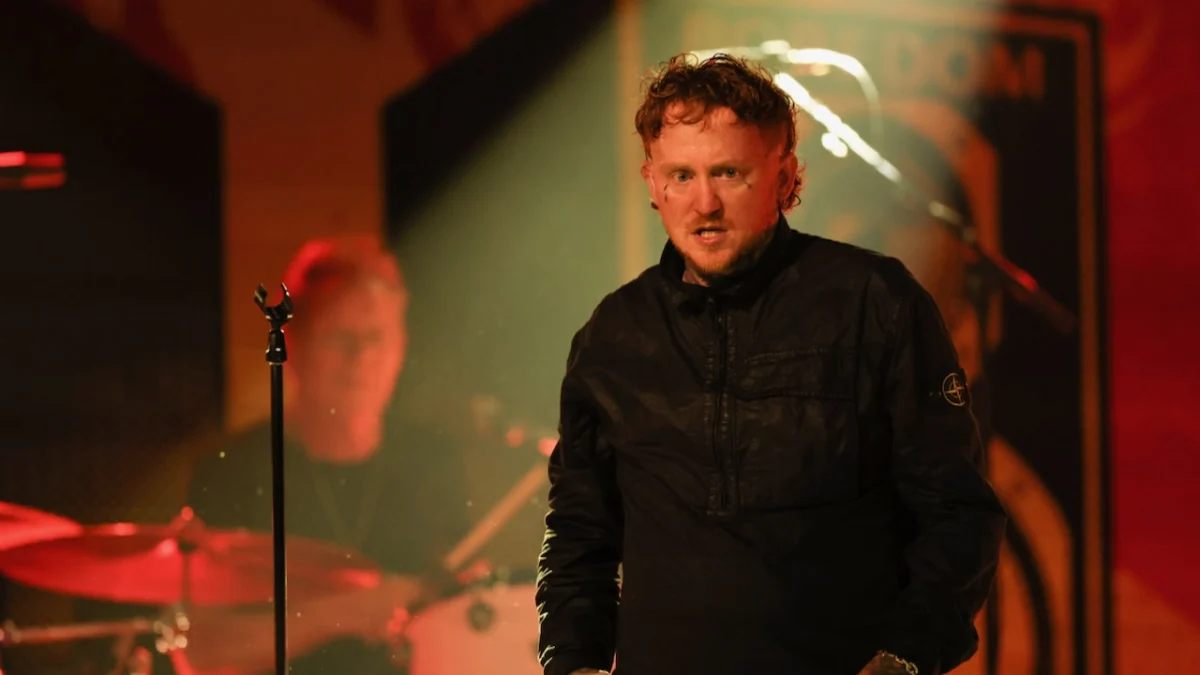
DENVER — The historic punk rock ethos reared its confrontational head on Friday night at Denver’s Ogden Theatre, where Sex Pistols frontman Frank Carter brought the band’s high-energy North American tour to a temporary halt. Mid-set, Carter unleashed a blistering verbal tirade from the stage directed at a male concertgoer who had reportedly breached a designated women- and trans-inclusive mosh pit.
The incident, which was immediately captured on multiple mobile devices and subsequently circulated widely across TikTok and Instagram, highlights an ongoing, tense conversation within the modern live music community regarding safety, inclusivity, and the traditional—often exclusionary—dynamics of punk rock gigs.
Main Facts
During the Sex Pistols’ Friday night performance in Denver—part of their ongoing North American trek commemorating the 50th-anniversary milestone of their seminal album, Never Mind the Bollocks, Here’s the Sex Pistols—frontman Frank Carter spotted a male audience member inside a specialized, women-only zone near the front of the stage.
Rather than ignoring the breach, Carter stopped the show to address the crowd directly. He called out the man for undermining a space deliberately carved out to protect female and marginalized fans from physical, sexual, and psychological harassment—a persistent hazard in traditional rock mosh pits.
- The Confrontation: Carter confronted the man from the stage, condemning his entitlement and lack of empathy regarding the safety realities faced by women at live music events.
- The Removal: After the exchange, in which the audience member reportedly shook his head and attempted to argue, Carter had venue security physically eject him from the venue.
- The Aftermath: Carter doubled down on social media over the weekend, issuing definitive statements clarifying the purpose of the safe spaces, detailing trans-inclusive policies, and even sharing an apology message he received from the offending concertgoer’s father.
Chronology of Events
The altercation unfolded in real time, shifting rapidly from a standard punk rock performance to an impromptu masterclass on concert safety and accountability.
1. The Breach and the Interruption
As the Sex Pistols tore through their setlist at the Ogden Theatre, Frank Carter’s attention was drawn to a section of the floor that had been explicitly designated as a women-only mosh pit—a recurring feature of the band’s current tour. Spotting a male attendee inside the barrier, Carter halted his engagement with the song to confront the individual directly.
2. From-the-Stage Confrontation
Footage shared on social media shows Carter pacing the stage, pointing directly at the man, and dismantling the common argument that women have equal access to standard pit environments.
“Every time, there’s always a fucking man that tells me, ‘[Women] can do this all the fucking time,’” Carter shouted to the packed venue. “Like, they can’t. They fucking can’t. Do you know why? Because they walk in the mosh pit and they get a fucking elbow to the head by a fucking idiot!”
When the concertgoer appeared to challenge the frontman by shaking his head in disagreement, Carter escalated his response.
“You’re shaking your head like you’re a fucking woman? Are you fucking stupid? It’s not your lived experience, so just shut the fuck up! […] Do you know what, instead of crouching, just fucking leave, bro!”
Carter further challenged the man’s refusal to recognize basic safety disparities, noting, “How is it so difficult for you to see space made for women at a Sex Pistols gig? Did you decide? No! They can’t fucking do this whenever. Ask any one of them if they feel safe in every mosh pit! Roll your fucking eyes at me—you fucking did this. You did this!”
3. Ejection from the Venue
The confrontation culminated when Carter instructed venue security to remove the man from the premises. As the individual was being escorted out, Carter offered a final, quintessential punk send-off, telling him he could "see me outside after the gig."
4. Digital Retaliation and Clarification
By Saturday, the incident had snowballed online. Carter took to Instagram Stories to address the situation at length. He established zero tolerance for misogyny, homophobia, and entitlement, while explicitly defining the parameters of the safe space.
Furthermore, Carter revealed he had been contacted by the man’s father, who offered a frank apology for his son’s behavior, writing that it "wasn’t how he was raised, wasn’t how he was taught."
Supporting Data & Context: The 50th Anniversary Tour
The Sex Pistols are currently traversing North America to celebrate half a century of Never Mind the Bollocks, Here’s the Sex Pistols—the 1977 record that defined the British punk movement. However, this iteration of the band features Frank Carter on lead vocals, bringing a contemporary punk ethos and a staunch commitment to progressive social politics to legacy tracks.
Throughout the anniversary tour, Carter has implemented a strict policy at every venue: setting aside a dedicated portion of the floor exclusively for women. In a live music landscape historically dominated by aggressive, unregulated mosh pits where female concertgoers frequently report incidents of unwanted groping, physical intimidation, and assault, Carter’s initiative has been widely praised by fans and safety advocates alike.
- Concert Safety Statistics: Music industry advocacy groups have long noted that a significant percentage of female concertgoers experience harassment or assault in general-admission crowds.
- The Rise of Safe Spaces: In recent years, indie, punk, and metal acts alike have begun experimenting with designated front-row or mosh-pit areas to ensure marginalized fans can enjoy live music without compromising their physical safety.
Official Responses and Statements
Carter’s weekend Instagram Stories offered a comprehensive manifesto regarding why these spaces are non-negotiable. He wrote:
"If you are a man who gets offended by a band making room for a female only moshpit then you are PART OF THE PROBLEM. Stay home, read a book by Bell Hooks, come back when kindness, compassion and empathy have landed with you. Incels, homophobes, misogynists, racists, fascists not welcome. Also this isn’t up for debate. I don’t care for your pedantry. If it isn’t your lived experience, don’t fucking speak on it."
Carter also addressed the socio-political climate surrounding women’s safety, adding:
"If you are offended by being told something isn’t for you then imagine how it feels to be a woman in the current climate."
Crucially, Carter clarified the inclusive parameters of the space, ensuring that vulnerable communities are properly accounted for:
"And finally… When I say a Ladies only moshpit pit. I of course mean a trans inclusionary space. The space is for people who don’t usually feel safe… To dance and have fun without the worry of physical, sexual or psychological violence being used against them while they are vulnerable. DO NOT LET THEM DIVIDE US."
The viral nature of the event generated extensive commentary across platforms like TikTok and Instagram, with hashtags such as #sexpistols, #womensspaces, #equality, and #protectwomen trending as fans debated the boundaries of concert etiquette. While a vocal minority of online commenters echoed the entitlement criticized by Carter, the overwhelming consensus among concertgoers praised the frontman for actively enforcing accountability in real time.
Broader Implications for Live Music Culture
The Denver incident at the Ogden Theatre is far more than a fleeting rock-star rant; it serves as a cultural litmus test for the evolution of live music spaces.
For decades, the mosh pit has been romanticized as a democratic, albeit chaotic, free-for-all where the standard rules of polite society do not apply. However, that lack of regulation has historically functioned as an exclusionary barrier, disproportionately pushing women, non-binary individuals, and smaller-framed fans to the outer edges of the venue to avoid injury or harassment.
By carving out protected zones and—crucially—having frontmen like Frank Carter actively police those boundaries, bands are signaling a structural shift in how concert safety is managed. No longer are safety measures left solely to overburdened venue security guards reacting after an assault has occurred; instead, artists are leveraging their platform to establish preventative cultural norms.
As the Sex Pistols continue their 50th-anniversary tour across North America, the Denver confrontation stands as a stark reminder: the rebellion of punk rock was never about an individual’s right to trample the safety of others. Rather, as Carter forcefully demonstrated, true punk solidarity demands looking out for the most vulnerable people in the room—and showing the door to anyone who refuses to do the same.
 Siti Muinah
 Azzam Bilal Chamdy
