

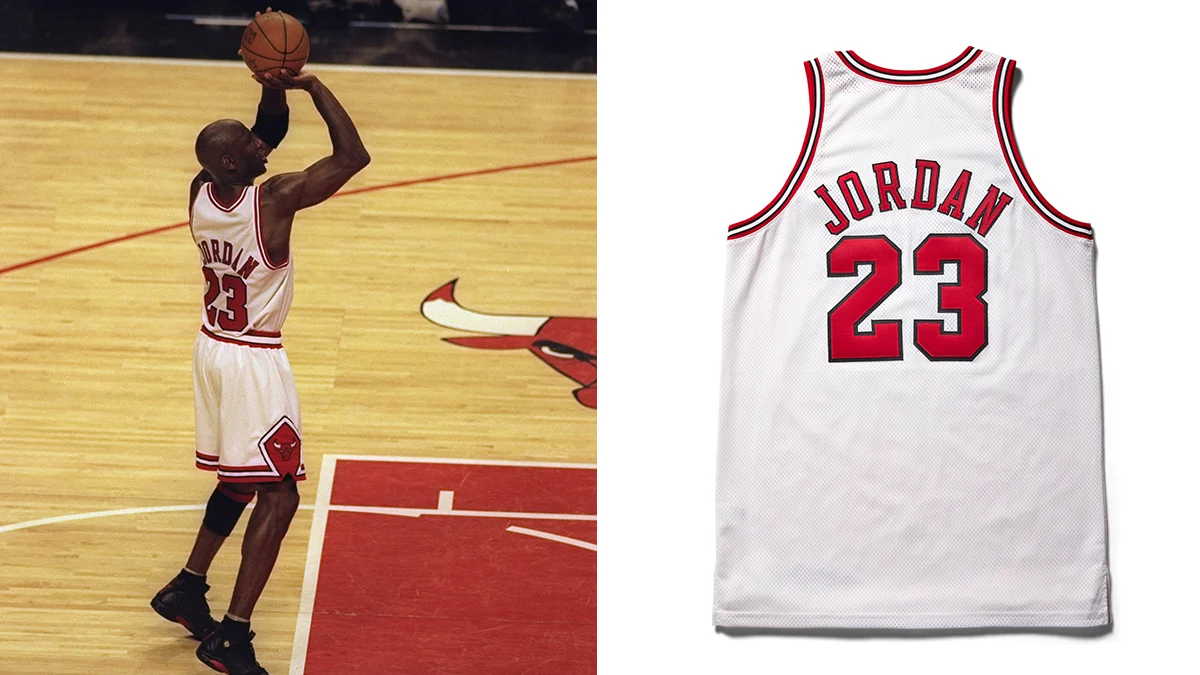
Twenty-three years after his final departure from the professional basketball court, Michael Jordan continues to defy the laws of gravity—not just in highlight reels, but in the high-stakes arena of global auctions. In a monumental sale that further cements his status as the undisputed titan of sports memorabilia, Jordan’s game-worn jersey from Game 3 of the 1998 NBA Finals has hammered down for a staggering $12.26 million.
Facilitated by Pharrell Williams’ premier digital marketplace and auction house, Joopiter, the sale has officially rewritten the record books. The jersey now holds the title of the most expensive game-worn NBA garment ever sold at auction, comfortably eclipsing the previous record-holder: Jordan’s own Game 1 jersey from that same championship series, which realized $10.1 million.
The Weight of History: Why the 1998 Finals Matter
To understand the astronomical valuation of this white Chicago Bulls jersey, one must understand the cultural and historical gravity of the 1998 NBA Finals. Famously chronicled in the ESPN/Netflix docuseries The Last Dance, the 1998 championship represented the final curtain call for the most dominant dynasty in modern basketball history.
It was the season of "the Last Dance," a campaign defined by internal friction, media scrutiny, and the sheer force of will required for Jordan and his teammates to secure their sixth championship ring in eight years. The series against the Utah Jazz was not merely a sporting event; it was a cultural phenomenon, standing to this day as the most-watched championship series in the history of the sport.
The specific jersey in question—worn during the pivotal Game 3—is a relic of that dominance. In that contest, Jordan put on a clinic, scoring 24 points in just 32 minutes of play. The Bulls dismantled the Utah Jazz with a clinical 96–54 victory, a statement win that showcased the cold, calculated brilliance of a team playing for their legacy. Beyond the statistics, the scarcity of the item is paramount: this is the only white 1998 NBA Finals jersey from Jordan to ever reach the public market, elevating it from a piece of athletic apparel to a fine-art level collectible.
A Chronology of a Record-Breaking Sale
The path to this $12.26 million result was marked by intense anticipation and a broader shift in the landscape of high-end collecting.
- 1998: Michael Jordan wears the jersey during a dominant Game 3 performance in the NBA Finals against the Utah Jazz, leading the Bulls to a lopsided 96–54 win.
- Post-1998: The jersey enters private collections, preserved with the kind of meticulous care usually reserved for Renaissance paintings.
- The Rise of Joopiter: Pharrell Williams launches his digital-first auction house, positioning the platform as a bridge between high-fashion, rare artifacts, and the growing market for "blue-chip" sports memorabilia.
- The Auction Launch: Joopiter announces the inclusion of the jersey in a curated sale, emphasizing its provenance and rarity.
- The Hammer Falls: After a competitive bidding period, the final price of $12.26 million is confirmed, setting a new benchmark for the category.
Supporting Data: The Maturation of the Memorabilia Market
The sale of the 1998 jersey is a bellwether for the "Alternative Assets" sector. Collectors are increasingly viewing sports memorabilia as a legitimate hedge and a cornerstone of diverse portfolios, similar to real estate, fine wine, or vintage cars.
However, Jordan does not hold the crown for the most expensive jersey in all of sports history. That distinction currently belongs to the legendary Babe Ruth. In 2024, the New York Yankees icon’s "Called Shot" jersey from the 1932 World Series sold for a monumental $24.12 million, according to The Athletic. While Jordan’s 1998 jersey falls short of the "Sultan of Swat’s" record, it sits comfortably at the top of the NBA hierarchy, proving that the demand for "His Airness" remains in a league of its own.
The success of the sale also underscores the strength of the Joopiter platform. While critics initially questioned whether a celebrity-backed auction house could handle assets of such historical significance, the company has proven its versatility. Beyond the basketball court, Joopiter has successfully transacted items as diverse as a triceratops skeleton named "Trey" and a collection of high-complication Jacob & Co. timepieces owned by Pharrell Williams himself.

Official Perspectives: Defining the "Evolution" of Collecting
The resonance of this sale was not lost on the leadership at Joopiter. Caitlin Donovan, the company’s global head of sale, underscored the significance of the event in a formal statement following the conclusion of the auction.
"It has been a privilege for Joopiter to bring such an important piece of Michael Jordan’s legacy to market, and to see it establish a new auction record for an NBA jersey," Donovan noted. She went on to articulate the broader shift in the global marketplace, stating, "Sports collectibles are in an exceptionally exciting period of evolution. As the category continues to mature, objects of true rarity, provenance, and cultural significance are increasingly recognized on the global collecting stage. This result speaks to that momentum, and we are excited to continue building Joopiter’s presence in the category and bringing exceptional pieces of sports history to collectors around the world."
Implications for Future Collectors
The $12.26 million price tag has significant implications for the future of sports collecting:
1. The "Blue-Chip" Classification
The sale reinforces that items associated with "GOAT" (Greatest of All Time) athletes—such as Jordan, Ruth, Ali, and Gretzky—are now treated as blue-chip assets. Collectors are no longer just fans; they are sophisticated investors who prioritize provenance, authenticity, and historical impact above all else.
2. The Power of Digital Provenance
Joopiter’s success highlights the changing geography of the auction world. Digital-first houses are successfully displacing traditional, brick-and-mortar auction houses by creating high-production, narrative-driven experiences that cater to a global audience. The "Last Dance" narrative was expertly woven into the sale, proving that storytelling is now just as important as the physical condition of the item.
3. The Ceiling is Rising
With each record-breaking sale, the psychological barrier for entry into the high-end memorabilia market shifts. As Jordan’s jersey surpasses the $10 million mark, it paves the way for other iconic items—such as game-winning sneakers or championship rings—to command prices that were previously considered impossible.
Conclusion: A Legacy That Endures
Michael Jordan’s influence on the world is no longer confined to the hardwood of the United Center. Whether through the global expansion of his brand, the persistent cultural impact of his career, or the record-shattering prices of his game-worn gear, Jordan remains a focal point of human achievement.
As the hammer fell on the 1998 jersey, it served as a reminder that history is not just something we read in books; it is something we can touch, own, and pass on. For the anonymous collector who secured this piece of the "Last Dance," the $12.26 million price tag is likely a small fee to pay for a literal piece of the greatest player to ever lace up a pair of sneakers. In the world of sports memorabilia, Michael Jordan remains the king, and for now, the records continue to fall exactly where he left them.
 Ali Ikhwan
 Laily UPN
 Raul Delapena Setiawan
