

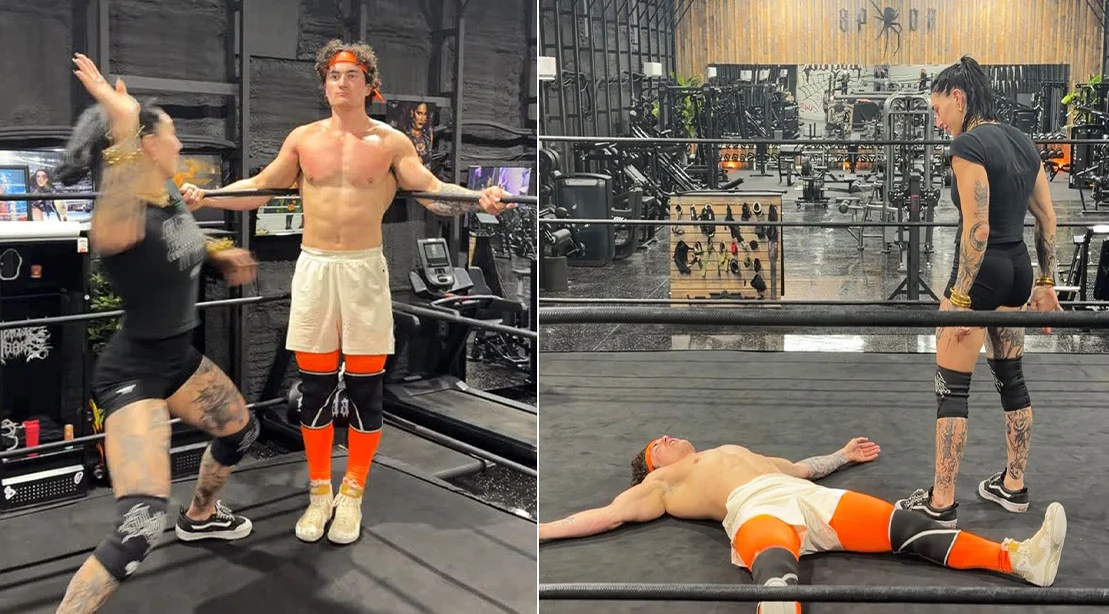
The age-old mantra of the WWE, "Don’t Try This at Home," serves as a stark warning to fans worldwide. While the spectacle of professional wrestling is a choreographed dance of athleticism and narrative, the physical toll it exacts on the human body is nothing short of authentic. This reality was vividly illustrated recently when popular fitness influencer Jesse James West, who commands a digital audience of nearly 10 million YouTube subscribers, stepped into the squared circle with one of the most formidable forces in sports entertainment: Rhea Ripley.
What was billed as a lighthearted social media collaboration quickly descended into a grueling masterclass in physical endurance. For West, whose fitness content often focuses on strength training and body composition, the encounter served as a visceral reminder that there is a vast, insurmountable chasm between gym-based fitness and the brutal, impact-heavy discipline of professional wrestling.
The Collision of Two Worlds: Main Facts
The viral interaction, documented across both Instagram and YouTube, features the Australian powerhouse—widely regarded as one of the most physically imposing and technically proficient wrestlers of her generation—taking the novice influencer through his paces.
Rhea Ripley, the first Australian-born champion in WWE history and a central pillar of the SmackDown brand, did not coddle her guest. The session, intended to showcase the "real" side of wrestling, involved high-impact maneuvers that left West visibly shaken and physically marked. The objective was clear: to demonstrate that the strikes, slams, and grapples seen on television are not merely theatrical, but are calculated applications of force designed to incapacitate.
A Chronology of the Beatdown
The training session began with an air of playful banter, but the atmosphere shifted the moment physical contact commenced.
Phase 1: The Initial Strike
Ripley, known for her aggressive in-ring persona, set the tone immediately. With a cold, professional focus, she delivered a thunderous chop to West’s chest. The sound echoed throughout the room—a sharp, percussive crack that left a stark, crimson welt across the influencer’s torso almost instantly. The impact was not merely aesthetic; the sheer force of the strike clearly winded West, who was visibly unprepared for the level of physical intensity required to withstand a standard WWE maneuver.
Phase 2: The Escalation
Following the initial strike, Ripley punctuated the moment with a primal growl, signaling to West that the "fun" phase of the collaboration had concluded. Rather than allowing him to recover, the intensity only escalated. Ripley transitioned from strikes to grappling, demonstrating the technical precision that has propelled her to the top of the women’s division.
Phase 3: The Tandem Assault
As if the session weren’t demanding enough, Ripley’s husband and fellow wrestling professional, Buddy Matthews, entered the fray. Matthews added to the "educational" experience by delivering an additional, heavy-handed chop, ensuring that West felt the full weight of professional-grade striking. By the end of the encounter, the influencer was left clutching his chest, reeling from the reality of the punishment that WWE superstars absorb on a nightly basis.
Supporting Data: The Science of the Strike
To understand why West was so thoroughly "humbled," one must look at the physics behind a professional wrestler’s strike. A standard "chop" in professional wrestling is not just a slap; it involves the rotation of the torso, the snap of the wrist, and the precise targeting of the pectoral muscles.
Professional wrestlers spend years conditioning their bodies to "take" these blows. Their skin, muscles, and internal bracing mechanisms are trained to disperse energy. Conversely, a standard gym-goer, regardless of their muscle mass or dedication to hypertrophy, lacks the specific connective tissue hardening required to absorb such blunt force trauma.
When Ripley struck West, she was utilizing techniques refined through thousands of hours of competition. For West, whose training is focused on aesthetics and strength, the impact was a shock to the nervous system. The resulting inflammation and the immediate, vivid discoloration of his skin were the direct physiological results of blunt force impact against a body that has not been "ring-hardened."
Perspectives and Reactions
The internet’s response to the video was immediate and polarized. Comments sections across Instagram and YouTube were flooded with a mix of amusement and genuine respect for the sport.
"That’ll leave a mark," wrote one observer, highlighting the raw nature of the footage. Other users, particularly long-time wrestling fans, noted that the video was a necessary "reality check" for influencers who often underestimate the athleticism required for professional wrestling.
West himself, while maintaining his high-energy persona, was uncharacteristically subdued following the session. His cries of "it stings" were not played for the camera; they were the genuine reactions of a man who had finally experienced the reality of the profession he had been observing from the safety of his screen.
The Implications: A Lesson in Respect
The interaction between Ripley and West carries broader implications for the world of sports entertainment. In an era where digital creators frequently cross over into athletic spaces, there is often a misconception that performance-based sports like wrestling are "fake" or easily replicated.
1. Debunking the "Fake" Narrative
This video serves as a powerful piece of evidence in the ongoing argument regarding the legitimacy of professional wrestling. By subjecting an athletic, fit individual to just a fraction of the intensity a wrestler experiences, the footage proves that "choreography" does not mean "painless."
2. The Professional Athlete Gap
The gap between a fitness influencer and a WWE superstar is not just about muscle size or lifting capability; it is about the ability to endure. Professional wrestling is a discipline that requires a unique blend of cardiovascular stamina, pain tolerance, and technical knowledge. West’s experience highlighted that professional wrestlers are among the most versatile and resilient athletes in the world today.
3. Future Collaborations
This event sets a precedent for how collaborations between digital influencers and professional athletes should be handled. Moving forward, creators will likely approach these scenarios with significantly more caution. The lesson for West is clear: while he may be a king of the gym, the squared circle belongs to those who have dedicated their lives to the art of professional wrestling.
Conclusion
Rhea Ripley’s "humbled" version of Jesse James West is more than just a viral social media moment; it is a profound testament to the toughness required in the WWE. As Ripley continues her reign as one of the most dominant champions in the organization’s history—broadcast weekly to millions of homes via the USA Network and Netflix internationally—she has once again proven that her reputation is well-earned.
For West, the experience was undoubtedly painful, but it provided him with a newfound respect for the craft. He stepped into the ring looking for content, but he left with a permanent red mark on his chest and a lasting lesson in what it truly means to be a professional wrestler. In the end, the "Don’t Try This at Home" warning remains the most valuable advice for anyone daring to test their mettle against the elite of the WWE.
 rifanmuazin
 Laily UPN
