

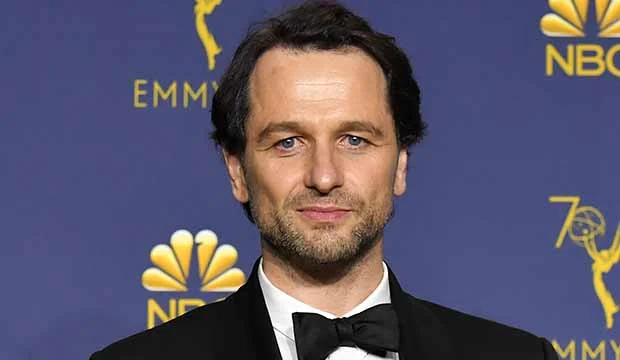
Matthew Rhys finds himself in a position that most performers only dream of: a genuine, double-threat contention for this year’s Emmy Awards. It is a rare, rarefied air, though not entirely uncharted territory for the Welsh actor. In 2017, Rhys famously balanced a lead actor nomination for his iconic turn in The Americans—a series that would eventually secure him the trophy in 2018—with a guest actor nod for his unsettling, lecherous portrayal of novelist Chuck Palmer in HBO’s Girls.
As the industry pivots toward the upcoming awards season, history appears to be repeating itself. Rhys is currently a formidable contender for his chilling performance as the villainous Nile Jarvis in Netflix’s limited series The Beast in Me, a role that has already garnered significant recognition from the Golden Globes, the Critics Choice Awards, and the Actor Awards. Simultaneously, he has become the anchor of this spring’s most unexpected cultural phenomenon: Apple TV+’s Widow’s Bay. In this blend of comedy and supernatural horror, Rhys portrays Tom Loftis, a small-town mayor forced to reconcile with the chilling reality of a town curse while battling the desperate, paternal urge to protect his son.
A Career Defined by Range: The Path to Double Recognition
For Rhys, the possibility of dual recognition is a source of profound humility. “Never in my wildest dreams did I think I would be discussing two shows for all of this,” he admits. “It’s everything you dream of, and having the opportunity to inhabit two such wildly different characters is the absolute luxury of the craft. I’m just incredibly grateful.”
The actor’s career has long been defined by this ability to pivot between the grounded and the grotesque. From the deep-cover espionage of the Cold War to the quiet desperation of a small-town official facing otherworldly threats, Rhys approaches his work with a rigorous dedication to "the real." Whether he is playing a man orchestrating psychological warfare or a man trying to keep his family afloat in a cursed coastal town, his commitment to internal logic remains his signature.
The Art of the Villain: Dissecting Nile Jarvis
In The Beast in Me, Rhys delivers a masterclass in controlled volatility. Nile Jarvis is not merely a antagonist; he is a man burdened by a lifetime of perceived victimhood. When discussing the character’s dark psyche, Rhys explains that he found the human tether through a collaborative development of the character’s backstory.
“I went to the writers early on,” Rhys says. “I said it has to be grounded in something. It can’t just be arch. He has to come from somewhere.” By establishing a history involving the loss of his mother in childbirth and a father’s resulting resentment, the writers provided Rhys with a "world of pain" that transformed Nile from a standard villain into a tragic, if monstrous, figure.

The physicalization of the role was equally critical. "Nile’s wardrobe helped me enormously," he notes. "Shoes always help. Beautiful shoes make you feel good, and the suits give you a different deportment and a different kind of posture. The hair did something very different than what I am usually used to."
The Horror of the Mundane: The World of Widow’s Bay
If Nile Jarvis represents the overt, calculated evil, Tom Loftis in Widow’s Bay represents the terrifying struggle to maintain normalcy when the world begins to fray at the edges. Directed by Hiro Murai, the series avoids the trap of leaning too heavily into the genre labels of "horror" or "comedy."
“Hiro said we’re not playing a horror or a comedy,” Rhys explains. “We have created a real world with real people with real backstories, and we play it for real. It’s liberating when they say that. You feel emancipated from the pressure of playing a tone.”
For Rhys, the stakes in Widow’s Bay are deeply paternal. His "super objective," a theatrical term for a character’s overarching motivation, was simple: Tom wants the island to flourish for his son. “He’s doggedly blinkered because he’s like, ‘If I ignore this, it doesn’t exist and therefore the island will flourish and so will my son.’”
The Dynamics of Collaboration: Banks, Danes, and the Craft of Acting
A significant portion of Rhys’s success stems from his ability to engage with formidable scene partners. When asked to compare the intimidating presence of Jonathan Banks—his co-star in The Beast in Me—with the laser-focused intensity of Claire Danes, Rhys offers a nuanced perspective.
“Jonathan Banks is terrifying,” Rhys says, noting the actor’s gravelly voice and sardonic, off-set humor that often keeps his counterparts off-balance. "But more intimidating is Claire Danes. The second I began rehearsing with her, a ramrod went up my back. It’s like playing tennis against Serena Williams. I don’t play tennis, but I imagine that’s what it’s like being served at 110 miles an hour. She sharpened my game in a way I didn’t think possible."

Overcoming Challenges: From ‘Psycho Killer’ to 300-Year-Old Corpses
The technical challenges of these roles provided some of the most memorable moments on set. In The Beast in Me, a scene involving a dance sequence to the Talking Heads’ "Psycho Killer" proved divisive in its interpretation. While some viewers found the scene "camp," Rhys reveals his intention was far more earnest, aiming to show a character desperately trying to signal his own humanity, however misguided that attempt may have been.
In Widow’s Bay, the challenges were more existential. Performing alongside Hamish Linklater while speaking to a "300-year-old corpse" required a delicate balance. “You hope the audience is with you and they don’t go, ‘This is silly now,’” he says. “Finding those big, extreme moments and landing them in a real way where an audience will follow you—those are the concerns.”
Implications for the Industry
As the Emmy cycle approaches, the discourse surrounding Matthew Rhys serves as a reminder of the evolving standards of television excellence. The ability to anchor two distinct, high-profile projects simultaneously is a testament to the versatility required in the modern streaming era.
Rhys’s approach—which favors grounding the extreme in the relatable—highlights a shift in how prestige television is constructed. By treating horror as a human drama and a psychological thriller as a character study, Rhys has successfully navigated the thin line between genre tropes and high-art performance.
His lifelong love for Jaws and his playful frustration over not being cast as the legendary Quint—leaving him to play the "Brody" role opposite Stephen Root—further emphasizes his connection to the foundational elements of storytelling. Whether he is being the one who is scared or the one who is doing the scaring, Rhys continues to demonstrate that he is one of the most reliable and compelling actors of his generation.
As he waits to see if his double-nomination dream becomes a reality, one thing is certain: Matthew Rhys has solidified his place as a cornerstone of contemporary television. His work in The Beast in Me and Widow’s Bay will undoubtedly be remembered as a high-water mark for 2026, offering a masterclass in the endurance and adaptability required to thrive in a landscape that demands constant reinvention.
 Ammar Sabilarrohman
 Siti Muinah
 Iffa Jayyana
