

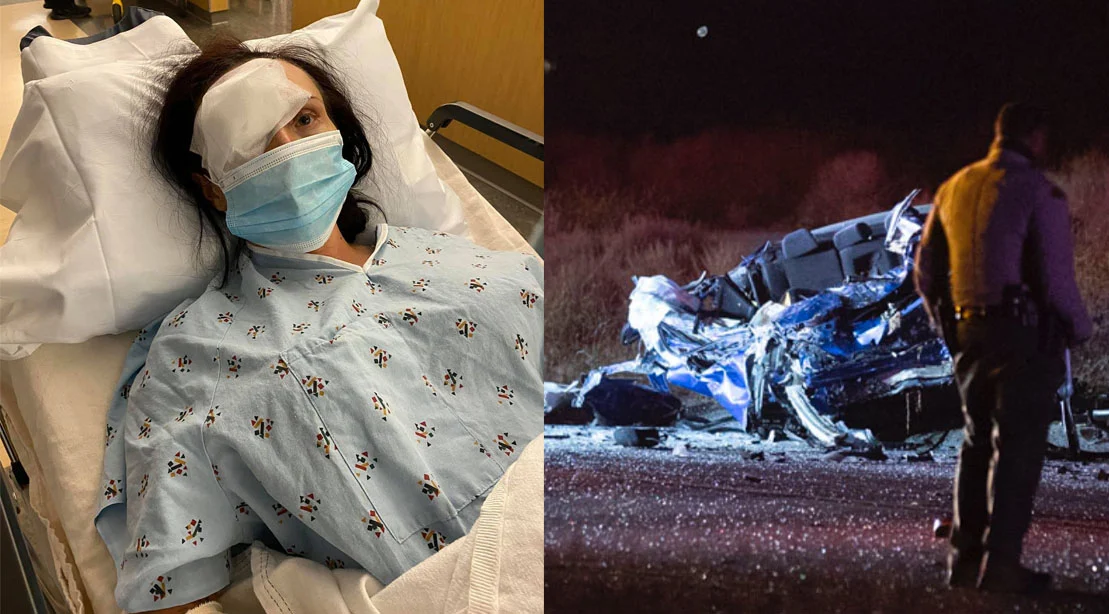
In the subculture of modern fitness, the term "survived" is often deployed with hyperbolic flair. A lifter might claim to have "survived" an grueling leg day, or an athlete might describe their 12-week competition prep as a battle for survival. Yet, for Detective Tiffany Kautz of the San Bernardino County Sheriff’s Department, the word carries a weight that renders such gym-floor analogies trivial. For Kautz, survival was not a metaphor—it was a literal, visceral, and near-impossible feat of biological engineering.
The Catastrophe: A Collision with Destiny
On a June afternoon in 2020, the trajectory of Kautz’s life was irrevocably altered by a violent collision. A Dodge Ram truck, traveling at an estimated 95 miles per hour, veered across the center line and slammed into her vehicle. The physics of the crash were catastrophic; the impact did not merely deform the metal of her car—it shredded it. The truck flipped, its engine block raking across the roof of Kautz’s vehicle like a blade through parchment.
When the dust settled and emergency crews arrived, the scene was harrowing. Kautz had sustained a massive scalp avulsion extending from her forehead to her eye and a near-complete amputation of her hand. The trauma was so severe that she coded twice while being transported via medical helicopter to the trauma center.
The survival of such an event is a confluence of factors: the rapid intervention of first responders, the critical care provided by medical staff, and the presence of her former police academy classmate, Detective Clarence Harris, who happened to be in the area to provide the support and communication her family desperately needed. However, beyond the external aid, there existed a singular, internal variable that physicians later highlighted: her physical condition.
"The nurse or doctor told my husband that the only reason why I survived is because of my physical fitness," Kautz recalls. "So, I really, truly believe it saved my life in that incident, and maybe if my body hadn’t been in that condition, it wouldn’t have been able to withstand the trauma."
A Foundation of Steel: The Athlete in Uniform
Long before she pinned a badge to her chest, Kautz was a veteran of the fitness industry. Her professional background included years as a personal trainer and a club manager for 24 Hour Fitness. She possessed a granular understanding of hypertrophy, the nuances of metabolic conditioning, and the critical importance of cardiovascular health.
When she transitioned to law enforcement in 2016, she did not abandon her athletic identity; she integrated it into her service. "I really, truly believe that fitness is even more important to maintain as a law enforcement officer because of the things that we are expected to do," she explains. "You never know when you’re going to be called upon to perform at your absolute peak."
This philosophy proved prescient. While her colleagues saw fitness as a lifestyle choice, Kautz viewed it as an essential component of her tactical gear—a form of biological body armor that, while invisible, proved to be the difference between life and death.
The Road to Recovery: Chronology of a Comeback
The recovery process was not a linear trajectory; it was a grueling ascent. After spending several days in the Intensive Care Unit and two weeks hospitalized, Kautz was discharged with a singular, relentless focus: returning to active duty.
The Micronutrient Strategy
Upon returning home, Kautz immediately applied the same discipline she had taught her clients for years. She shifted her focus to nutrition, prioritizing a high intake of micronutrients—the "lots of colors on my plate" approach—to facilitate cellular repair and inflammation management.
Creative Rehabilitation
Physical limitations, including a cast that immobilized her wrist for nearly two months, failed to halt her progress. When traditional movement was restricted, she innovated. "If I could do a lower body exercise, I was doing the lower body exercise," she says. She eventually purchased ankle cuffs, attaching them to her biceps to perform cable movements for her chest, shoulders, and back, ensuring that no muscle group remained dormant while her wrist healed.
The Psychological Crucible
The most significant obstacle arrived six months into her recovery. During a routine run, the vibration and impact triggered sharp, debilitating pain in her wrist. The realization that she was still far from operational readiness prompted a dark moment of introspection. Her resolve was further tested when a physician, evaluating her progress, delivered a sobering prognosis: "You better look into a different career because you’re never going to be able to shoot a gun again."
For many, this would have been a point of surrender. For Kautz, it was the catalyst for an obsession. "I go, ‘Watch me,’" she recalls.
Defying the Odds: The Return to the Field
The doctor’s skepticism ignited a fire that carried Kautz through the final, most difficult stages of her rehabilitation. She transitioned from basic physical therapy to advanced, sport-specific training designed to stabilize her wrist and regain the fine motor control required for duty.
The challenge was not merely physical; it was bureaucratic. She had to undergo the standard departmental qualification—a rigorous, non-negotiable shooting test. Missing her quarterly review during recovery, she had to re-prove her proficiency from scratch.
When she finally stood on the range and successfully qualified, it was more than a professional milestone; it was a personal victory that mirrored the intensity of a gold medal. Returning to the field, to the camaraderie of her unit, and to the active service of her community, provided the final piece of her healing process. "I had to watch my partners do all the fun things while I was just sitting writing paper," she says. "So, I was so excited to be back, to be in uniform, to go do the thing that I signed up to do."
Implications for Public Safety
Detective Kautz’s story serves as a potent case study for the law enforcement community. Her experience highlights the often-understated necessity of physical preparedness in the high-stakes world of public safety.
The "Service First" Fallacy
Kautz is a vocal advocate for shifting the mindset of first responders. She argues that the "service first" mentality—often used as an excuse for neglecting one’s own health—is flawed. "I always make time for myself first," she states. "Because if I make time for myself, I feel better when I’m taking time for other people afterwards. I really, truly believe that if I’m not at my best, I can’t give you my best."
A Blueprint for Resilience
Today, as a wife, a mother of two, a police officer, a Figure competitor, and an aspiring HYROX athlete, Kautz is proof that the body’s capacity for adaptation is vast, provided the mind is equally conditioned. Her story is being shared not as a trophy of her own resilience, but as a roadmap for others. She advocates for a culture where nutrition, cardiovascular output, and strength training are viewed as foundational pillars of duty, not optional accessories.
By treating her own life as a project in continuous improvement, Kautz has transformed from a victim of a horrific accident into a beacon of professional and personal excellence. Her journey serves as a reminder that while we cannot always control the crises that cross our paths, we can exert absolute control over the physical and mental state with which we meet them. In the life of Detective Tiffany Kautz, fitness was not just a hobby; it was the mechanism that ensured her story did not end on that highway in June 2020.
 Lina Hope
 rifanmuazin
 Laily UPN
