

For fitness enthusiasts and bodybuilders alike, the triceps brachii represents the majority of upper arm mass. While the biceps often capture the spotlight, it is the three-headed triceps—the medial, lateral, and long heads—that truly define the visual aesthetics and functional power of the arm. For decades, the overhead triceps extension has stood as the gold standard for isolating these muscles. However, as modern biomechanical understanding evolves, the overhead movement is coming under scrutiny for its potential impact on spinal health.
Enter Travis Smith, a prominent fitness and transformation coach, who has introduced a tactical pivot in training methodology. By shifting the body from a vertical to a horizontal plane, Smith is advocating for a technique that maintains high-intensity muscle fiber recruitment while eliminating the axial loading that often compromises the lumbar spine.
Main Facts: The Biomechanics of the Triceps Extension
The traditional overhead triceps extension is a staple of hypertrophy training because it puts the long head of the triceps into a stretched position. When a muscle is stretched under load, it is theoretically primed for greater mechanical tension and subsequent growth. However, this biomechanical advantage comes with a cost: stability.
When performing a standing or seated overhead extension, the body must exert significant effort to stabilize the torso. As the weight increases, the core must work overtime to prevent hyperextension of the lower back. This creates a "leakage" of energy; instead of the nervous system directing 100% of its focus toward the triceps, a portion of that effort is diverted to spinal bracing.
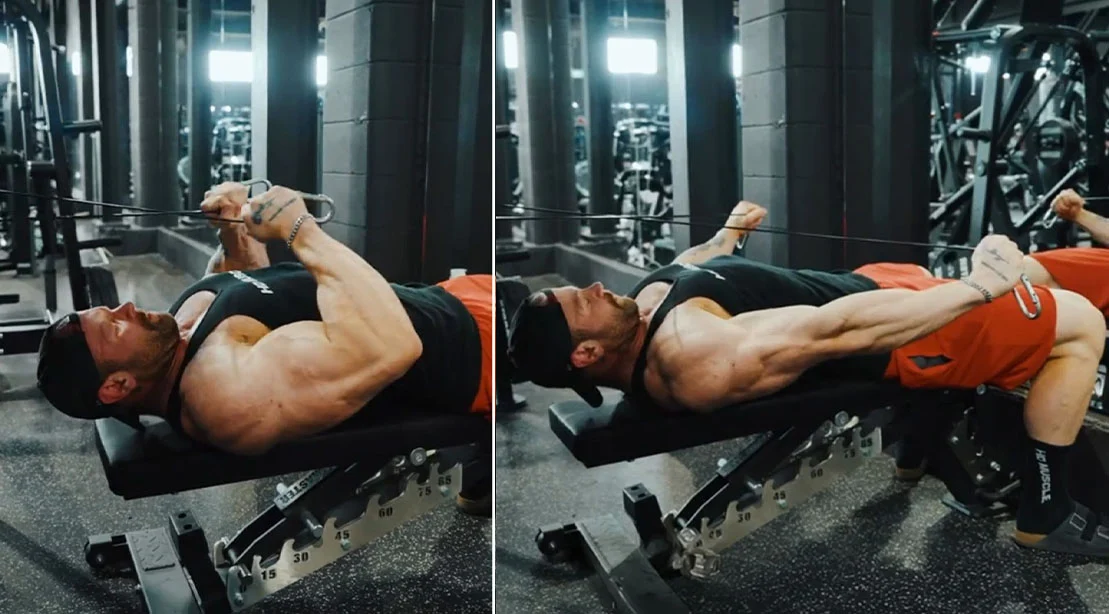
Travis Smith’s proposed solution is the Lying Triceps Cable Crossover. By placing the athlete in a supine position (lying on a bench), the floor or bench provides a rigid, external base of support. This effectively removes the spine from the equation, allowing for a focused, isolated contraction that prioritizes metabolic stress and mechanical tension in the target tissue rather than core stability.
Chronology: The Evolution of Triceps Isolation
The history of triceps training is a progression of finding ways to overcome the anatomical limitations of the human shoulder.
- The Early Era (Pre-1970s): Training was dominated by simple compound movements like the close-grip bench press. While effective for strength, these moves often limited isolation.
- The Golden Era (1970s–1990s): The rise of the "Skull Crusher" (EZ-bar lying triceps extension) revolutionized isolation. Athletes realized that by moving the load through an arc, they could fatigue the triceps more effectively. However, reports of elbow pain became common.
- The Modern Era (2000s–Present): The integration of cable machines allowed for "constant tension." Unlike free weights, where gravity creates "dead zones" at the top or bottom of a movement, cables provide a continuous pull, ensuring the muscle is under load throughout the entire range of motion.
- The Current Pivot: Coach Travis Smith’s recent demonstration via Instagram marks the latest shift: combining the stability of a bench-based movement with the constant tension of cable resistance to create a "spine-safe" training environment.
Supporting Data: Why Stability Dictates Growth
In the realm of hypertrophy, "stability" is often the most underrated variable. The Central Nervous System (CNS) is programmed to protect the body from injury. If the brain perceives that the spine is at risk during a heavy overhead movement, it will subconsciously limit the amount of force the triceps can produce. This is a survival mechanism known as "protective inhibition."
By lying on a bench, the trainee provides the CNS with a sense of total security. When the back is supported, the brain feels safe to "unlock" the full potential of the motor units in the triceps.
The Cable Advantage
Cables offer a unique advantage over dumbbells or bars: the vector of resistance. With a dumbbell, the resistance is strictly vertical. With cables, the line of pull can be adjusted to match the muscle’s line of action. By crossing the cables over in front of the body while lying down, the resistance is maintained at an angle that perfectly aligns with the fibers of the triceps, specifically targeting the long head—the largest of the three heads—through a full range of motion.
Official Responses and Expert Insights
Travis Smith’s demonstration has resonated across the fitness community, particularly among those who have struggled with the "classic" gym injuries associated with overhead work.
"Lying on the bench locks your torso and shoulders in place," Smith explained during his demonstration. "So, you can focus on producing as much force as possible with the triceps. The less energy spent stabilizing movement, the more you can put into the target muscle."
Beyond the back, Smith addresses a common complaint among veteran lifters: elbow health. "If regular skull crushers bother your elbows, this variation is the one for you," he notes. The traditional EZ-bar skull crusher forces the elbow joint into a fixed, often awkward plane of motion. The cable crossover, however, allows for a more natural, fluid movement pattern that adapts to the individual’s anatomy, reducing the shear stress on the olecranon process (the tip of the elbow).
Implications: Implementing the Technique
For those looking to integrate this movement into their current split, the technical execution is paramount. Here is the recommended protocol:
The Setup
- Positioning: Place a flat bench in the center of a dual-cable station. Ensure the bench is positioned so that when you lie down, your head is positioned between the two pulleys.
- The Grip: Use two D-handles or carabiner-clipped ropes. Cross the cables over so that the right hand holds the left pulley and vice versa. This "cross" is essential for maximizing the contraction.
- The Execution: Begin with elbows bent and fists held high. As you extend, focus on keeping your elbows tucked; they should not flare outward.
- The Stretch: Lower the cables in a controlled arc behind the head, allowing for a deep stretch in the long head of the triceps.
- The Contraction: Extend until the arms are fully straight, squeezing the triceps at the peak of the movement.
Training Volume
Smith recommends a volume of 2 to 3 sets. Aim for a repetition range of 8 to 12. This range is widely accepted in exercise science as the "hypertrophy sweet spot," balancing enough mechanical tension to trigger muscle protein synthesis with enough metabolic fatigue to induce sarcoplasmic growth.
The Future of "Smart" Hypertrophy
The shift toward the Lying Triceps Cable Crossover represents a broader trend in the fitness industry: "Smart Hypertrophy." For decades, the mantra was "no pain, no gain," often ignoring the long-term wear and tear on the spine and joints. Today, the focus has shifted toward longevity.
If one can achieve the same—or better—hypertrophic results by optimizing biomechanics and reducing unnecessary stress on the lumbar spine, the decision becomes a matter of professional logic rather than personal preference.
Addressing Common Myths
- Myth: "You can’t get a real pump without free weights."
- Fact: The pump is a result of blood flow and metabolic stress. The cable crossover, by keeping the muscle under constant tension, often produces a superior "pump" compared to free weights because there is no point in the movement where the muscle can rest.
- Myth: "Compound movements are the only way to build arms."
- Fact: While compound movements are excellent for total body strength, the triceps are a small muscle group that responds exceptionally well to isolation when the intensity is high enough.
Conclusion: A Shift in Perspective
The beauty of the Lying Triceps Cable Crossover lies in its simplicity. It does not require expensive, proprietary equipment—just a standard bench and a basic cable machine found in almost any gym worldwide.
By removing the stability requirement, Travis Smith has democratized high-intensity triceps training. Athletes who previously shied away from overhead extensions due to back pain can now train the triceps with the same intensity as their counterparts.
Ultimately, the goal of training is to stimulate muscle growth while preserving the integrity of the body’s structural system. If you can eliminate the vertical load on your spine without sacrificing the stretch on your triceps, you aren’t just training harder; you are training smarter. As Smith suggests, the proof is in the results—and for those willing to lie back and lock in, the gains speak for themselves.
To follow Travis Smith for more evidence-based coaching tips and transformation strategies, you can find him on Instagram at travyjsmith.
 Lina Hope
 rifanmuazin
 Laily UPN
