

By Aviation Correspondent
Published: June 9, 2026
In a milestone that may mark the definitive turning point for sustainable flight, Florida-based nonprofit Helios Horizon has successfully completed the world’s first piloted flight of an electric aircraft powered by advanced solid-state battery technology. The breakthrough, which occurred on June 5, 2026, at the Zephyrhills Municipal Airport, represents a leap forward in energy density, safety, and operational efficiency—factors that have long hindered the widespread adoption of electric aviation.
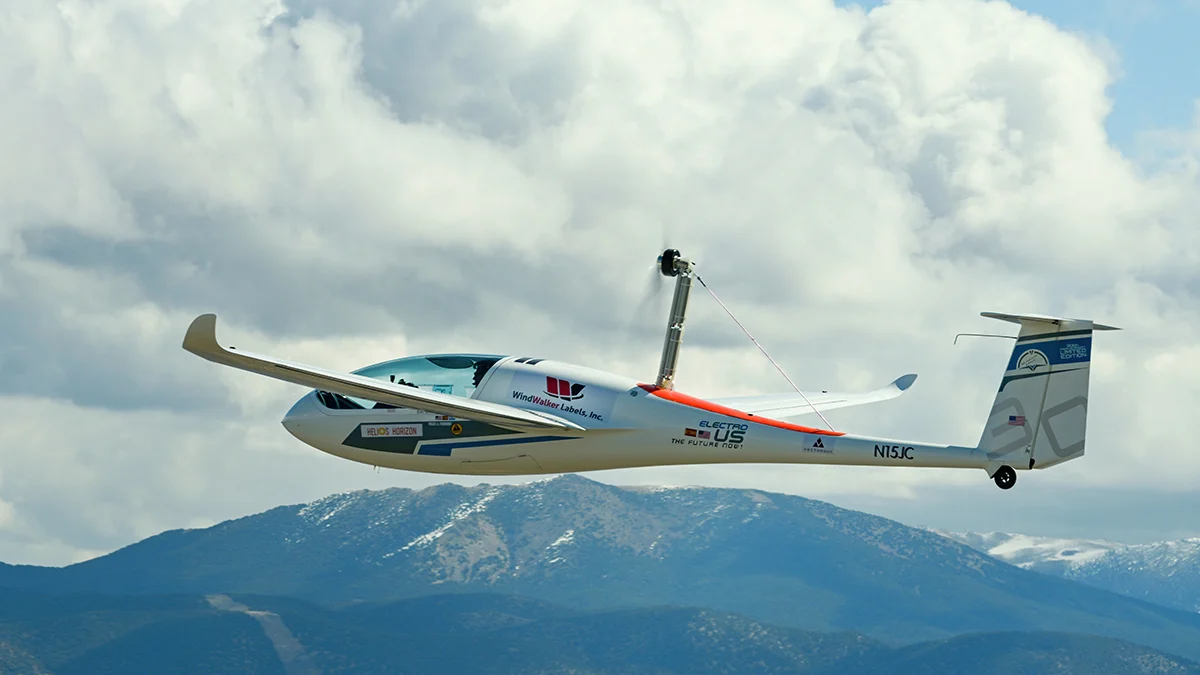
By retrofitting a Pipistrel Taurus motor glider, the team at Helios Horizon—led by founder and chief test pilot Miguel Iturmendi—has demonstrated that the limitations of traditional lithium-ion batteries are no longer an insurmountable barrier to long-range, emission-free travel.
The Technical Breakthrough: Replacing Liquid with Solid
The core of this achievement lies in the fundamental chemistry of the aircraft’s power plant. Conventional electric vehicles and aircraft rely on lithium-ion batteries, which utilize liquid electrolytes to move energy between electrodes. While effective, these batteries are heavy, prone to thermal runaway, and limited in their energy density.

The Helios Horizon utilizes solid-state cells, which replace the flammable liquid electrolyte with a stable solid material. This change is not merely iterative; it is transformative. The new battery packs integrated into the aircraft boast an energy density of 410 Wh/kg, a staggering improvement over the 260 Wh/kg provided by the original lithium-ion setup.
According to technical specifications released by the nonprofit, these solid-state batteries offer 60 to 80 percent greater energy density while occupying a smaller physical footprint than the power cells found in most modern electric vehicles. Furthermore, the chemistry allows for rapid charging, capable of moving from a near-depleted state to an 80 percent charge in under 15 minutes.
Chronology of the Mission
The project, which has been in stealth development for several years, culminated in a high-stakes flight test series in central Florida.
- Pre-flight Integration (May 2026): The Helios Horizon team completed the final installation and ground-testing of the solid-state battery modules within the modified Pipistrel Taurus airframe. The team spent weeks ensuring that the weight and balance profile remained optimal despite the shift in energy storage technology.
- The Maiden Flight (June 5, 2026): Under clear Florida skies, Miguel Iturmendi took the controls of the aircraft at Zephyrhills Municipal Airport. The mission involved a series of short, controlled test flights designed to stress-test the battery’s power delivery under varying loads.
- Performance Validation: Following the successful takeoff and landing, the flight data confirmed that the solid-state cells maintained voltage stability and thermal equilibrium, outperforming the legacy lithium-ion hardware during hours of sustained operation.
- Future Outlook (Late 2026): The team has announced plans to push the aircraft toward its ultimate goal: reaching the stratosphere at altitudes exceeding 40,000 feet.
The Mechanics of "Regenerative Flying"
One of the most innovative aspects of the Helios Horizon is its multi-modal energy management. Recognizing that battery capacity is finite, the engineers have designed the aircraft to be a "living" energy system.

The airframe is equipped with integrated solar panels that trickle-charge the cells during flight. More impressively, the aircraft utilizes "regenerative flying." When the aircraft is in a descent, the propeller acts as a wind turbine, capturing the kinetic energy of the airflow and converting it back into electrical current to replenish the batteries.
"Regenerative flying, in which we glide and windmill the propeller during descents, can significantly increase the range of the airplane," says Iturmendi. This creates a circular energy economy within the aircraft, allowing it to extend its mission duration far beyond what a static battery capacity would suggest.
Official Perspective: The Voice of the Pilot
Miguel Iturmendi, serving as both the visionary founder and the man in the cockpit, expressed the gravity of the achievement during a post-flight press conference.
"For the first time, we have a battery technology that yields the range and charging times necessary to make commercial electric aviation viable, while providing the safety the flying public will demand," Iturmendi stated. He emphasized that the primary hurdle for the industry has always been the "safety-to-weight" ratio. Because solid-state batteries are significantly more stable at high temperatures and resistant to physical puncture, they provide an inherent safety buffer that liquid-electrolyte batteries cannot match.

Iturmendi also teased the rapid trajectory of this technology. He expects that within the next 24 months, the energy density of these solid-state cells will increase by another 40 percent, potentially making long-haul, zero-emission regional travel a reality within the decade.
Implications for the Aerospace Industry
The success of the Helios Horizon test flight carries profound implications for the global aviation sector, which is currently under immense pressure to decarbonize.
1. The Death of Range Anxiety
The biggest critique of electric aviation has been the "short-hop" limitation. With energy density climbing past 400 Wh/kg, the industry is approaching the "crossover point"—the moment when electric propulsion becomes more efficient than combustion for regional routes.
2. Infrastructure Independence
The Helios Horizon’s ability to charge via any standard AC source without the need for bespoke, high-voltage ground infrastructure is a game-changer for regional airports. This democratization of charging capability means that small municipal airfields can quickly become hubs for electric transit.

3. Stratospheric Potential
The team’s ambition to reach 40,000 feet—an altitude higher than that of most commercial passenger jets—serves as a proof-of-concept for high-altitude, long-endurance (HALE) operations. Such platforms are essential for telecommunications, atmospheric monitoring, and surveillance, and doing so with a clean, electric, and quiet power source would revolutionize the utility of drones and high-altitude aircraft.
4. Regulatory and Safety Standards
As the industry moves toward adopting solid-state technology, the Helios Horizon serves as a living laboratory for regulators like the FAA. By proving that solid-state batteries can survive the harsh, fluctuating environments of flight, the nonprofit is paving the way for the certification of larger, passenger-carrying electric aircraft.
Conclusion: A Concept with Global Ambitions
While the Helios Horizon remains a "concept demonstrator" at this stage, it has successfully cleared the hurdle of theoretical possibility. It is no longer a question of if electric flight can be powered by solid-state technology, but rather how quickly it can be scaled.
By proving that the combination of high-density energy storage, regenerative power management, and lightweight airframes can thrive in real-world conditions, Helios Horizon has provided a blueprint for the future of flight. As the team prepares for their upcoming stratospheric tests later this year, the rest of the aviation industry—from legacy manufacturers to clean-tech startups—will be watching closely. The horizon of aviation is, quite literally, beginning to look brighter, cleaner, and more efficient than ever before.
 Ali Ikhwan
 Laily UPN
 Raul Delapena Setiawan
