

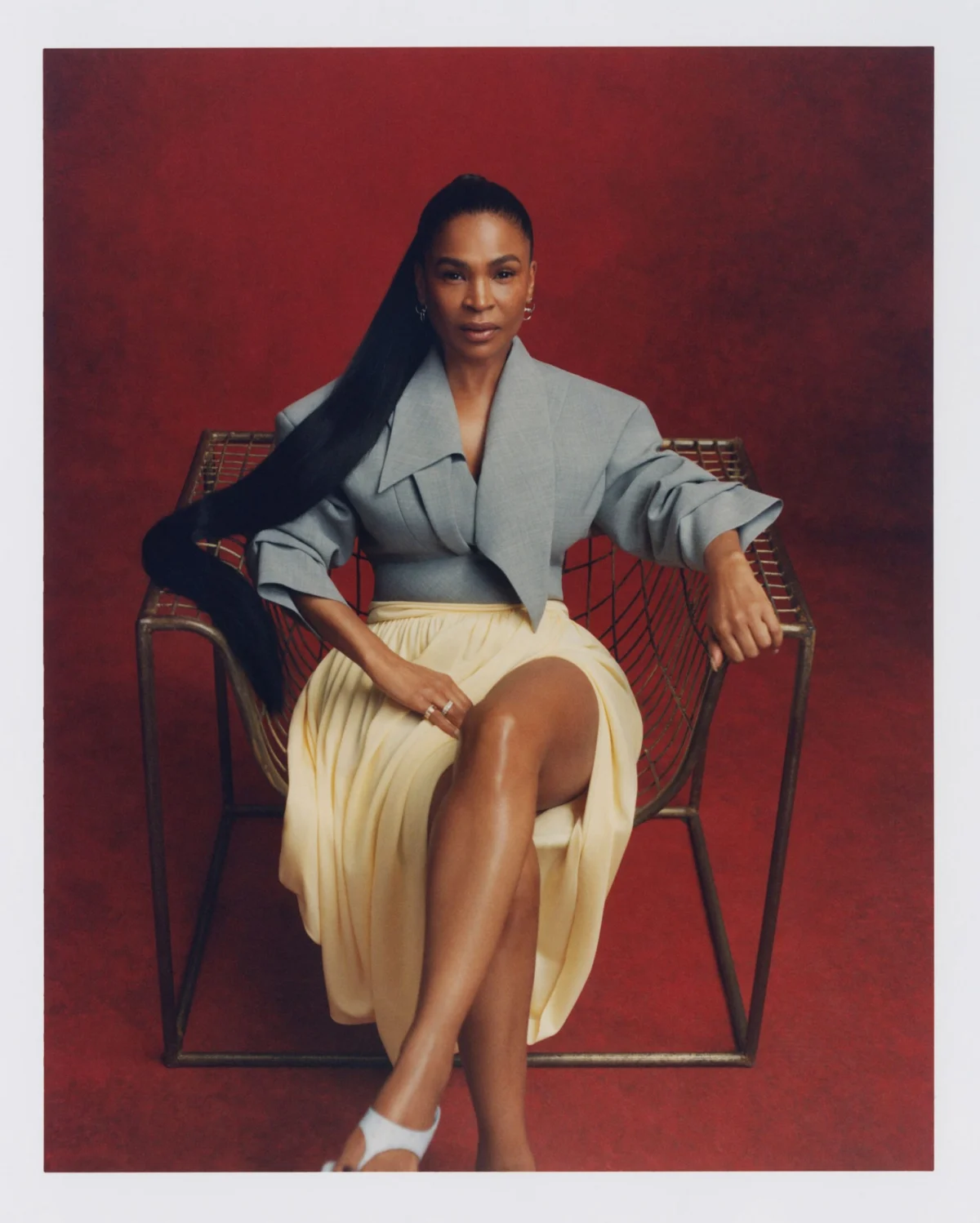
There is a specific, disorienting vertigo that accompanies exiting a darkened movie theater in the middle of a sun-drenched afternoon. The world outside feels hyper-real, yet jarringly loud—a stark departure from the curated reality you have inhabited for the previous two hours. The film still clings to you, a lingering scent or a phantom weight. It was in this state of cinematic transition that I met Nia Long for an early lunch at the Chateau Marmont, the historic Hollywood enclave where the line between art and reality frequently blurs.
I had just screened Michael, the upcoming Michael Jackson biopic, a month ahead of its April release. As I sat in a quiet corner of the hotel, my mind was still cycling through the film’s complex emotional topography. When Long arrived—dressed in an oversized blazer, wide-leg jeans, and a Miu Miu baseball cap pulled low—the sensation of "movie vertigo" only intensified. Watching her walk toward the table, I was struck by a strange, prismatic doubling effect: the woman before me and the woman I had just watched on screen, playing the Jackson family matriarch, Katherine Jackson, seemed to layer over one another like transparencies held up to the light.

The Art of the Unspoken: Portraying Katherine Jackson
In Michael, Long’s performance is defined by a profound, studied stillness. In her first appearance, as she observes her children rehearsing, the camera lingers on her face for several beats. She says nothing, yet she communicates everything. While her co-stars—Colman Domingo, playing the blustering Joe Jackson, and Jaafar Jackson, delivering an uncanny transformation as his late uncle—command the space with explosive energy, Long does something entirely different. She makes silence load-bearing.
"There have been moments in my life where I’ve been required to be more graceful than I’ve ever had to be in the past," Long explains, her voice dropping into a register of quiet intensity. "And that requires a sense of really being able to dig deep into some sort of self-examination. What do I stand for? What’s important to me, ultimately, regardless of Hollywood, the noise? Number one, for me personally, my children come before anything. And so I think when you look at Michael’s journey, and you look at Katherine’s journey, the only way you thrive and survive is through a tremendous amount of grace."

She pauses, reflecting on the weight of the word. "What I think I learned from her is that sometimes grace is really quiet."
A Career Defined by Cultural Iconography
Nia Long occupies a singular place in the American cultural imagination. For a specific generation, she is the definitive embodiment of "90s Fine"—a descriptor that transcends physical beauty to encapsulate a particular aura of grace, intelligence, and self-possession. Whether as Nina in Love Jones, Jordan in The Best Man, or Lisa in The Fresh Prince of Bel-Air, Long did not just play roles; she anchored them in a cultural consciousness that felt both aspirational and deeply relatable.

When I ask her about this legacy—the weight of being a symbol for so many—she remains grounded. "My commitment to work is not for accolades or attention, or even to be famous, quite honestly," she says. "But I do think because of my commitment to truth and purpose, there is a thing—and I don’t know what that thing is—that people see in my work. And it makes them feel good. It makes them feel inspired. It makes them feel like they know me."
In a notoriously fickle industry, particularly for Black women, Long’s longevity is a testament to both her talent and her tactical approach. She does not view her success as a given. "There are highs and lows," she admits. "I’m having a great year, but I don’t know what’s happening next year."

Strategy and Self-Preservation
While Long approaches her characters with a search for emotional truth, she approaches the "business" of show business with a pragmatic, almost clinical eye. "The only strategy I have in this game is my bank account," she says with a laugh. "Let’s strategize how we’re going to make money and create generational wealth. That is where I’m strategic."
This pragmatism, however, is balanced by an iron-clad commitment to her agency. "I work hard to make sure that when I represent us, it’s not just someone putting their agenda on me," she explains. "Whether it’s my hair, my makeup, my wardrobe, or my lines—I am the guardian of that image."

Implications: Navigating the Public and the Private
The conversation inevitably shifts toward the intersection of her personal life and the public’s perception of her. In 2022, Long navigated the intense scrutiny of a high-profile cheating scandal involving her former partner of 13 years. While many celebrities would retreat or offer carefully worded PR statements, Long has navigated the aftermath with an unflinching clarity.
"The amount of pouring into myself that I’ve done is strong and mighty and intentional," she says. "I’ve now identified the things that I need to work on and the things that I need to heal. But I have also identified what is intolerable."

Her advice for those facing similar public or private ruptures is surprisingly practical. She suggests writing down everything one feels without the intent to send it, noting that the goal is not to engage with the other person’s behavior, but to solidify one’s own bottom line. "I don’t think it’s healthy to hold onto things because then you’re just walking around with this burdensome energy," she says. "You don’t have to respond to the noise with the undercurrent of your own trauma."
The Future: Writing Her Own Narrative
Long is currently in the midst of writing her first memoir—a process she describes as "one of the biggest, bravest, and most challenging" things she has ever undertaken. The book serves as a vehicle for self-reckoning, taking her back to her childhood in Iowa City, where she first grappled with her identity as a Black girl in a predominantly white space.

"In writing this memoir, I realized the impact that experience had on my own view of beauty," she reveals. "And my own self-acceptance. I thought I was beautiful because my mother said it and my family said it, but the world told me something different." It is a profound irony, she notes, that she is now a global face for Estée Lauder, a brand that represents a standard of beauty she once struggled to see herself reflected in.
As she moves into this next phase of her life—as an "empty nester" with her youngest son entering his teenage years—she is looking to produce more, direct, and continue to tell stories that honor the "second act" of life. Her upcoming film, Don’t Ever Wonder, directed by Eugene Ashe, serves as a poignant exploration of this theme. "This is a continuation of love," she explains, "and of what happens once you’ve had your kids, they’re off to college, and you’re empty nesters. There’s a lot of funny and there’s a lot of heartbreak, and I think it’s a really honest story."
.jpg)
Conclusion: Defining Freedom
As our lunch concluded, I asked Long what freedom means to her at this stage in her life. She didn’t hesitate.
"Being able to do what you want to do when you want to do it, because it serves your spirit—not what everyone else thinks you need to be or should be," she says. She emphasizes that this freedom does not require a stage, nor does it require an audience. It is found in the quiet moments, like the evening she was planning to spend making a pizza with her son.
.jpg)
For Nia Long, the "Nineties Fine" icon has evolved into something more resilient and perhaps more radical: a woman who has stopped seeking permission. Whether she is commanding the screen in a period biopic or simply reclaiming her peace in her own kitchen, she is proof that grace, when practiced with intention, is the most powerful tool of all.
 Asro
Asro
 Suro Senen
 Azzam Bilal Chamdy
