

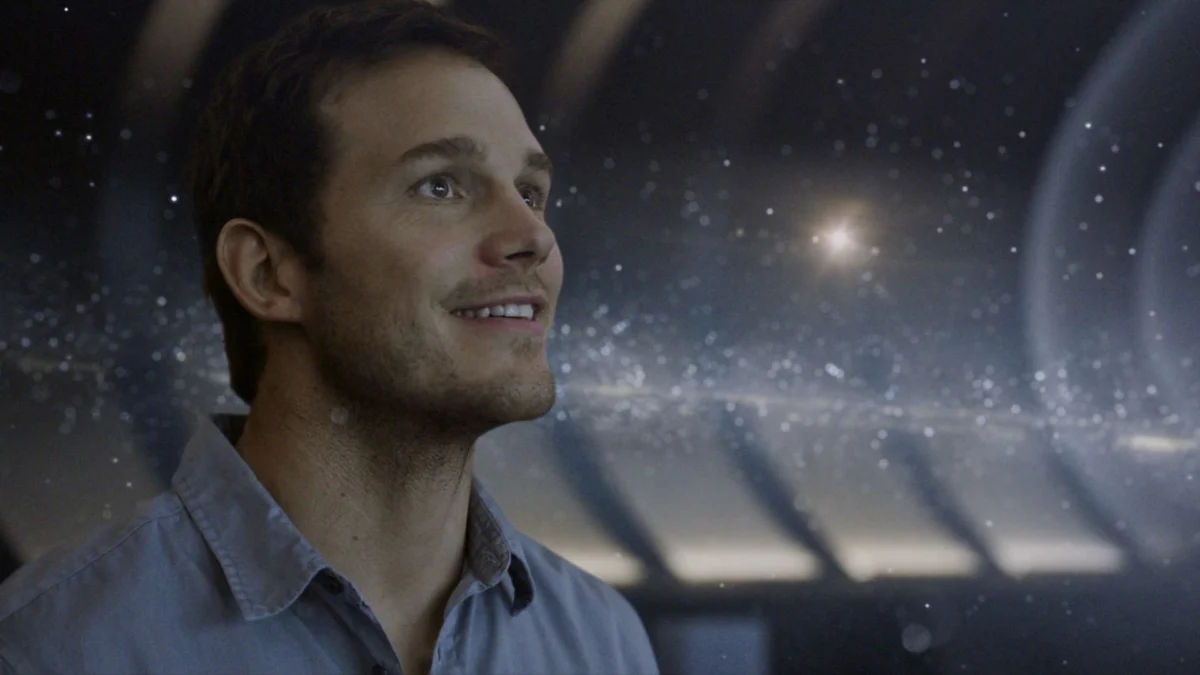
In the modern landscape of streaming, the popularity of a film is rarely a direct reflection of its critical reception. Nowhere is this more evident than with the 2016 science fiction romance Passengers, directed by Morten Tyldum. Despite being panned by critics upon its release for its deeply unsettling moral framework, the film has found a second life as a recurring powerhouse on Netflix’s global charts. As of June 2026, the film is once again dominating viewership metrics, proving that audiences remain morbidly fascinated by one of the most controversial "love stories" in recent cinematic history.
The Premise: A High-Concept Nightmare
The narrative of Passengers is built on a premise that is as intriguing as it is ethically repulsive. Set aboard the Avalon, an interstellar colony ship transporting 5,000 people to a new home on Homestead II, the story follows Jim Preston (Chris Pratt), a mechanical engineer. Due to a malfunction, Jim is prematurely awakened from cryo-sleep 90 years before the ship is scheduled to reach its destination.
Faced with the crushing isolation of an infinite void and the certainty of dying of old age long before the Avalon arrives, Jim descends into a desperate, nihilistic spiral. His trajectory shifts, however, when he encounters Aurora Lane (Jennifer Lawrence), a writer still in stasis. Driven by an unhinged cocktail of loneliness and desire, Jim makes the conscious, calculated decision to wake her up—effectively ending her life’s ambition and sentencing her to share his solitary confinement.
A Chronology of Controversy: From Development to Streaming Success
To understand why Passengers continues to capture public attention, one must look at the timeline of its troubled journey.
- 2007-2015: The Script’s "Black List" Era: Before it was a big-budget spectacle, the screenplay by Jon Spaihts was considered one of the best unproduced scripts in Hollywood, landing on the prestigious "Black List." At that stage, the story was darker and more cynical, focusing heavily on the moral bankruptcy of Jim’s choice.
- December 2016: The Theatrical Release: Upon its release, the film was marketed as a grand, sweeping space romance starring two of the world’s most bankable actors. The tonal disconnect between the marketing and the actual content—which features a man gaslighting a woman into a relationship after destroying her future—created an immediate backlash.
- 2017-2023: The Critical Re-evaluation: Critics and cultural essayists dismantled the film’s narrative arc. The comparison to Titanic in space was quickly replaced by comparisons to thrillers involving kidnapping and Stockholm syndrome.
- 2024-2026: The Streaming Renaissance: As Netflix algorithms favor high-concept "star power" vehicles, Passengers has repeatedly surged in the Top 10 lists, driven by a combination of curious new viewers and a dedicated "hate-watch" culture that views the film as a bizarre, unintentional psychological study.
Supporting Data: The "Star Power" vs. "Quality" Discrepancy
The success of Passengers on Netflix highlights a growing trend in digital media consumption: the "Star Power Floor." When a film features A-list talent like Pratt, Lawrence, Michael Sheen, and Laurence Fishburne, the "floor" for potential viewership is significantly higher than that of an indie film with a better script.

Data from third-party streaming trackers suggests that Passengers consistently overperforms in "Total Minutes Viewed" compared to its average user rating on platforms like IMDb or Letterboxd. This indicates that while audiences are actively choosing to press play, they are often finishing the film with a sense of cognitive dissonance. The visual fidelity of the ship’s design, the lush cinematography, and the chemistry between the leads are objectively high-budget, yet the narrative core is widely cited as the film’s "insulting" weak point.
The Ethical Debate: Is it a Romance or a Horror Film?
The primary point of contention surrounding Passengers—and the reason it remains a lightning rod for discourse—is the refusal of the screenplay to fully reckon with the horror of Jim’s actions.
The film attempts to frame Jim’s decision as a tragic necessity born of human frailty. However, the narrative trajectory in the second half pivots into a traditional "boy saves girl" rescue mission. This pivot is where many critics believe the film fails. By allowing the characters to reconcile through a series of generic space-faring heroics, the film implicitly excuses the initial act of kidnapping.
The "Stockholm Syndrome" Argument
Many film scholars have argued that Passengers functions more effectively as a psychological horror film than a romance. When viewed through the lens of the victim, Aurora’s realization of her fate is a moment of profound existential dread. The film’s inability to maintain the gravity of that moment—and its decision to have other male characters treat Jim’s choice as a "romantic" gesture—highlights a jarring disconnect between the filmmakers and their audience.
Official Responses and Industry Context
While Sony Pictures, the studio behind the production, has never issued a formal apology for the film’s moral ambiguity, the creative team has historically defended the concept as an exploration of "what people do when they are alone."

In various press junkets from 2016, director Morten Tyldum and lead actors Pratt and Lawrence frequently referred to the film as a "moral dilemma." However, the industry discourse has moved on. The film is now frequently cited in screenwriting seminars as a "cautionary tale" of how to write a protagonist that an audience simply cannot forgive, regardless of the star power attached to the role.
The Implications: Why We Can’t Look Away
Why does this "bad" movie keep winning on Netflix? The answer lies in its status as a "cultural curiosity."
- The "Train Wreck" Factor: There is an inherent human desire to witness a high-budget failure. Watching two of the most talented actors of their generation navigate a script that seems to fundamentally misunderstand its own premise is a form of entertainment in itself.
- The Aesthetic of Consumption: The Avalon is a gorgeous setting. For viewers looking for "background noise" that features high-end production design, Passengers provides an immersive, albeit frustrating, experience.
- The Gendered Lens: The film has become a touchstone for discussions regarding the "male gaze" in Hollywood. By analyzing why the film fails, critics and viewers alike have found a rich text for discussing how power dynamics and consent are handled in blockbuster cinema.
Conclusion: A Testament to Cinematic Persistence
Passengers will likely remain in the Netflix rotation for years to come. It serves as a reminder that the quality of a film’s script is not the only metric for its longevity. Its persistence is a testament to the fact that movies do not have to be "good" to be "important."
Whether you view it as an accidental horror movie, a failed romantic drama, or a fascinating social experiment, Passengers continues to demand attention. It remains a polarizing piece of pop culture that invites us to ask a difficult question: Can we enjoy a film that we fundamentally despise? If the current Netflix charts are any indication, the answer is a resounding, albeit conflicted, "yes."
 Nana Muazin
 Layla Zulfa
 Basiran
