

It is 1995, and the world feels flush with the optimism of a pre-digital dawn. Your stock portfolio is reaching new heights, and your garage, currently barren, is screaming for a centerpiece. You are faced with the quintessential dilemma of the mid-nineties high-roller: do you opt for the wide-hipped, turbocharged ferocity of the Porsche 993, or the rowdy, dramatic theater of a Lamborghini Diablo SV? For many, the answer was always the same—the Prancing Horse.
At the time, Ferrari was in the midst of a critical pivot. President Luca di Montezemolo, notoriously candid about the lackluster performance of the preceding 348, had staked the brand’s reputation on a radical new project: the F355. It was a revelation. With its exotic five-valve-per-cylinder V-8, peerless Italian styling, and a quantum leap in handling dynamics, the F355 didn’t just succeed; it reestablished Ferrari’s dominance as the builder of the world’s most desirable driver’s cars.
Three decades later, the F355 remains a beloved icon, though the relentless march of automotive technology has naturally seen it eclipsed by modern hypercars. Yet, in a world dominated by touchscreens, heavy hybrid batteries, and driver-aid intervention, a question persists: can the magic of the 90s be reclaimed? Enter Evoluto Automobili, a British firm determined to bridge the gap between nostalgia and modern-day reality.

The Genesis of Evoluto: A Quest for Analog Perfection
Evoluto Automobili does not simply restore cars; they treat the Ferrari F355 as a canvas for a total engineering overhaul. Much like Singer and Tuthill have redefined the Porsche 911 experience, Evoluto is applying a fresh vision to the Ferrari platform. The process is exhaustive: the client provides a donor car—which, according to Evoluto’s communications manager Rob Borrett, must be in structural health, “not burnt or bent”—and after nine months of meticulous labor and a $795,000 investment, they receive a machine that is fundamentally transformed.
The parent company, DRVN Automotive Group, brings substantial pedigree to this venture. With deep roots in aerospace engineering and tech, and serving as the official U.K. distributor for Koenigsegg, DRVN has the infrastructure to support high-end automotive manufacturing. The project was born from the frustration of chairman Darren McDermott, who, tired of the multi-year waiting lists associated with modern hypercar acquisitions, decided to build his own solution. By acquiring Penso, a high-performance engineering consultancy known for white-label projects like the Jaguar Project Seven, Evoluto gained the capability to execute their vision with OEM-level precision.
Chronology of a Transformation
The conversion process is a deep-tissue surgery for the vehicle. Every donor 355 is stripped to the bare chassis, dipped, cleaned, and reduced to its essential metal. From there, the team integrates ten distinct carbon-fiber structural reinforcements, a move that increases the chassis’s torsional stiffness by a staggering 23 percent.

Every exterior panel is replaced with custom carbon-fiber bodywork, subtly flared to provide a wider track and a more menacing, purposeful stance. The interior is entirely reimagined, discarding all original panels in favor of a bespoke cockpit swathed in premium leather and matte carbon fiber. Under the skin, the engine, transmission, and suspension are not just serviced—they are reimagined, balanced, and blueprinted. The result is a car that is 220 pounds lighter and 100 horsepower more potent than the original.
Design Philosophy: Ian Callum’s Touch
When modifying a car as aesthetically balanced as the F355, the margin for error is razor-thin. To navigate this, Evoluto enlisted the legendary Ian Callum, the man whose design language defined modern Aston Martin and Jaguar.
Callum’s approach was one of "subtle aggression." The original 355’s planar surfaces are replaced by carbon-fiber panels that honor the original silhouette while incorporating functional aerodynamic improvements. The side air intakes have been enlarged, not just for visual drama, but to improve airflow to the mid-mounted V-8. These intake modifications necessitated a redesign of the door mechanism—a small functional tradeoff that requires a deliberate touch—but the aesthetic result, particularly with the rear vents that pay homage to the iconic 288 GTO, is undeniable.

The interior is a sanctuary for the purist. There are no digital screens here, no invasive infotainment systems, and no complex menus. The only concession to the 21st century is a discreet mount for a smartphone, finished in carbon fiber and aluminum. The iconic gated shifter, the defining feature of the Ferrari experience, remains, though it is now topped with a unique, donut-shaped knob that offers a tactile, ergonomic delight for the driver.
Technical Specifications and Engineering Prowess
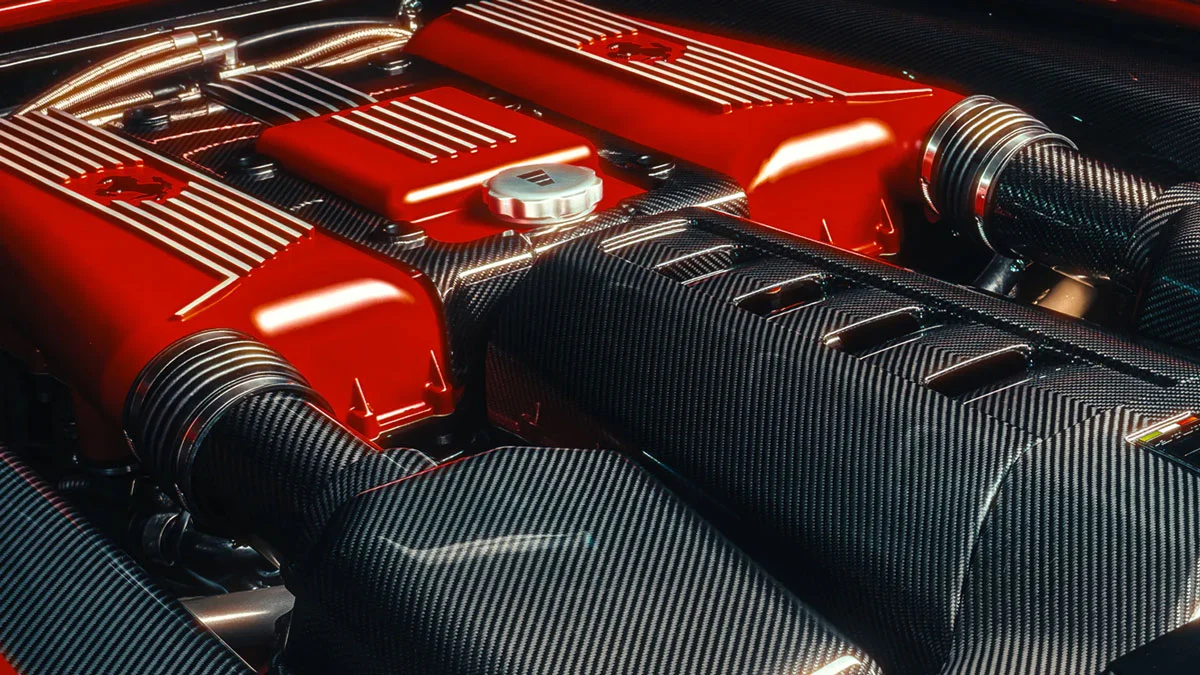
The heart of the Evoluto experience is its naturally aspirated 3.5-liter V-8. To extract an additional 100 horsepower—bringing the total to 420 hp—the engineering team scrutinized over 200 drivetrain components. Key upgrades include ported cylinder heads, a bespoke stainless-steel exhaust system, a lightweight flywheel, and titanium driveshafts. For those seeking even more, an optional 3.7-liter bore-up increases output to 473 hp, utilizing titanium connecting rods to handle the increased stress.
Perhaps the most significant change for the owner is the maintenance architecture. Ferrari’s original F355 service requirements were notorious for requiring the engine to be removed. Evoluto has mitigated this with a one-piece, aerospace-grade wiring harness, allowing for easier access and significantly reducing service downtime.

The suspension has undergone a complete geometry overhaul. The front track is widened by 77 mm and the rear by 66 mm, providing a much more planted feel during high-speed cornering. By partnering with suspension specialists R53, Evoluto has developed dampers that offer a compliant, modern ride without sacrificing the razor-sharp feedback of a track-focused machine. Combined with a new electrohydraulic steering system that operates at a quicker two turns, lock-to-lock, the car is transformed from a grand tourer into a precision instrument.
Performance: A New Lease on Life
Driving the 355 by Evoluto is, in the words of those who have tested it, like witnessing the original machine struck by lightning. On a technical road like Malibu’s Latigo Canyon, the car exhibits a level of agility that would embarrass many modern sports cars. It flickers through corners with a chassis balance that feels intuitive and communicative.
The engine note, echoing off canyon walls through the titanium exhaust, is nothing short of a symphony. Because the engine is tuned to breathe more freely, it pulls with a newfound urgency throughout the entire rev range, singing all the way to its 8,500 rpm redline. While the drilled pedals are spaced slightly wide for casual driving, they reward the skilled driver who practices perfect heel-toe downshifts.

Joe Richardson, a former F355 owner, notes that the original car, while brilliant, often felt hampered by its over-assisted, slow-ratio steering. "In the Evoluto, that disconnect is gone," Richardson explains. "The steering is sharp, the throttle response is immediate, and the connection between man and machine is as raw as you could ever want."
Official Perspectives and Future Implications
The existence of the 355 by Evoluto signifies a broader shift in the automotive world: the "Restomod Era." As modern cars become increasingly sanitized, insulated, and heavy, the market for "analog experiences" has reached a fever pitch.
Evoluto is not aiming to mass-produce these vehicles. They are limiting their production run to 55 coupes, ensuring that each example remains a rare, collectible piece of engineering. Once the coupe run is exhausted, the company plans to pivot to an open-air "Spider" model, further expanding the appeal of their platform.

"We aren’t just fixing old Ferraris," says CEO Ian Muir. "We are correcting the compromises that were made 30 years ago because of the manufacturing limitations of that era. We are giving the F355 the performance potential it always deserved."
The Verdict: Is It Worth It?
A total investment approaching or exceeding seven figures for a 30-year-old car platform is a significant financial decision. However, the value proposition of the Evoluto restomod lies in the experience. It is a screen-free, analog masterpiece that has been refined with the best materials and engineering techniques of the current day.
For the collector who wants the soul of a 1995 Ferrari but demands the reliability, structural rigidity, and performance of a 2026 supercar, there is effectively no alternative. The 355 by Evoluto is more than a restoration; it is a profound tribute to Maranello’s golden age, updated for those who refuse to compromise on the purity of the driving experience. In an age of autonomous driving and electric silence, Evoluto is keeping the fire of the internal combustion engine—and the romance of the analog sports car—very much alive.
 Evan Lee Salim
 Asep Darmawan
 Laily UPN
