

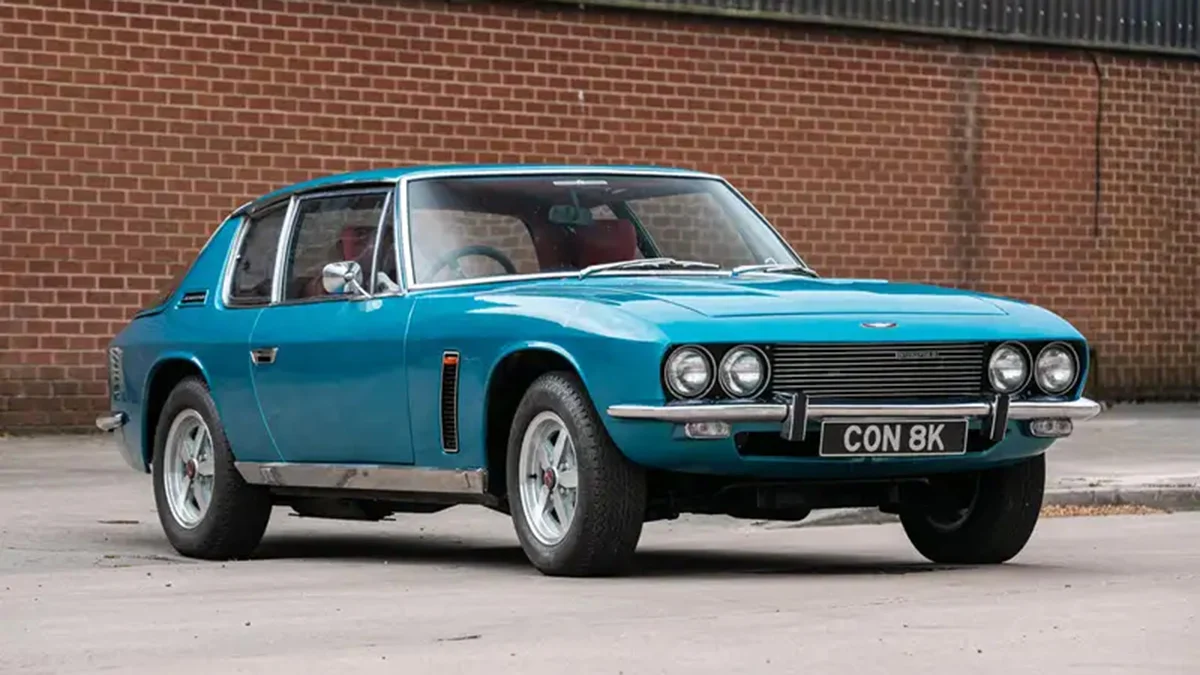
For collectors of rock ‘n’ roll memorabilia, the provenance of an object—the story of who touched it, drove it, or lived with it—often carries as much weight as the object itself. Next month, at the prestigious Iconic Sale held at the BRDC Classic at the Silverstone Circuit in Northamptonshire, England, one such artifact will cross the auction block: a 1972 Jensen Interceptor III that once belonged to none other than John Bonham, the legendary drummer of Led Zeppelin.
Often cited as the greatest drummer in the history of rock music, "Bonzo" was as synonymous with power and precision as the machine he chose to drive. The Jensen Interceptor, a grand tourer that serves as the closest British equivalent to a quintessential American muscle car, is a fitting mechanical reflection of the man who defined the rhythmic backbone of "Whole Lotta Love."
Main Facts: A British Icon with an American Heart
The Jensen Interceptor III, taking its place in the automotive pantheon as a sophisticated yet brutal grand tourer, represents a fascinating cross-pollination of cultures. First introduced in 1966, the Interceptor was an anomaly: an undeniably British design, handcrafted in West Bromwich, but powered by the unapologetic, high-displacement V-8 engines sourced from Chrysler in the United States.
Bonham’s specific vehicle is an H-Series model, finished in a striking Reef Blue exterior paired with a luxurious, soft crimson leather interior. Under the hood lies the 6.3-liter (383 cubic inch) Chrysler V-8 engine, which, in its prime, produced a formidable 330 horsepower and 410 ft-lbs of torque. This raw, low-end grunt is channeled to the rear wheels through the legendary three-speed TorqueFlite automatic transmission—a setup that prioritized effortless, high-speed cruising and tire-shredding torque over finesse.

While Jensen would eventually swap this 6.3-liter powerhouse for a larger 7.2-liter version later in 1972, Bonham’s specific unit remains a testament to the early, aggressive iteration of the Series III. The car is not merely a celebrity prop; it is a mechanical performance piece that captures the spirit of the early 1970s—a time of excess, volume, and unparalleled creative output in music.
Chronology: From the Rock Star’s Garage to Resurrection
The story of this Interceptor is one of both glamour and decay. John Bonham took delivery of the vehicle in March 1972, at the height of Led Zeppelin’s global dominance. Between recording sessions at Headley Grange and sold-out stadium tours that redefined the scope of rock concerts, Bonham utilized the car as his personal transport.
Following Bonham’s untimely death in 1980, the trail of the vehicle becomes somewhat obscured, as is common with celebrity-owned assets that pass through private collections. However, by the time it was rediscovered in 2020, the car had suffered the indignity of neglect, residing in what is best described as "barn find" condition. It was a shell of its former glory, requiring significant mechanical and aesthetic intervention to be returned to the road.
The current owner, recognizing the historical significance of the chassis, embarked on a comprehensive, no-expense-spared restoration. Over the course of three years, approximately £83,000 ($110,000 USD) was poured into the vehicle. The restoration effort was a collaborative masterpiece, featuring work from experts at Martin Robey, Prestige Panels, and Riverbourne Classics. The result is a car that appears to have been teleported directly from 1972. Every inch of the leather, the depth of the Reef Blue paint, and the integrity of the Chrysler V-8 have been meticulously addressed to ensure the vehicle functions as it did when Bonham first gripped the steering wheel.

Supporting Data: The Anatomy of the Jensen Interceptor
To understand why this car is an investment-grade asset, one must look at the technical pedigree of the Jensen Interceptor. The design, penned by the Italian studio Carrozzeria Touring, featured a distinctive wrap-around rear window that gave the coupe a "fastback" silhouette. It was a car for the gentleman racer, designed to traverse the English countryside or the autobahns of Europe at triple-digit speeds with total composure.
Performance Specifications:
- Engine: 6.3-liter Chrysler V-8 (383 cu in)
- Transmission: 3-speed TorqueFlite Automatic
- Horsepower: 330 hp @ 4,600 rpm
- Torque: 410 lb-ft @ 2,800 rpm
- 0-60 mph: Approximately 7.5 seconds (impressive for a 1972 grand tourer)
- Top Speed: 135 mph
While the car struggled to compete in sales volume against the Ford Mustang or the Dodge Charger in the North American market, it cultivated a fiercely loyal cult following among those who appreciated the blend of British coachwork and American reliability. The Interceptor is widely considered the "thinking man’s muscle car," a vehicle that offers the refinement of a luxury lounge with the engine note of a drag racer.
Official Responses and Auction Expectations
Iconic Auctioneers, the firm managing the sale at the Silverstone Circuit on July 25, has framed this lot as one of the highlights of the season. "It is rare that we see a vehicle with such a direct link to a cultural icon of Bonham’s stature," a spokesperson for the auction house noted. "The fact that it has been restored to such a high standard, with full documentation of its provenance, elevates it beyond a mere classic car purchase. This is an investment in music history."

The auction house has set an initial estimate upward of $67,000. However, industry analysts suggest that this figure may be conservative. When factoring in the "Bonham premium"—the added value derived from the musician’s celebrity status—combined with the $110,000 spent on the restoration, it is highly probable that the final hammer price will far exceed the estimate. Auctions involving items associated with Led Zeppelin have historically seen intense bidding wars, and this Jensen represents a rare, tangible asset that offers both historical and functional value.
Implications: The Legacy of the Drummer and His Machine
The sale of this Jensen Interceptor invites us to reflect on the relationship between rock stars and their machines. In the 1970s, the car was the ultimate extension of a performer’s persona. For John Bonham, whose drumming style was characterized by a heavy foot and an explosive dynamic range, the Jensen Interceptor was a natural companion. It was loud, it was powerful, and it possessed an undeniable "cool" factor that transcended the standard automotive market.
The preservation of this vehicle serves as a bridge to a bygone era. As we move further away from the golden age of analog rock and internal combustion, the value of these machines increases. They are no longer just modes of transportation; they are museum pieces that capture the vibration of a time when rock music was the most dangerous and exciting thing on the planet.
For the successful bidder, this car will represent more than just a means to get from point A to point B. It is a piece of the Led Zeppelin mythos—a vessel that once carried the man who laid down the beat for "When the Levee Breaks." Whether it ends up in a climate-controlled gallery or on the open road, the Jensen Interceptor III remains a powerful, snarling testament to one of the most influential musicians to ever step behind a drum kit.

As the auction approaches, the automotive and music worlds will be watching the Silverstone Circuit closely. When the gavel drops on July 25, it will not just be the sale of a vintage car; it will be the final transfer of a piece of rock ‘n’ roll soul, ensuring that John Bonham’s legacy continues to roll on, thunderously, for another generation.
 Evan Lee Salim
 Asep Darmawan
 Laily UPN
