

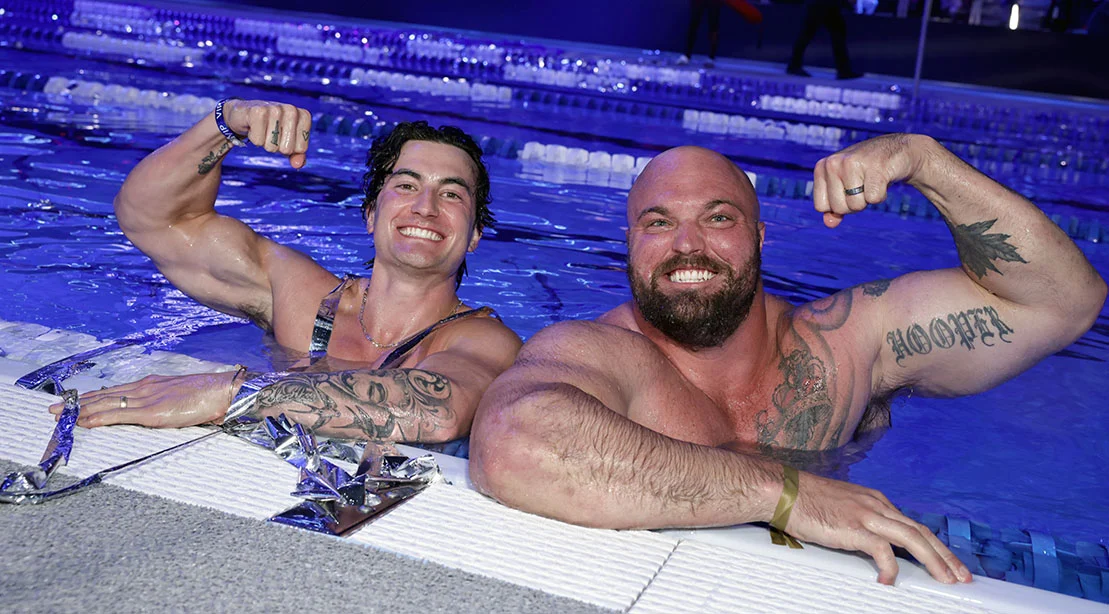
To the casual observer, Mitchell Hooper is an avatar of raw, primal power. Known to millions as “The Moose,” the reigning World’s Strongest Man occupies a space in the athletic landscape that seems to defy the laws of human physiology. He moves monumental weights—tires, stones, and steel—with a mechanical precision that makes the impossible appear routine. Yet, to define Hooper solely by his capacity to lift is to overlook the most compelling aspect of his career: his evolution from an insecure, multi-sport enthusiast into one of the most thoughtful, transparent, and philosophically grounded figures in modern strength sports.
The Unlikely Ascent: From Marathoner to Strongman
Long before he stood at the summit of the strongman world, Hooper’s athletic trajectory was anything but linear. He was a curious, restless athlete, cycling through disciplines that couldn’t be more distinct from the brute force of professional strongman competition. He tried his hand at golf, endured the grueling rhythm of marathon running, and explored the tactical demands of football and various endurance sports.
None of these pursuits signaled that he would one day dominate the pinnacle of international strength athletics. In fact, for a young Hooper, the idea of being a world-class athlete felt like a fantasy. While his peers often projected visions of NFL or NHL glory, Hooper remained grounded in a self-awareness that bordered on skepticism. Looking back at his younger self—specifically between the ages of five and ten—he notes that he would be the most shocked by his own trajectory. He didn’t grow up believing in his own destiny; he grew up battling the internal friction of self-doubt.
The Shadow of Insecurity: A Vulnerable Champion
The most jarring revelation in Hooper’s narrative is his candid admission of the insecurities that defined his adolescence. While he now carries the mantle of the world’s strongest man, the teenage Hooper was consumed by weight struggles, social anxiety, and debilitating panic attacks. He recalls the routine of wearing hoodies to school—not for the aesthetic, but to conceal the excessive sweating brought on by the anxiety of one-on-one social interactions.
“Being fat,” he admits without hesitation when asked about his greatest moments of self-doubt. This admission acts as an olive branch to a silent demographic: men who struggle with mental health in isolation. By refusing to paint a picture of a “cured” athlete, Hooper distinguishes himself from the typical sports influencer. He does not claim to have reached a finish line of mental wellness; rather, he frames his life as a continuous act of putting one foot in front of the other. He acknowledges that talking about his struggle does not inherently provide him relief, but he views it as a moral imperative to help those who feel equally isolated.
Fatherhood and the Redefinition of Strength
As Father’s Day approaches, Hooper’s reflections on his role as a parent have added a new, poignant layer to his public persona. In recent discussions, including those with fitness creator Jesse James West, Hooper dismantled the romanticized notion of early parenthood. He speaks openly about the “un-fun” reality of the first six months, where the demands of the newborn and the exhaustion of the mother can leave a father feeling redundant or “less useful.”
This shift in responsibility has fundamentally altered his definition of success. For a professional strongman, the metric is usually weight on a bar or a podium finish. For a father, it is the quiet, consistent act of providing and protecting. “Change the diapers,” he advises, emphasizing that in those early, chaotic months, the most significant contribution a father can make is the labor that goes unnoticed. This philosophy—which he calls “Dad Strong”—transcends the gym. It is about showing up consistently and carrying the weight of a dependent life, an anxiety that is far more profound than any competition pressure.
The Enhanced Games: A Data-Driven Experiment
Hooper’s recent participation in the Enhanced Games has sparked significant debate, but his involvement is rooted in a desire for empirical study rather than mere controversy. He views the project through two primary lenses: the study of medically supervised performance enhancement and the challenge of conventional wisdom regarding the aging athlete.
During the event, Hooper observed that many athletes were nearing their personal bests well past the traditional “peak” age of 30. To him, this suggests that human performance potential is significantly broader than modern sports science has traditionally dared to admit. Furthermore, he emphasizes that the event proceeded without the catastrophic injuries critics had prophesied. For Hooper, the conversation should shift from moralizing to data collection, prioritizing outcomes over emotional reactions.
The 505kg Attempt: A Victory of Perspective
The viral footage of Hooper’s near-miss 505kg deadlift at the Enhanced Games is often misinterpreted by fans as a failure. However, the context of the attempt tells a story of professional sacrifice. Following a relentless schedule that included victories at the Rogue Invitational, the Arnold Strongman Classic, and the World’s Strongest Man, Hooper was operating on the brink of physical collapse.
In the lead-up to the Enhanced Games, he was managing severe back pain and could barely perform basic movements. The fact that he managed to pull the bar from the floor at all was, in his estimation, a triumph of the nervous system. This speaks to the hidden reality of elite strength sports: the crushing weight of systemic fatigue that lingers long after muscles have ostensibly recovered.
Strategic Restraint: The Science of Longevity
One of the most telling insights into Hooper’s mindset is his strategic use—and, more importantly, his strategic avoidance—of performance-enhancing equipment. While he is a proponent of the Airwaav performance mouthpiece, which can reduce respiratory rates and enhance power, he famously opted against using it for his maximum deadlift attempt at the Enhanced Games.
Understanding the mechanics of the lift, he knew that the increased rate of force production provided by the mouthpiece could potentially trigger an injury. He wasn’t looking to “yank” the bar; he was looking for a controlled, sustainable lift. This decision is a hallmark of his maturity. He is not interested in one-off record attempts if they come at the cost of his long-term health, his ability to provide for his family, or his career longevity.
A Balanced View on Health and Genetics
Hooper’s approach to performance-enhancing substances (PEDs) is equally nuanced. He rejects the singular focus on PEDs as the ultimate health threat to athletes, arguing that it is a lazy, narrow lens through which to view human physiology.
He points to his own life: “The number one thing people should be concerned about is my genetics. My dad and his parents both had cardiac events in their 50s.” For Hooper, his body weight, cardiovascular volume, and genetic predisposition are far greater threats than the substances often debated in the media. He advocates for an “honest health conversation” that accounts for the totality of an athlete’s lifestyle rather than isolating a single, controversial variable.
Implications: The Legacy of a Thinking Champion
Mitchell Hooper’s legacy is shaping up to be far more than a collection of trophies. By bridging the gap between elite performance and human vulnerability, he is challenging the archetype of the “strongman.” He is showing that it is possible to chase the limits of human strength while simultaneously acknowledging the fragility of the mind and the body.
Whether he is discussing the intricacies of deadlift biomechanics or the quiet exhaustion of changing a diaper, Hooper remains consistent in his message: perfection is a myth, but progress—defined by integrity, data, and persistence—is the only goal worth pursuing. As he continues to navigate the complexities of his sport and his life, he serves as a reminder that the strongest men are not those who never fall, but those who continue to carry the weight of their own humanity with grace.
 Lina Hope
 rifanmuazin
 Laily UPN
