

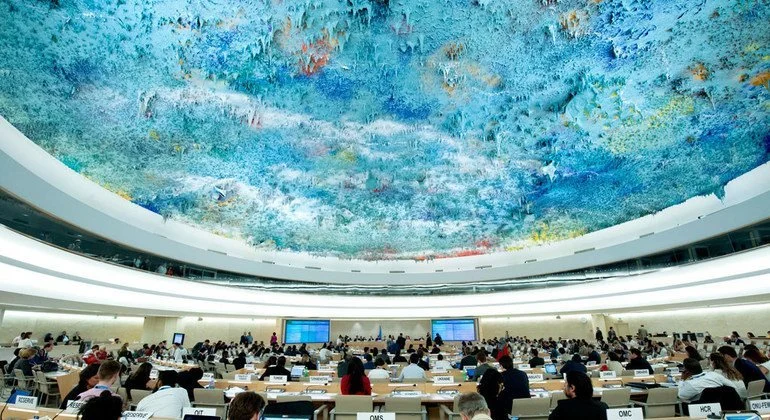
As the United Nations Human Rights Council (HRC) marks its 20th anniversary this year, the global landscape remains as volatile and challenging as it was at the institution’s inception in 2006. Conceived as a more robust, credible replacement for the defunct Commission on Human Rights, the Council was designed to transcend the "political point-scoring" that paralyzed its predecessor. Today, as it holds its 62nd session in Geneva, the Council finds itself at a critical juncture: navigating an era of flagrant human rights violations while grappling with a systemic funding crisis that threatens its operational capacity.
The Genesis: A Mandate for Reform
The birth of the Council on June 19, 2006, was born of necessity. Then-Secretary-General Kofi Annan, in a landmark address, urged the 47 Member States to eschew the "petty manoeuvres" that had eroded the authority of the previous Commission. Luis Alfonso de Alba Góngora, the Council’s inaugural president, recalls the birth of the body as a period of intense geopolitical friction.
"Building the Council was not an easy task," Góngora reflects. "Member States held radically different views on what should be preserved from the old Commission and what needed to be discarded. The international environment was hostile; there were significant powers that opposed the creation of the Council entirely."
Despite these early hurdles, the HRC was elevated to a subsidiary body of the UN General Assembly, granting it a higher institutional status than its predecessor. The goal was simple but ambitious: to create a forum where accountability, dialogue, and action could flourish, even when political consensus remained elusive.
Chronology: Two Decades of Evolution
- 2006: The Human Rights Council is established by General Assembly Resolution 60/251, replacing the Commission on Human Rights.
- 2008: The Universal Periodic Review (UPR) mechanism is fully operationalized, ensuring every UN Member State faces human rights scrutiny every four and a half years.
- 2011: The Council responds to the Arab Spring, establishing Commissions of Inquiry into the situations in Syria and Libya, demonstrating its capacity for rapid mobilization.
- 2016: The Council marks its 10th anniversary, facing continued scrutiny regarding the selectivity of its focus, particularly concerning the Israeli-Palestinian conflict.
- 2020: The COVID-19 pandemic forces the Council to adopt virtual and hybrid working methods, testing its ability to remain effective during global lockdowns.
- 2024: As it turns 20, the Council addresses an unprecedented number of concurrent crises, including conflicts in Gaza, Ukraine, and Sudan, while facing severe budgetary constraints.
A Multifaceted Approach to Accountability
The Council’s architecture is built on the principle that every voice counts. This inclusive model is perhaps its most significant departure from traditional diplomatic bodies. By integrating non-governmental organizations (NGOs), civil society activists, independent investigators, and victims themselves into its formal sessions, the Council ensures that the reality of human rights abuses is not filtered solely through state-sanctioned lenses.
High Commissioner for Human Rights Volker Türk emphasizes this inclusive mandate: "I have been to many interactive panels that involve children, young people, survivors, and victims. That is a model of participation that the UN must stand for—and it is one we need to extend even further."
This inclusivity is bolstered by the work of approximately 50 Special Rapporteurs. These independent experts serve as the "frontline" of the UN’s human rights apparatus. Farida Shaheed, Special Rapporteur on the right to education, notes the discomfort this often causes for member states. "We speak when others fall silent," she explains. "We bring to the table issues that are not always discussed, and frankly, people do not always like what we have to say."
Supporting Data: The Mechanism of Action
The HRC’s output is staggering in its volume. During its three annual sessions, the Council considers dozens of resolutions ranging from thematic issues—such as the right to a clean, healthy, and sustainable environment—to specific country-focused mandates in nations like South Sudan and Ukraine.
The "Considered Approach" involves a rigorous, often grueling process of informal negotiations. Observers frequently witness "caffeine-starved" delegates dashing out of the iconic Room XX in Geneva to conduct hushed-room negotiations. While many resolutions are adopted without a vote, the mechanism of the vote serves as a vital barometer for international consensus—or the lack thereof—on critical human rights crises.
Crucially, the UPR mechanism serves as the Council’s bedrock. By subjecting every UN member to a peer-review process, the Council forces states to engage in a formal dialogue regarding their own human rights records. While critics often highlight the Council’s perceived bias, proponents argue that the UPR creates a unique, institutionalized pressure that few other international bodies can replicate.
Official Responses and the "Existential" Funding Crunch
Despite its success as a forum for dialogue, the Council is currently facing an existential threat: a severe UN-wide funding crisis. This is not merely a bureaucratic inconvenience; it is a structural barrier to the Council’s mandate.
As the UN budget shrinks, the Council has been forced to reduce interpretation services and limit the time delegates have to speak. Independent experts have reported that they are being forced to "rationalize" their workload, which effectively means fewer investigations and less oversight in areas where rights are most under siege.
Deputy High Commissioner for Human Rights Awa Dabo has issued a sobering reminder of what is at stake. "Human rights were built for moments like this—when rights have come under pressure, when people need protection, and when principles must turn into action," she stated. However, she acknowledged that without adequate funding, the "action" part of that equation becomes increasingly difficult to fulfill.
Implications: The Road Ahead
As the Council moves into its third decade, the implications of its performance are clear. It remains an indispensable stage for the unheard, yet it is trapped between the lofty expectations of the international community and the cold reality of geopolitical polarization and financial austerity.
The "heady days" of 2006, as described by veteran diplomats like the UK’s Bob Last, were defined by a sense of possibility. Today, the mood is more tempered. The Council is no longer a "new" institution; it is a battle-hardened one. It has survived the erosion of multilateralism, the rise of populist nationalism, and the constraints of a global pandemic.
However, the criticisms regarding selectivity and political bias persist. To remain relevant, the Council must demonstrate that its mechanisms—from its Special Rapporteurs to its UPR process—are applied with consistency, regardless of the political weight of the nation under review.
Conclusion: An Indispensable Forum
Reflecting on the journey from the inaugural 2006 session to the present, communications official Rolando Gomez offers a pragmatic assessment: "While it has faced its share of challenges and controversies, it has become an indispensable forum for dialogue, accountability, and action on human rights issues worldwide."
The Council’s ability to survive for 20 years in an increasingly fragmented world is a testament to the enduring necessity of a global human rights watchdog. Whether it can evolve to meet the challenges of the next 20 years—particularly regarding digital rights, climate-induced migration, and the shifting power dynamics of the Global South—will depend on whether Member States view it as a tool for collective progress or merely a platform for national interest.
As UN Secretary-General António Guterres aptly noted during the anniversary event, human rights are currently under "flagrant" assault. The Human Rights Council, for all its flaws, remains the only international stage where these assaults are systematically documented, debated, and challenged. The next chapter of its history will be defined by whether the international community chooses to invest in this mechanism or allow it to be weakened by the very forces of division it was created to counter.
 Asro
Asro
 Layla Zulfa
