

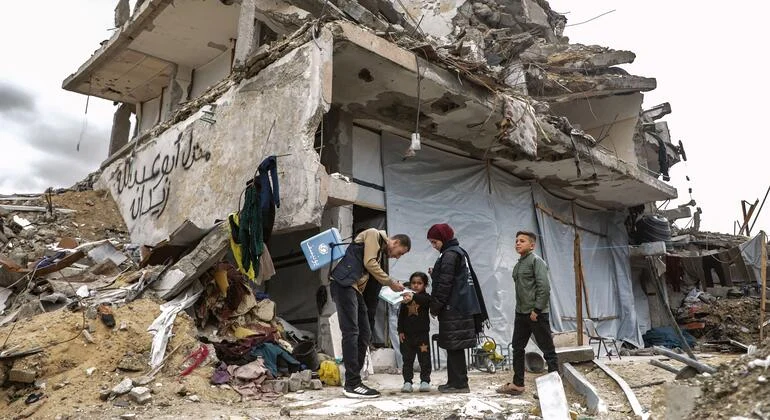
The humanitarian catastrophe in the Gaza Strip has reached a harrowing new milestone, with international observers and UN agencies warning that the safety of civilians—particularly children—has effectively evaporated. UNICEF spokesperson James Elder, speaking from Amman during a recent briefing in Geneva, painted a grim picture of a region where the mere act of existence has become a death sentence. “During a period supposedly defined by restraint and protection, a child has been killed, on average, every single day for more than eight months,” Elder stated. “That is an absurd and devastating figure.”
As the conflict, which erupted in October 2023 following Hamas-led attacks on Israel, continues to grind through the urban landscape of the Gaza Strip, the distinction between active combat zones and civilian life has vanished. According to UN officials, children are not falling in the crossfire of front-line battles; they are being killed in their homes, in schools, and while attempting to carry out the most mundane activities, such as playing football or fishing.
The Normalization of Violence: “Sneeze and You Might Get Shot”
The chilling reality of life in Gaza, as described by Elder, is governed by shifting, opaque boundaries defined by the Israeli military. Referred to as the “Orange Line” and the “Yellow Line,” these moving zones of occupation create a volatile environment where the civilian population is perpetually at risk.
“You sneeze near the Orange Line and you may well get shot,” Elder remarked, highlighting the “continual creeping” of these boundaries. This volatility, coupled with what the UN describes as an “utter lack of accountability,” has facilitated a climate where the vast majority of child fatalities—upwards of 90 percent—are attributed to actions by Israeli forces. These deaths are not solely the result of heavy artillery; they are the consequence of targeted strikes, bombings, and the use of quadcopter drones that haunt the skies above residential neighborhoods.
A Chronology of Sustained Crisis
The current hostilities began in October 2023, following the Hamas-led terror attacks on Israel. What was initially framed as a military campaign to dismantle Hamas infrastructure has evolved into a protracted conflict that has displaced nearly 1.9 million people—the vast majority of Gaza’s population.
The Phases of the Conflict:
- Initial Escalation (October 2023): The conflict triggered a total blockade of the enclave, leading to an immediate collapse of essential services.
- The Humanitarian Vacuum (Winter 2023–Spring 2024): As the intensity of the air and ground campaigns increased, the healthcare system effectively disintegrated. The World Health Organization (WHO) has confirmed that not a single hospital in Gaza remains fully operational.
- The Current Phase (Mid-2024): Despite brief periods of relative lull or declared ceasefires, the mortality rate among children has remained consistent. The shift in the conflict has moved from large-scale military maneuvers to localized, high-risk interactions near the “Orange” and “Yellow” lines of control.
Supporting Data: The Anatomy of a Collapse
The statistics provided by UN agencies, including UNICEF and OCHA (the Office for the Coordination of Humanitarian Affairs), serve as a cold indictment of the current situation.
- Child Mortality: For over eight months, one child has been killed daily on average.
- Displacement: 1.9 million people are currently displaced, with 1.2 million having lost their homes entirely.
- Infrastructure: No fully operational hospitals remain.
- Water Scarcity: 1.1 million children face daily uncertainty regarding access to clean water.
- Aid Access: While UN emergency relief chief Tom Fletcher noted that denial rates for aid missions into Gaza have dropped from 31 percent to 11 percent, the qualitative impact of this aid remains insufficient.
The lack of basic necessities is not merely a logistical failure; it is a systemic dismantling of the components of life. Parents are forced to watch their children suffer from skin conditions and other illnesses, unable to provide even the most basic sanitation because of the denial of clean water. “I talk to mothers who have children screaming because they don’t have the clean water to wash,” Elder said. “Imagine a parent unable to fix that night after night.”
The Politics of Denial: Aid and Infrastructure
Even when aid is permitted to enter the enclave, the Israeli authorities impose strict limitations on the types of materials allowed. While fuel has trickled in, the refusal to allow essential spare parts for power generators and water purification systems renders the aid largely ineffective.
Jens Laerke of OCHA highlighted the secondary crisis created by this denial: the accumulation of solid waste. Without the necessary machinery to manage waste, Gaza is becoming a breeding ground for disease. “We’ve all heard the stories about the rats, the insects, and so on and so forth,” Laerke said. “There is an opportunity to get rid of all that, but we are not getting the access.”
This administrative strangulation of infrastructure ensures that even those who survive the direct violence are subjected to a slow, agonizing degradation of health and dignity.
Regional Implications: The Spillover into Lebanon
The violence is no longer confined to the Gaza Strip. The recent surge in hostilities in southern Lebanon, where at least 18 people were reported killed in Israeli airstrikes targeting Hezbollah fighters, has drawn sharp condemnation from the UN.
The humanitarian logic remains the same across borders: the speed at which damage is inflicted far outpaces the capacity to repair it. “It is infinitely easier and faster to hurt people and inflict damage than it is to restore people’s livelihoods,” Laerke noted. He warned that every day of intensified warfare translates into months, if not years, of future humanitarian recovery operations. The risk of a wider regional conflagration remains high, threatening to expand the psychological and physical toll that has already traumatized over 770,000 children in Gaza.
Official Responses and the Quest for Accountability
The international community, represented by the UN Security Council, remains caught in a cycle of reporting and condemnation. While aid access figures have shown slight, incremental improvements, the broader picture remains one of systematic deprivation.
The primary critique leveled by UNICEF and other agencies is the profound lack of accountability for the military actions resulting in civilian deaths. The UN argues that the “scale of human suffering” in Gaza is currently without modern precedent. The repeated exposure to violence, the loss of family members, and the constant threat of displacement have created a generation of children experiencing severe, long-term psychological distress.
Conclusion: A Moral Failure
The situation in Gaza stands as a stark reminder of the limits of international humanitarian law when faced with a lack of political will. The “creeping” boundaries, the denial of spare parts for essential infrastructure, and the daily tally of child fatalities constitute a humanitarian crisis that UN officials describe as “almost beyond comparison.”
As long as the conflict persists, the children of Gaza remain in a state of suspended animation, waiting for a safety that never arrives. With no functional hospitals, inadequate water, and a military presence that demands total subservience to shifting, arbitrary lines, the prospect for recovery is dim. The consensus among aid workers on the ground is clear: until there is a fundamental shift in access, accountability, and the cessation of hostilities, the “devastating” cycle of death will continue to define the lives of the most vulnerable.
 Asro
Asro
 Layla Zulfa
