

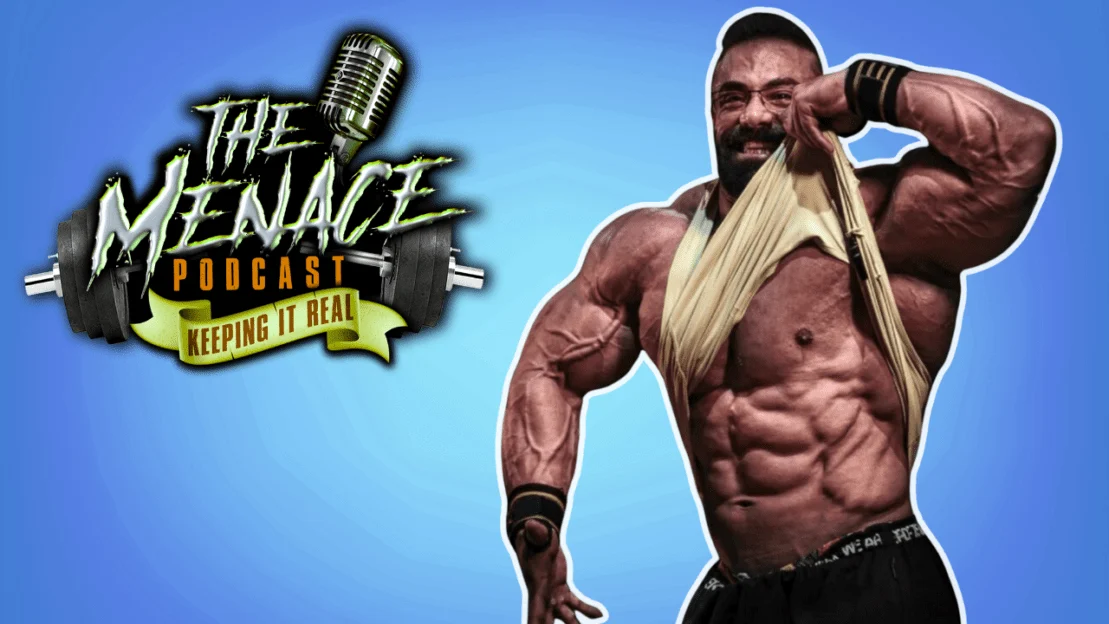
In the high-stakes world of professional bodybuilding, where mass, conditioning, and symmetry are often discussed in the same breath, one of the sport’s most iconic figures is offering a sobering revisionist history of his own storied career. Dennis “The Menace” James, a titan who spanned three decades of competitive excellence, recently opened up on Episode 289 of The Menace Podcast. Joined by industry stalwarts Jose Raymond and legendary trainer Milos Sarcev, James shared a candid assessment of what he would do differently if he could return to the height of his competitive powers.
His conclusion was both simple and profound: he would trade the obsessive pursuit of pure, raw size for the refined, performative mastery of posing. For a man who graced the Mr. Olympia stage ten times and cracked the top five in 2003, this admission serves as a powerful testament to the often-overlooked psychological and technical rigors of stage presentation.
A Legacy Forged in Iron: The Chronology of “The Menace”
To understand why James’s advice carries such weight, one must look at the timeline of his illustrious journey. Dennis James did not just compete; he survived and thrived through three distinct eras of bodybuilding evolution.
The 1990s: The Rise of a Global Contender
James first made his mark in the 90s, capturing the Mr. Universe title—a prestigious accolade that served as a springboard for his professional entry. During this period, the sport was transitioning from the aesthetic-heavy leanings of the late 80s toward the “mass monster” era that would define the turn of the millennium. James was at the forefront of this shift, possessing a frame that could carry immense muscularity without sacrificing the structural integrity required for high-level competition.
The 2000s: The Golden Era of Competition
The 2000s saw James at his absolute zenith. He became a staple of the Olympia stage, consistently placing among the world’s elite. His victory at the Europa Super Show cemented his reputation as a competitor who could hold his own against the sport’s greatest legends, including Ronnie Coleman, Jay Cutler, and Dexter Jackson. During this decade, he competed in the Mr. Olympia contest with a frequency that few modern athletes can replicate, demonstrating a durability and work ethic that defined his moniker, “The Menace.”
2010–2012: The Final Chapters
As the sport shifted into the 2010s, James remained a relevant force. His return to the Masters Mr. Olympia stage in 2012 was a victory lap for a career that had already left an indelible mark on the industry. Throughout these three decades, he developed a reputation for being one of the hardest workers in the gym, often known for brutal, high-volume sessions that pushed the limits of human endurance.
The Pivot: Why Size Isn’t Everything
During the candid conversation on his podcast, James addressed the elephant in the room: the singular focus on muscle volume. Reflecting on his training regimen, he noted that he would often spend hours on cardiovascular conditioning—a necessary evil for fat loss—at the expense of the one thing that actually separates a winner from the runner-up on stage: the pose.
“If I could change, if I could turn back the time, I would f*****g pose,” James admitted to his panel. He detailed a specific structural change he would make to his daily preparation: shifting from two hours of dedicated cardio to one hour of cardio and one hour of intense, focused posing.
The rationale is clear: judges do not judge the athlete in the gym. They do not ask how much weight was moved on a decline bench press or how many reps were performed on a leg extension machine. They judge the athlete under the harsh glare of the stage lights, where the ability to manipulate muscle groups and hold a pose is the only thing that matters.
The Psychology of Presentation: Lessons from the Pros
James recalled his time training under the tutelage of the “Mind behind the muscle,” Milos Sarcev. In those days, the exhaustion following a Sarcev-style “Giant Set” workout left James depleted, often leading him to skip the posing portion of his training. He viewed it as a chore, a secondary task that took away from the recovery time he desperately needed.
However, looking back, he points to contemporaries like Melvin Anthony as the standard-bearers of stage presentation. Anthony, famous for his fluid, artistic, and impeccable stage presence, treated his body like a sculptor treats clay. “He couldn’t keep his shirt on long enough,” James recalled. “But you could see, on stage, he held his s**t, and it was always perfect.”
For James, the lesson is that posing is not just a display of muscle; it is a display of control. It is an act of defiance against fatigue. When an athlete has pushed their body to the brink of physiological exhaustion during a contest prep, the ability to maintain composure, contract muscles at the perfect angle, and hide weaknesses is what earns the Sandow trophy.
The Expert Consensus: Milos Sarcev’s Perspective
Milos Sarcev, who is widely regarded as one of the most knowledgeable minds in the history of the sport, echoed James’s sentiments with technical precision. Sarcev emphasized that posing is, in effect, a form of active, isometric training.
“The biggest thing is keeping that midsection,” Sarcev explained. “From every angle, that’s it.”
Sarcev argues that consistent, high-intensity posing is the secret to managing the abdominal wall. In an era where many bodybuilders struggle with distension, Sarcev posits that constant, controlled muscle tension—practiced through rigorous posing sessions—teaches the body to maintain a tighter, more aesthetic profile. It is the difference between a bodybuilder who merely carries muscle and one who wears it with elegance and command.
Implications for the Modern Bodybuilder
The insights shared by James and Sarcev serve as a cautionary tale and a blueprint for the next generation of competitors. The modern bodybuilding landscape is more competitive than ever, with social media magnifying every flaw and every success.
1. Re-prioritizing the Training Split
Athletes today often over-train in the weight room while neglecting the nuances of their craft. James’s advice suggests that a successful program should treat posing as a primary movement, akin to the squat or the deadlift. By integrating posing into the end of a workout, or even as a standalone session, athletes can develop the neuromuscular connection required to display their physique to its full potential.
2. The Mental Game
Posing is not just physical; it is a mental test. It requires the athlete to be fully present, aware of their angles, and capable of maintaining tension even when the body is screaming for relief. Those who master this mental component are the ones who can “hide” a lagging body part or accentuate a strong one, effectively manipulating the judges’ perception.
3. Long-Term Health and Aesthetic Management
As Sarcev pointed out, the structural benefits of posing—specifically regarding the midsection—cannot be overstated. In an age where the sport faces criticism regarding the size of the midsection, returning to the fundamentals of “vacuum” poses and constant core control could be the key to preserving the “classic” look that fans and judges alike crave.
Conclusion: The Final Verdict
Dennis James’s career is one of undeniable success, yet his desire to change his approach speaks to the perpetual growth mindset required at the highest levels of professional sport. By acknowledging that he left points on the table due to a lack of focus on presentation, he provides an invaluable service to the bodybuilding community.
The message from Episode 289 is unequivocal: while the gym is where the muscle is built, the stage is where the athlete is made. Whether it is the ability to showcase a sweep in the quadriceps, the definition in the abdominal wall, or the sheer confidence of a well-executed transition, the art of the pose is the final, deciding factor.
For the aspiring bodybuilder, the lesson is simple: do not just lift to get big. Train to display. Because when the lights dim and the music starts, the only thing that will stand between you and the center of the stage is the quality of your flex. As Dennis James put it, no one asks about your bench press—they only care about what you look like when you step into the light.
 Lina Hope
 rifanmuazin
 Laily UPN
