

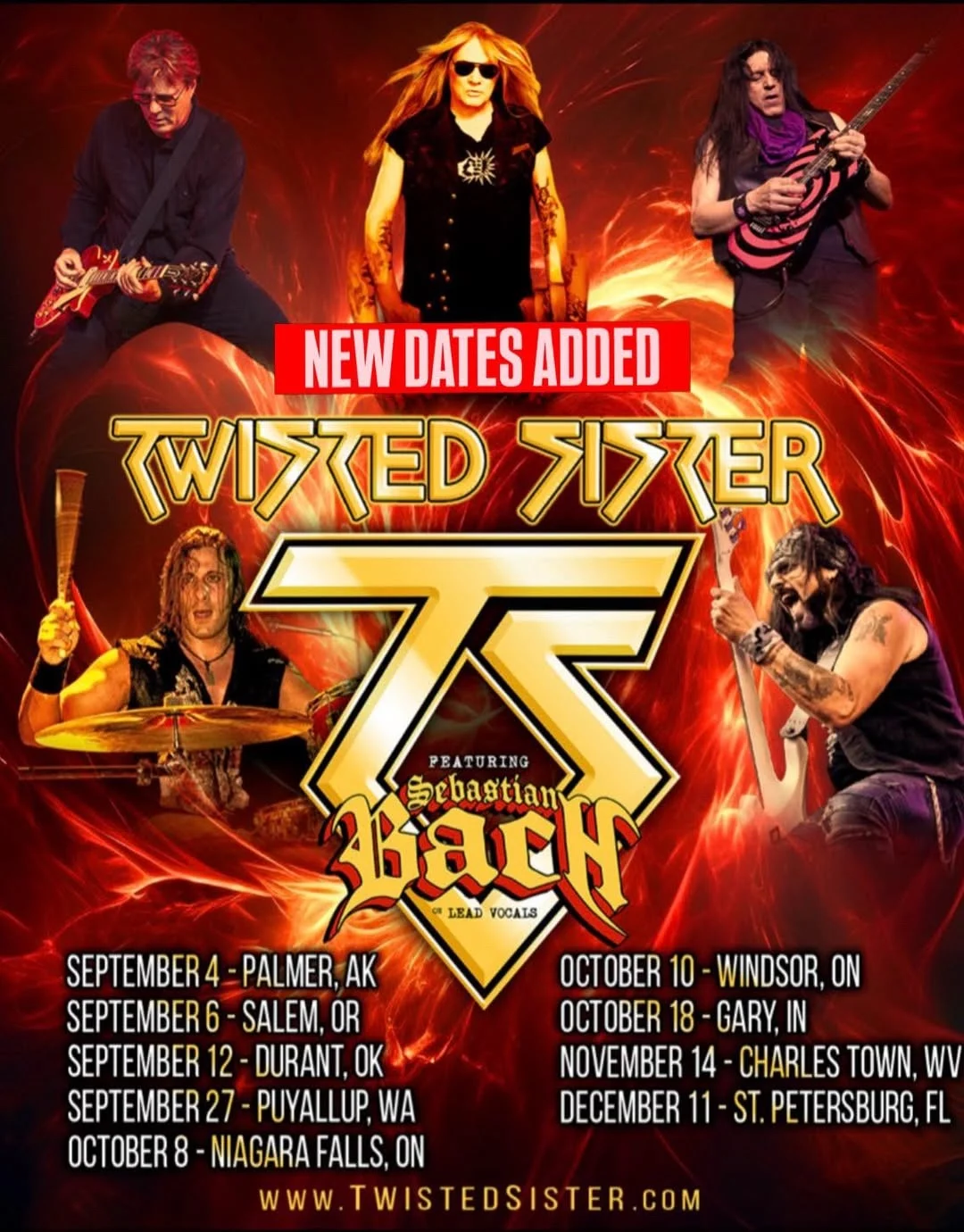
In a major development for hard rock enthusiasts, the legendary band Twisted Sister has announced an expansion of their 2026 North American tour. Following the successful reception of their initial reunion dates, the band has confirmed three additional performances, bringing their total itinerary to nine shows. These upcoming dates will once again feature the powerhouse vocals of former Skid Row frontman Sebastian Bach, who has stepped into the fold to honor the band’s enduring legacy.
This expansion signifies a transition for a band that defined the 1980s metal scene. While the original 50th-anniversary reunion plans were altered due to the departure of iconic lead singer Dee Snider, the chemistry between the remaining members and Bach has provided a fresh, high-energy lease on life for the group’s catalog.
A New Chapter: The Evolution of the 2026 Itinerary
The newly announced dates include October 18th in Gary, Indiana; November 14th in Charles Town, West Virginia; and December 11th in St. Petersburg, Florida. These shows follow a series of previously scheduled stops across North America, stretching from Alaska to the Florida coast.
The support act for these dates is set to be "Rockett Mafia," a high-octane tribute project helmed by Poison’s own drummer, Ricki Rockett. Specializing in the anthemic sounds of the 1970s and 1980s, the band is expected to provide a nostalgic and fitting prelude to the headlining performance of Twisted Sister’s hits.
Tickets for the new dates are already available via a pre-sale program using the code TWISTED2026 through Ticketmaster, with the general public on-sale scheduled for Friday, June 26th, at 10:00 a.m. local time. The demand for these tickets, as evidenced by the rapid expansion of the tour, suggests that the "Twisted Sister Featuring Sebastian Bach" configuration is resonating deeply with fans who feared the band’s live era had concluded prematurely.
Chronology: From Reunion Hopes to Vocal Handover
The timeline of these events tracks a challenging but ultimately triumphant period for the band.
- Early 2026: Initial anticipation for a full 50th-anniversary reunion tour reached a fever pitch. However, those plans were cast into doubt when Dee Snider announced he would be stepping down from the stage due to health concerns.
- February 2026: Snider addressed his fanbase directly, assuring them that despite his departure from the road, he was not in a life-threatening situation. He emphasized the necessity of prioritizing his long-term well-being over the physical demands of touring.
- March 2026: In a gesture of goodwill and respect, Snider officially gave his blessing for the band to continue their legacy without him. He hand-picked Sebastian Bach, a longtime peer and friend, as the ideal candidate to handle the vocal duties.
- April 2026: The first four dates of the new tour were officially announced, confirming that the "Twisted Sister Featuring Sebastian Bach" project was a reality.
- April 2026 (Sneak Peek): The partnership was solidified in the public eye when guitarist Eddie Ojeda joined Sebastian Bach during a solo performance, tearing through a high-energy rendition of "I Wanna Rock." This moment served as the definitive "proof of concept" for the collaboration.
- June 2026: Building on the momentum of the early ticket sales, the band expanded the tour, adding the three new dates that bring the current total to nine shows.
The Supporting Cast: Who is on Stage?
The current lineup of Twisted Sister is a testament to the band’s history and professional caliber. Alongside the dynamic frontmanship of Sebastian Bach, the stage is anchored by two of the band’s core architects: founding guitarist Jay Jay French and long-time lead guitarist Eddie Ojeda.
Supporting them is a rhythm section that brings precision and power to the band’s signature sound. Bassist Russell Pzutto and drummer Joe "Seven" Franco complete the roster, ensuring that the heavy, driving percussion and thick low-end that defined songs like "We’re Not Gonna Take It" remain intact. The inclusion of these musicians reinforces the notion that while the lead voice has changed, the soul and the sonic structure of the band remain authentically "Twisted."
Official Responses and the "Blessing" of the Frontman
The transition of the vocal mantle from Dee Snider to Sebastian Bach is unique in rock history, largely due to the amicable nature of the transfer. Snider, known for his outspoken nature and fierce protectiveness of the Twisted Sister brand, has been vocal about his support for the project.
In his public statements, Snider noted that his decision to step down was purely a matter of vocal preservation and physical endurance. "I’ve given everything I have to this band for decades," Snider said in earlier statements. "Knowing that Sebastian is the one taking the mic gives me a sense of peace. He understands the energy, the attitude, and the history of what we built."

Sebastian Bach, for his part, has treated the role with profound reverence. During his recent performances, he has acknowledged that he is not attempting to "replace" Snider, but rather to serve as a custodian of the music. "You don’t replace an icon like Dee," Bach noted in a recent interview. "You step in to make sure the fire stays lit for the fans who deserve to hear these songs live, at the volume they were meant to be played."
Implications for the Band’s Future
The expansion of this tour raises significant questions about the future of the Twisted Sister brand. With the original 50th-anniversary plans scrapped, many industry observers are viewing this current iteration as a "legacy tour" that functions differently than a traditional reunion.
By touring with Bach, the band is proving that their songs—many of which have become cultural touchstones—have an identity that transcends the specific members who originally recorded them. This model is becoming increasingly common in the classic rock sphere, where fans are prioritizing the preservation of the live experience over the requirement of a 100% original lineup.
Furthermore, the involvement of Ricki Rockett and the inclusion of other high-profile guest musicians suggests that the band is creating a "touring community" that celebrates the broader era of 80s hard rock. This could potentially lead to larger festival appearances or even a residency format in the future, should the nine-show run prove as successful as current projections suggest.
Analyzing the Market: Why Now?
The decision to expand the tour reflects a robust demand for 1980s rock in the current live music market. Data from the ticketing sector shows that "nostalgia-driven" concert sales have outperformed many contemporary pop acts over the last 24 months. For Twisted Sister, the timing is perfect. The band occupies a specific niche—high-energy, rebellious, and undeniably melodic—that appeals to multiple generations.
The strategy of adding shows in smaller, targeted markets (like Gary, IN and Charles Town, WV) rather than focusing solely on major metropolises indicates that the band is reaching their core demographic where they live, rather than forcing fans to travel to massive, expensive coastal venues. This "grassroots" approach to a legacy tour is a smart logistical move that maximizes the fan experience while maintaining the high production values associated with a band of their stature.
Conclusion: A Testament to Resilience
Twisted Sister has always been a band defined by its resilience. From their early days in the clubs of New Jersey to their global superstardom in the mid-80s, they have navigated internal conflicts, industry shifts, and the changing tides of popular music.
The 2026 tour, featuring Sebastian Bach, is perhaps the ultimate manifestation of that resilience. By finding a way to continue the music despite the physical limitations that forced their original frontman to step aside, the band is ensuring that their contribution to rock history is not archived, but celebrated.
For the fans who have followed them for half a century, and for the new generation of listeners discovering their anthems, these nine shows represent more than just a concert. They are a celebration of a sound that refused to die, a band that refused to quit, and a legacy that continues to find a voice—even when that voice changes hands. As the tour dates approach, the message remains as clear as it was in 1984: They are not going to take it, and their fans aren’t going to either.
 Pevita Pearce
 Asro
Asro
 Lina Irawan
