

Byline: Entertainment Desk
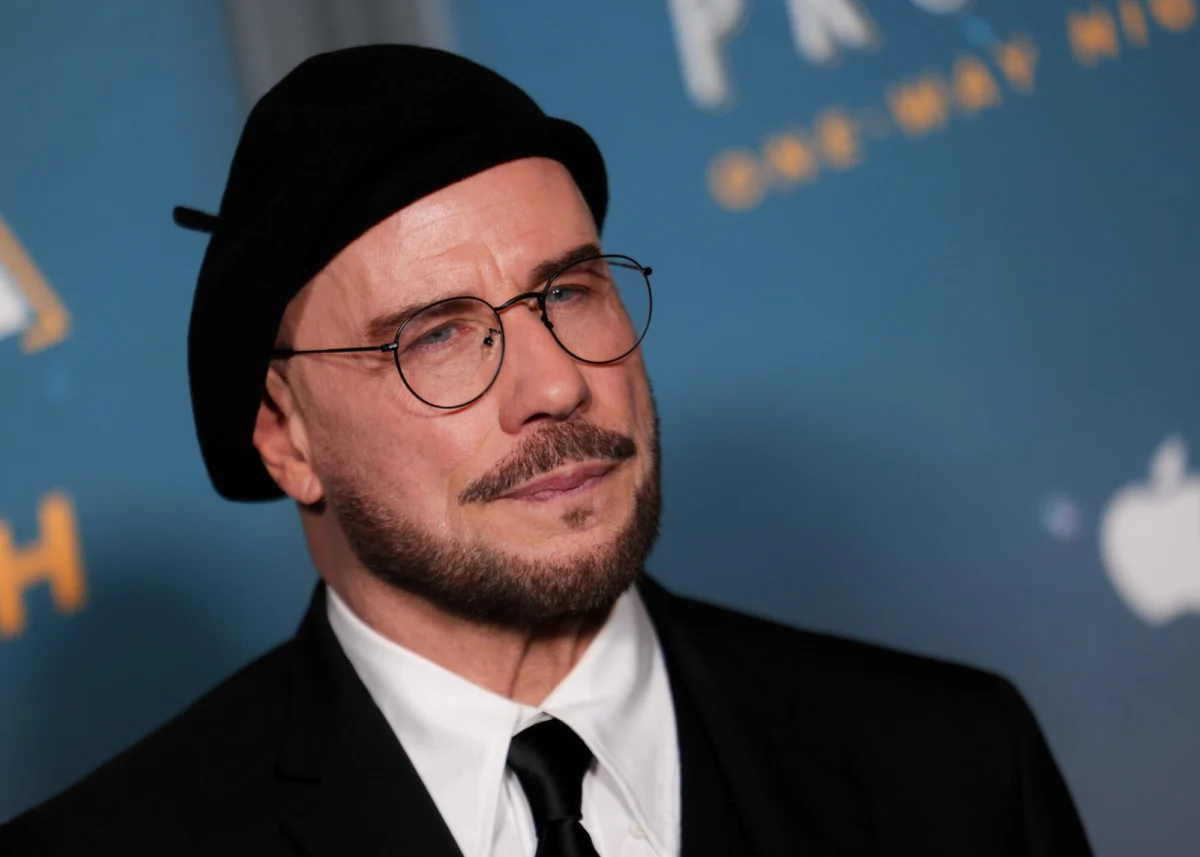
In an industry where personal branding is as curated as the cinematic output itself, John Travolta has executed a sartorial pivot that has captured the attention of both the fashion elite and the global film community. Since his headline-grabbing appearances at the Cannes Film Festival earlier this month, the legendary actor has made the beret—a headpiece with 800 years of historical weight—his undisputed signature look.
At the Directors Guild of America (DGA) premiere of his directorial debut, Propeller One-Way Night Coach, held this past Thursday, Travolta offered an intimate look into the philosophy behind his new aesthetic. Speaking with Variety’s Marc Malkin, the star revealed that his transition from iconic actor to behind-the-camera visionary necessitated a visual evolution. For Travolta, the beret is more than a trend; it is a declaration of intent.
The Genesis of a New Trademark
The decision to adopt the beret was born from a moment of professional introspection. After five decades in the spotlight, Travolta found himself looking at thousands of photographs of his past self and struggling to find a distinction between the "John Travolta" the public knew and the creative force he aspired to be as a director.
"I looked at all the photographs of me for 50 years and I can’t tell you the difference," Travolta explained to Malkin. "I started to not be able to differentiate, and I said, ‘Well, you’re not an actor really.’ I said, ‘You’re not an actor unless you’re really a director. Why don’t you dress like one?’"
His research into the visual shorthand of classic cinema led him to the "old school" masters of the craft. "I looked up all the old-school directors and they all had berets and sometimes glasses," he noted. "It was cliché, but in a wonderful way. They were probably reflecting painters and musicians of the type." By channeling this lineage of artistic authority, Travolta has effectively rebranded himself, successfully landing on the best-dressed lists of Vogue, GQ, and Harper’s Bazaar in the process. He now owns at least 12 of the caps, ensuring he has a selection for every mood and setting.
A Chronology of Style: From Bell-Bottoms to Berets
Travolta’s interest in fashion is not a recent development. The star’s sartorial awareness traces back to his teenage years, deeply influenced by family connections within the industry. "My brother-in-law worked for Vogue in the ’60s and Harper’s Bazaar, and he would style me as a teenager," Travolta recalled.
This early education in the power of clothing provided him with a lifelong appreciation for the transformative nature of style. He recounts his first forays into high fashion with vivid clarity: "I had my first bell bottoms, my first wide belt, my first double-breasted suit. I looked like Warren Beatty, Bonnie and Clyde."
This historical context explains why Travolta feels so comfortable experimenting with his image today. While many of his contemporaries stick to the traditional "Hollywood uniform" of a tailored suit and open collar, Travolta is actively looking to expand the boundaries of masculine expression. He notes that the current trend of "men in skirts," while a bold fashion statement, might be an attempt to compensate for a perceived lack of sartorial options.
"Guys don’t have enough to do," Travolta mused. "They’re putting men in skirts because there’s a lack of something there… why not change it up? We can have fun too." For Travolta, the beret serves as a masculine, historically grounded alternative to the stagnation of modern menswear.

The Collaborative Spirit: A Family Affair
The premiere of Propeller One-Way Night Coach was a familial affair, with Travolta’s daughter, Ella, playing a central role both on screen and on the red carpet. The father-daughter dynamic extended to their styling choices, with Travolta taking an active hand in helping Ella curate her own look for the event.
"We could have done twin berets, but today we decided to go Brigitte Bardot," Travolta shared. While they ultimately opted for separate aesthetic directions, Ella was quick to praise her father’s bold fashion choice.
"To make an amazing and artistic decision and just rock it is so cool, because so many people play fashion choices safe," Ella told Variety on the carpet. When asked about her father’s influence on her own style, she was unequivocal: "He’s so good with that, and knows what looks good." Her support underlines a recurring theme in Travolta’s current phase: a newfound confidence in his creative identity, supported by those closest to him.
Supporting Data: The Impact of the "Director’s Look"
The reception of Travolta’s beret has been overwhelmingly positive, serving as a masterclass in modern personal branding. In an era where celebrities are often critiqued for "safe" fashion choices, Travolta’s willingness to embrace a polarizing accessory has garnered significant earned media.
- Media Coverage: Since his Cannes appearance, social media mentions of "Travolta" and "beret" have spiked, with fashion influencers analyzing his ability to pull off a look that many consider difficult to style.
- Best-Dressed Status: His inclusion on the GQ and Vogue lists is a testament to the industry’s hunger for personality-driven fashion. By leaning into the "cliché," he has reclaimed it as an authentic expression of his new professional chapter.
- The Quantitative Approach: With a collection of 12 caps, Travolta has turned a single accessory into a functional wardrobe staple, signaling to the public that his transformation is not a one-off stunt, but a permanent change in his public persona.
Official Context: Propeller One-Way Night Coach
The impetus for this change—his directorial work—is as ambitious as his fashion. Propeller One-Way Night Coach is a one-hour film based on Travolta’s own 1997 children’s book. It is currently available for streaming on Apple TV+, marking a significant shift for the actor as he leans into storytelling from the director’s chair.
The project itself is a passion piece, reflecting a desire to translate his long-standing experience in front of the lens into a coherent, artistic vision behind it. The film, much like his beret, represents a move toward a more "old school" sensibility, prioritizing narrative charm and classic craftsmanship over the high-octane action roles that defined his early career.
Implications: The Future of Celebrity Personal Branding
John Travolta’s embrace of the beret carries significant implications for the future of celebrity styling. It challenges the "safety" culture of red-carpet appearances, where stylists often dictate looks that are calculated to avoid negative press. By contrast, Travolta’s look is deeply personal, rooted in his own research and historical interests.
His critique of the current state of menswear—suggesting that men are grasping at experimental trends because they lack variety—resonates with a growing conversation about the limitations placed on men’s fashion. Travolta is essentially arguing for a "third way": a style that is not necessarily avant-garde, but is instead rooted in history, personality, and a sense of fun.
Furthermore, his transition to directing, punctuated by his shift in wardrobe, sets a precedent for aging actors who wish to redefine their roles in the industry. By adopting the "Director’s uniform," he is signaling to the Hollywood establishment that he is no longer just the star of the show; he is the architect of it.
As Travolta continues to promote Propeller One-Way Night Coach, it is likely that the beret will remain a constant companion. Whether or not it starts a wider trend of directors reclaiming the headwear remains to be seen, but for now, John Travolta has successfully captured the spotlight once again—proving that with the right amount of confidence and a touch of historical flair, even the most traditional accessory can become a symbol of modern artistic reinvention.
 Nana
Nana
 Ali Ikhwan
 Iffa Jayyana
