

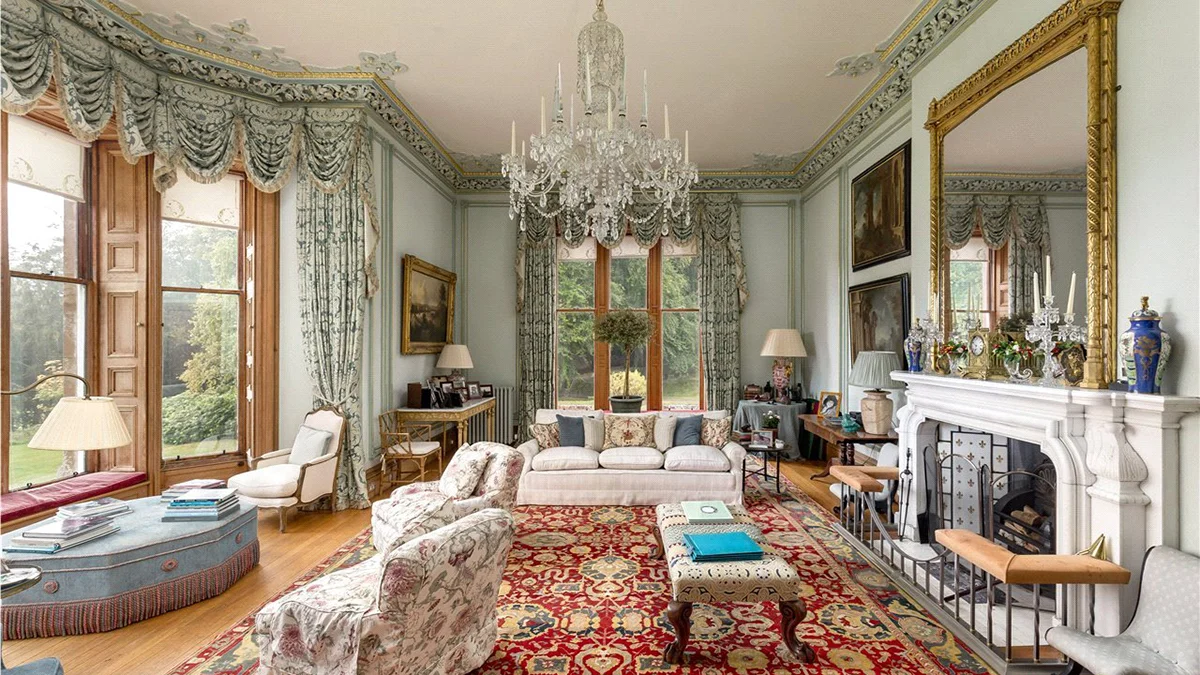
As the global spotlight turns toward Scotland during the excitement of the World Cup, those with an appetite for history and grand living have a unique opportunity to secure a permanent piece of the Highlands’ allure. Nestled just 45 miles south of Edinburgh, near the historic market town of Peebles, the sprawling Portmore Estate has hit the market. A breathtaking 3,500-acre sanctuary, this property offers more than just a home; it represents an entire ecosystem of Scottish heritage, architectural mastery, and unparalleled rural luxury.
With an asking price of more than $19.8 million, the estate is currently being represented by Emma Chalmers of the Galbraith Group, a firm specializing in the nation’s most significant land holdings.
Main Facts: A Baronial Masterpiece
At the heart of the Portmore Estate stands an 18-bedroom baronial mansion, a stone-hewn monument to 19th-century ambition. Designed in 1850 by the renowned architect David Bryce—a figure synonymous with the Scottish Baronial style—the residence is a study in verticality, steep rooflines, and intricate stonework.

The residence is constructed from striking red sandstone, which glows with warmth against the often-misty backdrop of the Scottish Borders. While the mansion honors its Victorian roots, it has not remained static. Following a fire in the 1980s, the south wing underwent a sophisticated reconstruction, blending seamless preservation with modern structural integrity.
The internal layout is a labyrinth of opulence. Original wood paneling, fine plaster cornicing, and gargantuan fireplaces remain the centerpiece of the ground floor. Among its most distinctive features is the dedicated "organ room," which still houses the home’s original instrument—a testament to the Victorian tradition of musical entertainment. The drawing room, with its mint-toned palette and light-drenched window seats, offers a serene vantage point over the estate’s manicured grounds, while the library—wrapped in classic green floral wallpaper—provides a cozy retreat for quiet contemplation.
A Chronology of Elegance
The history of Portmore is a reflection of the evolution of the Scottish landed gentry.

- 1850: Architect David Bryce is commissioned to design the primary residence. Bryce, already famous for his work on castles and stately homes across Scotland, brought a romantic, dramatic aesthetic to the Peebles landscape.
- The 19th Century: The estate thrives as a focal point of local agricultural and social life, with its sprawling 3,500 acres supporting traditional farming practices and woodland management.
- The 1980s: A period of significant change for the mansion occurs when a fire damages the south wing. The subsequent restoration effort is lauded for its sensitivity, retaining the character of the original Bryce design while updating the facilities for modern living.
- Modern Day: The current owners have spent years meticulously restoring the gardens, ensuring that the fountains, reflecting pools, and heritage hedges remain in peak condition. The property is now positioned as a turnkey opportunity for a buyer looking to steward a piece of history into the next century.
Supporting Data: The Estate’s Infrastructure
To classify Portmore as merely a "house" would be a disservice to the scale of the operation. The estate is a multifaceted asset that includes:
- Residential Portfolio: Beyond the 18-bedroom mansion, the property includes seven additional homes. These serve as versatile spaces for extended family, staff housing, or potential revenue-generating vacation rentals.
- Water and Land: The estate boasts a private reservoir, a critical feature for the self-sufficiency of such a vast plot. With over 600 acres of dedicated woodland and vast tracts of fertile pasture, the estate functions as a working sheep and cattle farm.
- Amenities: The mansion includes 13 bathrooms, a tartan-decorated billiard room for evening socializing, a dedicated children’s playroom, and two climate-controlled wine cellars.
- Gardens: The Victorian greenhouse is the crown jewel of the horticultural grounds, providing a space for year-round cultivation amidst the rugged Scottish climate.
Official Perspective: The Market Context
Emma Chalmers of Galbraith, the agent overseeing the sale, describes the property as a "once-in-a-generation" offering. "Portmore represents the pinnacle of the Scottish country estate," Chalmers noted in recent discussions regarding the listing. "It combines the architectural gravity of David Bryce with the practical, modern requirements of a 21st-century estate owner. From the working farm to the restored mansion, every inch of the 3,500 acres has been cared for with an eye toward both beauty and utility."
The valuation, starting at $19.8 million, places Portmore in the top tier of international real estate. It targets a specific buyer—someone who understands that the price tag is not merely for the square footage, but for the privacy, the stewardship of the land, and the prestige of owning one of the Borders’ most significant architectural landmarks.

Implications: The Future of the Scottish Estate
The sale of Portmore occurs at a time when the "Scottish Estate" has seen a resurgence in popularity. Post-pandemic, there has been a global shift in interest toward properties that offer total privacy, self-sufficiency, and a connection to the natural world.
Sustainability and Stewardship
Modern buyers are increasingly concerned with the ecological impact of their properties. Portmore’s 600 acres of woodland and its active agricultural components provide a unique opportunity for carbon sequestration projects, rewilding initiatives, or the continuation of regenerative farming. The estate isn’t just a place to live; it is a laboratory for sustainable land management.
The "Staycation" Economy
With seven additional residences on-site, the new owner is essentially purchasing a hospitality business. In a post-Brexit landscape where domestic tourism in the UK is thriving, the ability to convert these properties into high-end luxury rentals—leveraging the proximity to Edinburgh—offers a compelling financial incentive to maintain the estate as a commercial concern.

Architectural Preservation
The preservation of a David Bryce building is a heavy responsibility. The listing of Portmore underscores the tension between keeping history alive and making it livable. The successful renovation of the 1980s fire-damaged wing proves that these structures can adapt. For the next owner, the challenge will be to balance the "museum-quality" aspects of the organ room and library with the comfort required by a modern, active family.
Conclusion
As the world watches the football pitches in Scotland, the true game being played in the hills of Peebles is one of heritage and legacy. Portmore Estate stands as a testament to the enduring appeal of the Scottish Baronial style. It is a place where history is written in stone, where the sound of an 1850s pipe organ still echoes through the halls, and where the future of land stewardship is waiting to be written by its next custodian.
Whether it serves as a secluded family retreat, an exclusive hospitality venture, or a working agricultural powerhouse, Portmore is undeniably one of the most significant residential opportunities in the United Kingdom today. For those with the resources and the vision, the gates to this 3,500-acre kingdom are finally open.
 Evan Lee Salim
 Asep Darmawan
 Laily UPN
