

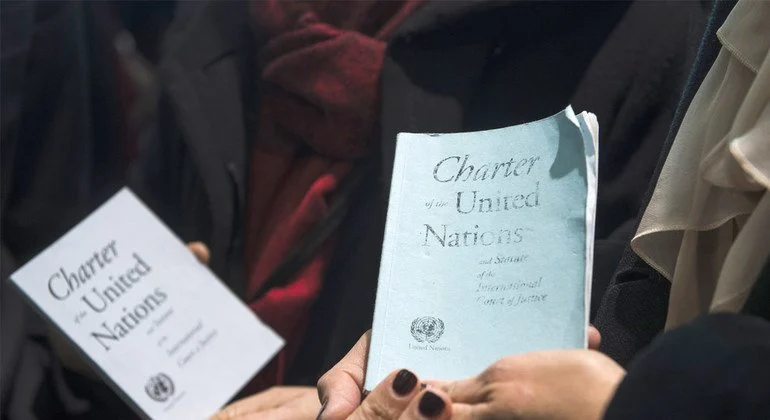
On June 26, 1945, amidst the smoldering ruins of the Second World War, representatives from 50 nations gathered at the Veterans’ War Memorial Building in San Francisco to sign a document that would redefine the course of human history. Today, 81 years later, that document—the Charter of the United Nations—stands as the bedrock of the rules-based international order. As the world marked UN Charter Day this week under the theme “Better Together: One Charter, One Future,” the rhetoric from the UN’s leadership was not merely celebratory; it was a clarion call for survival.
United Nations Secretary-General António Guterres, speaking before an informal meeting of the General Assembly, delivered a sobering assessment of the current state of international affairs. “The Charter was a promise to the world: That humanity can choose cooperation over chaos; law over lawlessness; dignity over domination; and hope over fear,” he declared. Yet, he conceded, that promise is currently under immense strain.
The Chronology of a Foundational Covenant
The birth of the United Nations was a direct response to the catastrophic failure of the League of Nations and the horrors of global totalitarianism. The Charter, which entered into force on October 24, 1945, established the primary architecture for maintaining international peace and security.
- June 26, 1945: The Charter is signed in San Francisco, codifying the core principles of sovereign equality, the prohibition of the use of force, and the peaceful settlement of disputes.
- 1948: The UN adopts the Universal Declaration of Human Rights, building upon the foundational values outlined in the Charter.
- 1950s–1970s: The UN facilitates the decolonization process, welcoming dozens of newly independent nations into the fold, drastically altering the organization’s demographics and mission.
- 1990s: The post-Cold War era brings renewed optimism, though it is quickly tested by conflicts in the Balkans and Rwanda, leading to intense debates over the "Responsibility to Protect."
- 2026: On the 81st anniversary, the organization finds itself grappling with a fractured geopolitical landscape, marked by a return to great-power competition and the necessity of the “UN80” reform initiative.
The Pillars of the Charter: Beyond an "A La Carte Menu"
The UN Charter is not merely a legal document; it is a moral compass for the international community. It outlines the essential goals of the organization: maintaining peace, fostering friendly relations among nations, achieving international cooperation in solving economic and social problems, and promoting respect for human rights.
Secretary-General Guterres was emphatic in his critique of the current geopolitical climate, noting that the Charter is "not an à la carte menu." His remarks targeted the growing trend of selective enforcement, where powerful nations invoke the principles of sovereignty when it suits their interests while ignoring the tenets of international humanitarian law when they stand in the way of military objectives.
Current challenges cited by the Secretary-General include:
- Wars of territorial expansion: The resurgence of old-fashioned conquest, which directly violates the prohibition against the use of force.
- The targeting of civilians: A systematic breakdown in the protection of non-combatants in conflicts from Gaza to Sudan and Ukraine.
- Broken ceasefires: The erosion of trust in diplomatic mediation.
- Selective Enforcement: The perceived paralysis of the Security Council when the interests of permanent members are at stake.
Supporting Data: Why the System Still Matters
Despite the valid and pervasive criticisms leveled at the UN—particularly its inability to halt ongoing conflicts—supporters argue that the institution’s track record of success is often obscured by the headlines of its failures.
In her address to the General Assembly, Annalena Baerbock, representing the German government, argued that the UN remains a "miracle of humanity." The scale of the organization’s daily impact is significant:
- Humanitarian Lifelines: UNICEF immunization campaigns have successfully saved more than 150 million children’s lives since the organization’s inception.
- Conflict Mediation: While the Security Council often appears gridlocked, UN peacekeepers remain on the ground in multiple theaters, providing a buffer that protects millions of civilians who would otherwise be left defenseless.
- Socio-Economic Progress: The UN’s agencies continue to coordinate global responses to health crises, climate change mitigation, and education, filling gaps that no individual state has the capacity or the mandate to address.
“Multilateralism has not failed,” Baerbock asserted. “Multilateralism works every day when humanitarian workers are delivering food even before sunrise in a crisis. Multilateralism works every day even if the Security Council is blocked, when peacekeepers protect civilians.”
Official Responses and the Imperative for Reform
The commemoration was not an exercise in self-congratulation. It was, instead, a high-level recognition that the UN of 1945 is ill-equipped for the complexities of 2026. The “UN80” reform initiative is the current vehicle for these necessary adjustments.
The Argument for Agility
The primary tension in the reform debate lies between the need for speed and the requirement for consensus. Critics argue that the UN’s bureaucratic layers prevent it from responding to crises in real-time. Proponents of reform argue that an "agile and efficient" UN requires a restructuring of the Security Council to better reflect the realities of the 21st century—specifically, the rise of the Global South and the shift in economic power.
Preservation Through Modernization
The overarching sentiment among the delegates was that the UN is "irreplaceable." Guterres noted that while the organization has never been perfect, the cost of its abandonment would be catastrophic. The consensus reached during the Charter Day events is that reform must be an act of preservation, not an act of dismantling. The goal is to modernize the tools of multilateralism to make them more effective in an era of digital warfare, climate collapse, and rapid technological change.
Implications: The Future of Global Governance
As the international community looks toward the future, the implications of the 81st anniversary are clear: the world is at a turning point. We are currently witnessing a contest between two visions of global order. The first is a return to a "might makes right" paradigm, where regional hegemons carve out spheres of influence through coercion. The second is the vision embedded in the Charter: a rules-based system where even the smallest state has a voice and where the protection of human dignity is a shared global responsibility.
The danger, as highlighted by the Secretary-General, is that the current erosion of international law will lead to a systemic collapse, similar to the events of the 1930s. To prevent this, the UN must demonstrate that it can deliver results that are visible to the average citizen—not just through high-level diplomacy, but through the tangible benefits of international cooperation.
A Renewed Commitment
The commemoration concluded with a renewed commitment from the Member States to uphold the principles of the Charter. However, the true test will not be in the rhetoric delivered at the podiums of the General Assembly, but in the willingness of nations to cede a portion of their narrow national interests for the sake of the collective good.
As the international community navigates the remainder of the decade, the mantra "Better Together" must evolve from a slogan into a functional diplomatic reality. The United Nations may be the oldest of the modern international institutions, but it remains the only venue where all of humanity’s problems are brought under one roof. In the face of mounting global crises, the choice remains as it was in 1945: cooperation or chaos. The survival of the Charter, and the future it promises, depends on the courage of the present generation to choose the former.
 Lina Hope
 Asro
Asro
 Layla Zulfa
