

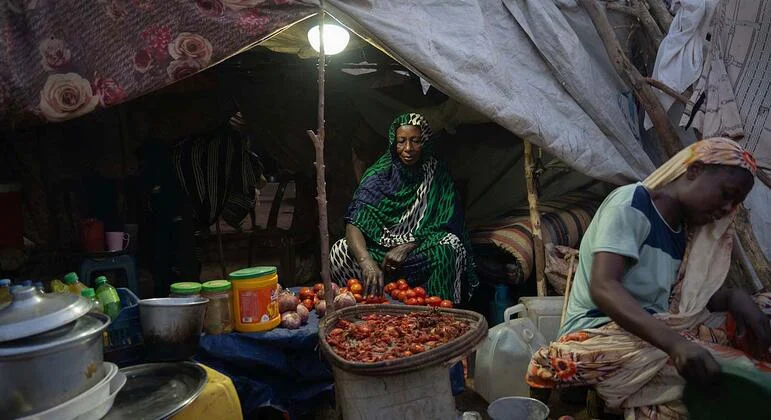
As the brutal conflict between the Sudanese Armed Forces (SAF) and the Rapid Support Forces (RSF) enters its fourth year, the international community is sounding the alarm over a potentially devastating new theater of war. The city of El Obeid, a critical hub in the Kordofan region, stands at a precarious precipice, with UN officials warning that the window to prevent a full-scale human rights disaster is rapidly closing.
Main Facts: A Conflict Reaching New Levels of Lethality
The war in Sudan, which erupted in mid-April 2023, has transformed from a power struggle between two rival military factions into a multifaceted humanitarian catastrophe. The recent surge in hostilities in El Obeid—marked by an increased RSF presence and a significant uptick in drone warfare—threatens to engulf half a million civilians in active, urban combat.
Rosemary DiCarlo, the UN Under-Secretary-General for Political and Peacekeeping Affairs, recently briefed the Security Council on the deteriorating situation. Her message was clear: the conflict is becoming increasingly unpredictable, geographically dispersed, and lethal. The reliance on advanced drone technology has moved the battle into the skies, leaving no corner of the country truly safe. Beyond El Obeid, fighting continues to rage across Dilling, Kadugli, and Babanusa, effectively cutting off vital humanitarian corridors and leaving entire communities isolated from aid, food, and medical supplies.
Chronology of a Collapsing State
To understand the urgency of the current situation, one must look at the trajectory of the conflict:
- April 2023: Initial hostilities break out in Khartoum, rapidly spiraling into a national conflict.
- Late 2023: The conflict spreads beyond the capital, with the Darfur and Kordofan regions becoming primary sites of contention as both the SAF and RSF seek to control strategic infrastructure and transport corridors.
- Early 2024: Relations between Sudan and its neighbors, particularly Ethiopia and Chad, fray as regional tensions rise, fueled by allegations of external military interference and cross-border security threats.
- Mid-2024: The "rainy season" lull, traditionally a period of reduced military activity, fails to materialize. Instead, the use of drones accelerates, ensuring that the violence remains constant despite the harsh environmental conditions.
- Present Day: The focus shifts to El Obeid. With the RSF expanding its encirclement of the city and the SAF responding with defensive positioning, the UN warns that the city is at risk of replicating the siege-like conditions witnessed in El Fasher last year.
Supporting Data: The Mounting Toll on Sudan’s Youth
The humanitarian cost of the war is most visible in the plight of Sudan’s children. Hannan Sulieman, Deputy Executive Director of UNICEF, provided the Security Council with harrowing statistics that underscore the severity of the crisis.
Since the conflict began, the UN has verified over 5,700 grave violations against children. More than 5,000 children have been killed or maimed, though officials believe the true figure is significantly higher due to the difficulty of documenting casualties in active war zones. Perhaps most alarming is the shift in weaponry: nearly 80 percent of child casualties reported in the first four months of 2024 were linked directly to drone attacks.
The infrastructure required for a functioning society—schools, hospitals, and water systems—has become a secondary target, either through direct strikes or as a byproduct of the chaotic, urban nature of the fighting. As Sulieman noted, "The children of Sudan cannot survive on expressions of concern. They have already lost more than three years of their childhood and cannot afford to lose another."
Official Responses and Diplomatic Impasse
The international response to the Sudanese crisis is characterized by a mix of intensive diplomatic consultation and deep frustration. The UN continues to facilitate high-level talks, relying on the "Quintet"—a coalition comprising the African Union, the European Union, the East African bloc IGAD, the League of Arab States, and the United Nations.
The Role of the "Quad"
The "Quad" group—the United States, Saudi Arabia, the United Arab Emirates, and Egypt—has been instrumental in pushing for humanitarian truces. However, despite these efforts, the parties on the ground have repeatedly failed to adhere to ceasefire agreements.
The Call for External Accountability
Ms. DiCarlo’s briefing to the Security Council carried a stern warning to external actors. She emphasized that the current intensity of the war, particularly the sophisticated nature of the drone strikes, would be impossible to sustain without external military support. She explicitly urged these foreign powers to use their influence to force a de-escalation, rather than providing the tools that fuel the destruction.
The UN Secretary-General’s Personal Envoy for Sudan, Pekka Haavisto, is currently engaged in shuttle diplomacy, attempting to secure localized agreements that might prevent the situation in El Obeid from mirroring the catastrophes seen elsewhere in the country.
Implications: A Regionalized Conflict
The implications of the war extend far beyond Sudan’s borders. The volatility in the White Nile and Blue Nile states, coupled with tensions with neighboring Chad and Ethiopia, suggests that the conflict is at risk of "spillover."
The Risk of Regional Contagion
Tensions with Ethiopia, exacerbated by allegations of interference in internal security, have created a delicate diplomatic standoff. Meanwhile, the shared border with Chad remains a flashpoint for instability, as the movement of refugees and armed groups threatens to drag neighboring countries into the fray.
The Humanitarian Vacuum
If El Obeid falls into a full-scale battle, the regional impact will be immediate. Millions of civilians who have already been displaced will be forced to move again, placing unbearable pressure on already overstretched host communities and neighboring nations. The destruction of bridges and transport corridors ensures that even if humanitarian aid is available, it cannot reach the people who need it most.
A Final Plea for Action
The path forward, according to the UN, requires a two-track approach: an immediate cessation of hostilities to protect civilians, paired with a robust, Sudanese-led political process. During recent consultations in Addis Ababa, a diverse spectrum of Sudanese civil society representatives reiterated that while their views on the future political process vary, the consensus on the need to stop the fighting is absolute.
For the international community, the challenge is clear. The "narrowing window" mentioned by the UN is not a metaphor; it is a ticking clock for half a million people in El Obeid. As the warring parties continue to prioritize territorial gain over human life, the demand from the UN is fourfold:
- Immediate de-escalation in and around El Obeid.
- Unconditional protection of civilians and civilian infrastructure.
- Strict adherence to international humanitarian law, ensuring schools, hospitals, and water systems are off-limits.
- Genuine engagement with UN-led mediation efforts to create the conditions for a lasting peace.
The tragedy of Sudan is not just that it is a war, but that it is a preventable one. Without a fundamental shift in the behavior of the warring parties and a more unified stance from the international actors backing them, the cycle of violence will continue to consume the future of an entire generation of Sudanese children. The time for rhetoric has passed; the time for decisive, coordinated action is now.
 Lina Hope
 Asro
Asro
