

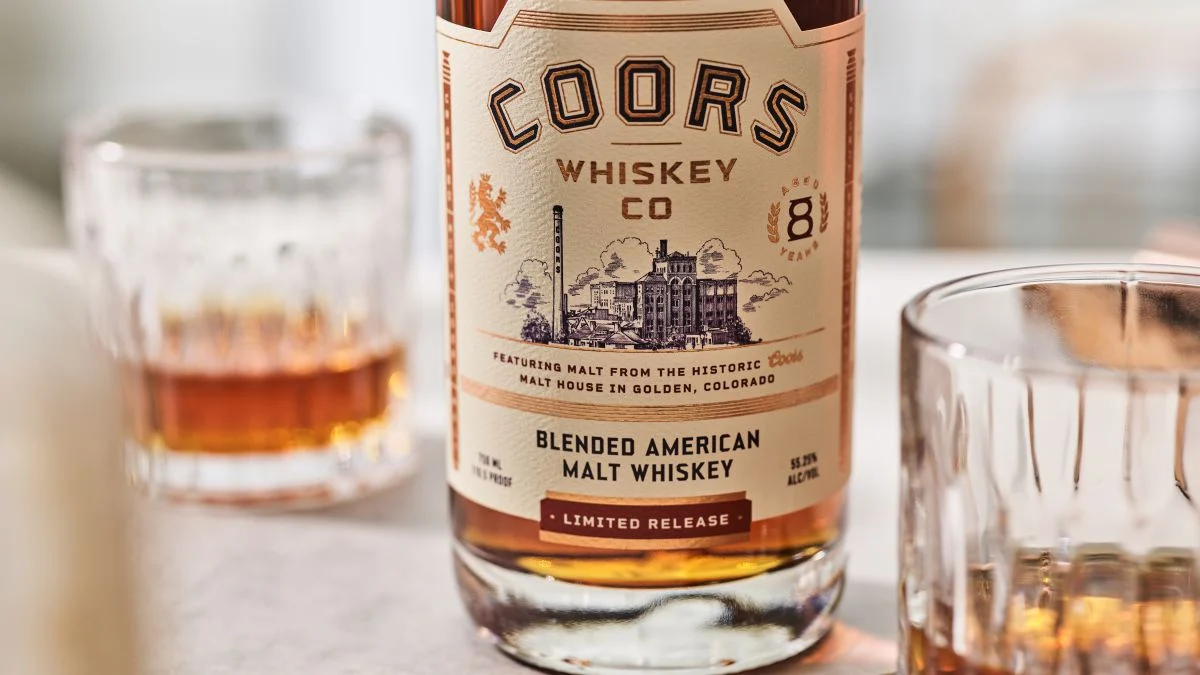
Welcome to Taste Test, where every week our critic Jonah Flicker explores the most buzzworthy and interesting whiskeys in the world. Check back each Sunday for his latest whiskey review.
In the rigid hierarchy of American spirits, bourbon occupies the throne. It is the king of the back bar, the darling of the cocktail world, and the primary driver of the domestic whiskey economy. While categories like rye, wheat, and American malt whiskey have carved out their own respectable niches, they often struggle to capture the collective imagination of the average drinker in the way that bourbon does.
So, when a beverage giant synonymous with the quintessential American lager—Coors—decides to pivot from the brewery to the distillery, one might expect a cautious, entry-level bourbon. Instead, the team at Coors Whiskey Co. has opted for a bolder, more technical path: a high-proof, eight-year-old blended malt whiskey. The result is not just a successful experiment; it is a profound realization of what happens when brewing expertise meets the patience of long-term aging.
The Origins: From Brewing Vats to Distilling Copper
To understand why this whiskey succeeds, one must first dismantle the bias against "macro-beer" producers entering the spirits space. It is a common trope among craft spirits enthusiasts to view corporate entries with a degree of skepticism. Yet, the history of fermentation is shared. Brewing and distilling are two sides of the same coin, and Molson Coors Beverage Company—a titan of the industry—has been quietly refining its spirits strategy since 2021.
The establishment of Coors Whiskey Co. was not a hasty marketing ploy but a calculated move to leverage the company’s massive infrastructure and, more importantly, its mastery of grain. The brand has previously tested the waters with Barmen Bourbon and the Five Trail series, the latter of which garnered mixed reviews ranging from "solid" to "forgettable." However, their latest offering—the Blended American Malt Whiskey—represents a shift in ambition.
The Technical Breakdown: A Masterclass in Malt
The Blended American Malt Whiskey is a technical achievement that highlights the nuances of malted barley. Unlike a single malt, which must originate from a single distillery, this release is a complex marriage of components.
The Mashbill and Production
The foundation of this whiskey lies in its proprietary malt. According to the brand, the liquid utilizes a blend of "Coors’ own proprietary malt and Colorado malt." This is where the pedigree of a brewing giant pays dividends; the company has spent over a century perfecting the malting process for their beer production. By applying that technical knowledge to a spirits mashbill, they have managed to create a distillate that feels robust yet refined.
The whiskey was distilled at the renowned Bardstown Bourbon Company in Kentucky, a facility widely regarded for its ability to produce high-end distillate for diverse clients. Under the guidance of Shaylyn Gammon, Coors Spirits Co.’s head of whiskey development and innovation, the liquid was aged for a minimum of eight years. This extended maturation is the secret to the whiskey’s success, smoothing out the aggressive, "green" barley notes that often plague younger malt whiskeys.
Specifications
- Proof: 110.5 (55.25% ABV)
- Age: 8 Years
- Composition: A blend of American malt whiskeys
- Distillery: Distilled at Bardstown Bourbon Company; blended and bottled by Coors Whiskey Co.
The Sensory Experience: A Profile in Contrast
One of the primary reasons many bourbon drinkers shy away from malt whiskey is a fear of the "hoppy" or overly vegetal profiles sometimes found in craft malt spirits. This Coors release systematically dismantles that prejudice.
On the nose, the whiskey is deep and inviting, lacking the sharp ethanol sting often associated with higher-proof spirits. Upon the first sip, the complexity reveals itself in layers. There is an immediate fruit-forward brightness—notes of tart cherry, crisp pear, and orchard-fresh apple. This quickly gives way to a decadent, darker profile: milk and dark chocolate, toasted almonds, and a subtle, grounding hint of vanilla bean.

As the whiskey moves toward the finish, a lighter, citrus-driven acidity emerges, reminiscent of lemon peel, followed by a warm, lingering spice profile of cinnamon and black pepper. The 110.5 proof point is high, providing a structural backbone that carries these flavors across the palate, veering toward a burn that catches the tongue just before it recedes into a long, pleasant finish.
Implications for the Future of American Whiskey
The arrival of this blended malt suggests a shifting landscape for major beverage conglomerates. By positioning this release as the first in a series focused on "exploration and innovation," Coors Whiskey Co. is signaling that they are not merely interested in capturing the bourbon market share. They are interested in expanding the vocabulary of the American drinker.
The Rise of "Blended Malt"
For decades, "Blended Malt" was a term almost exclusively reserved for Scotch whisky. The fact that an American powerhouse is championing the category suggests a growing consumer appetite for flavor profiles that move beyond the corn-heavy sweetness of bourbon. If this whiskey can succeed in a market dominated by rye and bourbon, it paves the way for a more diverse American spirits landscape.
Corporate Agility
There is also a broader lesson here regarding the power of collaboration. By utilizing the distilling expertise of Bardstown Bourbon Company while maintaining control over the sourcing and the specific malt-based blending process, Coors has successfully bypassed the typical "learning curve" issues that plague startup distilleries. They have effectively produced a whiskey that tastes like it has been in the market for decades.
Official Stance and Market Reaction
We reached out to the representatives at Coors Whiskey Co. to clarify whether the "blended malt" classification was due to the use of multiple distilleries or a divergence from 100 percent malted barley mashbills. While a response is pending, the current profile suggests a highly curated blend designed to maximize mouthfeel and complexity.
Industry analysts have noted that the release is a "surprise hit," particularly given the brand’s association with light, mass-market beer. Retailers are reporting strong interest from a demographic that typically buys "top shelf" bottles, suggesting that the Coors name, when backed by legitimate quality, can transcend its association with the stadium and the tailgate.
The Verdict: A Must-Try for the Skeptic
If you are a die-hard bourbon drinker who reflexively turns their nose up at malt whiskey, I challenge you to set aside your preconceptions for a moment. This release is a reminder that in the world of spirits, brand legacy matters less than the liquid in the glass.
The 110.5 proof is balanced with surgical precision, and the eight years of maturation provide a depth of flavor that is genuinely impressive. It is not just a "good for a beer company" whiskey; it is a good whiskey, period.
Score: 88
As Coors continues its trajectory into the spirits world, the "exploration and innovation" mandate will be one to watch. If they continue to maintain this standard of quality, they may well find themselves as relevant in the glass of a connoisseur as they are in the cooler of a casual drinker. For now, the Blended American Malt Whiskey serves as a successful, and thoroughly enjoyable, opening act.
 Ali Ikhwan
 Laily UPN
 Raul Delapena Setiawan
