

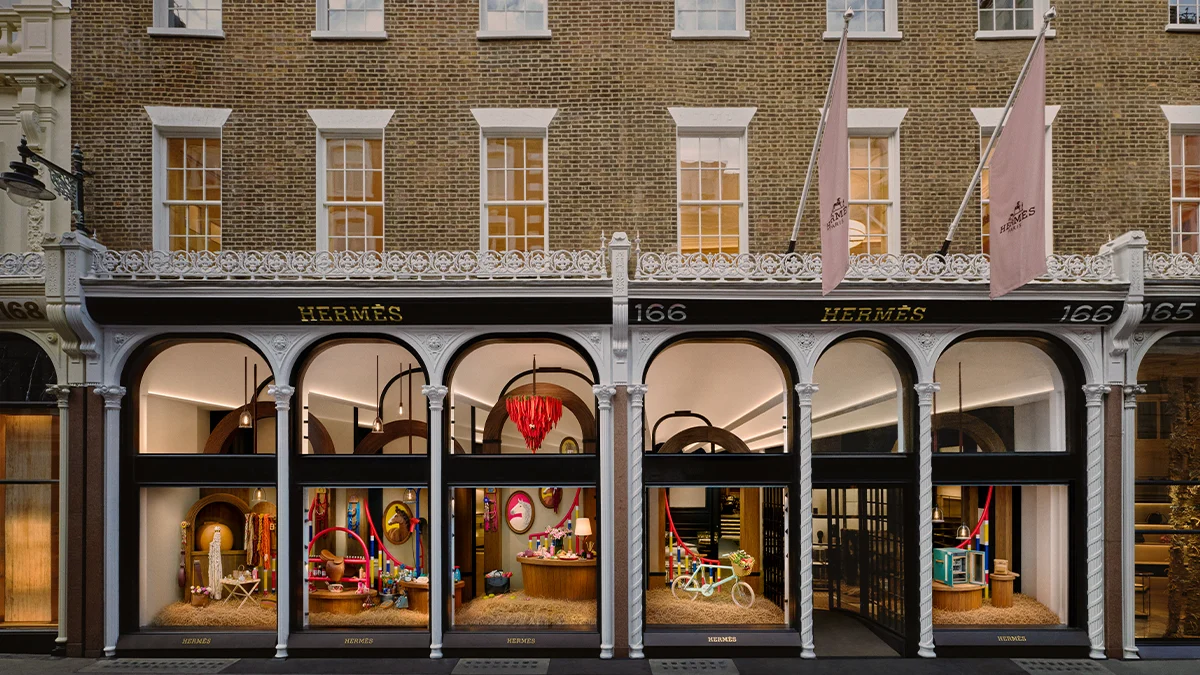
In the rarified atmosphere of London’s New Bond Street, where the world’s most prestigious luxury houses stand in perpetual competition for the attention of the global elite, a new landmark has emerged. The arrival of the new Hermès maison at number 166 is not merely a retail expansion; it is a profound architectural and cultural statement. Standing alongside the likes of Avenue Montaigne in Paris and Via Montenapoleone in Milan, New Bond Street has solidified its status as the heartbeat of global luxury. Yet, the opening of this sprawling, 21,000-square-foot flagship represents a transformative moment for the thoroughfare—a marriage of centuries-old British heritage and the singular, poetic craftsmanship of the French house.
A Sanctuary of Art and Architecture
The new flagship occupies six interlinked Grade II listed Georgian townhouses. These historic structures, which housed the venerable jeweler Asprey from 1847 until Hermès acquired the property for £75 million in 2009, have been meticulously restored. The interior design was entrusted to the Paris-based architecture studio RDAI, led by artistic director Denis Montel. Having collaborated with Hermès on hundreds of projects worldwide, Montel was uniquely positioned to navigate the delicate balance between the brand’s identity and the building’s storied, protected status.
Upon entering, visitors are greeted not by a traditional retail floor, but by a labyrinthine, five-story odyssey. With 55 distinct rooms, the space is connected by an intricate network of three lifts and four staircases. The centerpiece is a sweeping spiral staircase—an extension of a masterpiece originally designed by Foster + Partners—that serves as the vertical spine of the building.
The aesthetic is one of "British-inflected" Hermès. Pierre-Alexis Dumas, the brand’s artistic director, has famously remarked that his grandfather considered Hermès to be the "most British of French houses." This sentiment is woven into the very fabric of the store. More than 50 artisans were commissioned to contribute bespoke elements, ranging from handcrafted furnishings and intricate marquetry to specialist glasswork and decorative wall treatments. The space is further animated by 500 individual artworks, hand-selected by Dumas, which transform the retail environment into a curated gallery.
A Chronology of Vision: From Asprey to Hermès
The transformation of 166 New Bond Street is a project that spanned over a decade, reflecting the methodical, long-term approach that defines the house of Hermès.

- 1847: The townhouses begin their long tenure as the home of Asprey, establishing the address as a center for luxury and refined craftsmanship in the heart of London.
- 2009: Recognizing the architectural significance and prime location, Hermès purchases the property for £75 million, signaling its intent to establish a permanent, flagship presence in the United Kingdom.
- 2010–2023: A period of meticulous planning, conservation, and architectural design follows. The house undergoes a multi-year renovation process aimed at preserving the Georgian facade while gutting and reimagining the interiors to accommodate a modern retail experience.
- 2024–2025: The final phases of construction involve the installation of the 500 curated artworks and the integration of artisan-made furniture, ensuring every detail aligns with the maison’s rigorous standards.
- 2026: The official unveiling of the maison marks a new chapter for both the brand and the street, cementing the location as the premier destination for Hermès enthusiasts worldwide.
The Intersection of Heritage and Innovation
The brilliance of the new space lies in its ability to reconcile the heavy, storied past of the Georgian townhouses with the lightness and joy that characterize the Hermès brand. Throughout the building, visitors discover echoes of history. During the construction process, workers unearthed original 19th-century mosaics, which have been lovingly restored and integrated into the flooring.
Whimsical details provide a narrative thread, such as the inclusion of antique street signage, including a charming piece advertising late 18th-century bicycles. These touches serve as a nod to the equestrian and transport roots that initially tethered the house of Hermès to British culture in the 19th century. As Dumas explains, the goal was twofold: "The first [intention] is to pay homage to British culture, which had a large influence on the house… as a reference for the elegance and craftsmanship of equestrian tradition." The second, he admits, was the more arduous task: "To bring a little bit of Hermès soul into the space."
Supporting Data: The Scale of Ambition
The sheer scale of the new Bond Street location is unprecedented for a single-brand retail space in London.
- Total Area: 21,000 square feet spread across five levels.
- Capacity: 55 distinct rooms, each tailored to a specific métier of the house.
- Artistic Investment: 500 pieces of fine art selected by the artistic director.
- Craftsmanship: Over 50 specialist artisans employed for interior finishes.
- Circulation: Four staircases and three elevator systems to navigate the interconnected townhouses.
The range of goods available is comprehensive, covering every facet of the Hermès portfolio: the iconic leather goods and silk scarves, high jewelry, watches, home collections, and the complete ready-to-wear lines.
Voices of the Maison: The Philosophy of Ownership
During the inauguration, Hermès CEO Axel Dumas provided a rare glimpse into the corporate philosophy that guides the family-run business. Standing in the light-filled atrium, he emphasized that the decision-making process at Hermès remains intentionally decoupled from traditional, data-driven retail strategy.

"We tried to work mostly from intuition, desire, and not a strategy," the CEO stated. "We are not a marketing company, so we try to do what is right."
This philosophy is generational. In an era of short-term quarterly reporting, the Dumas family operates on a horizon that spans decades, if not centuries. "Pierre-Alexis and I are the sixth generation," he noted, referring to the continuity of the family leadership, "and we bought this for the seventh generation." This long-term mindset is reflected in the quality of the materials used throughout the store—stone, wood, and metal chosen not for their trendiness, but for their ability to endure and age with dignity.
Implications for the Luxury Retail Landscape
The opening of 166 New Bond Street serves as a bellwether for the future of physical retail. In an age where e-commerce is often touted as the primary vehicle for growth, Hermès is betting heavily on the "experiential store." By creating a space that functions as a gallery, a historic archive, and a boutique, the brand is providing an incentive for customers to engage with the product in a physical, tactile environment.
Furthermore, the investment validates London’s position as a critical node in the global luxury market, regardless of macroeconomic fluctuations. By choosing to restore rather than replace, and by investing in local artisans to contribute to the build, Hermès has set a new benchmark for how luxury brands should interact with the urban fabric of the cities they inhabit.
As the doors of the new maison remain open to the public, the implications are clear: the future of high-end retail lies in the intersection of deep historical reverence and bold, creative storytelling. Hermès has not just built a shop; it has constructed a cathedral of craft, ensuring that the legacy of the sixth generation is securely handed off to the seventh, all while securing a throne on the most famous shopping street in the world.
 Asep Darmawan
 Laily UPN
