

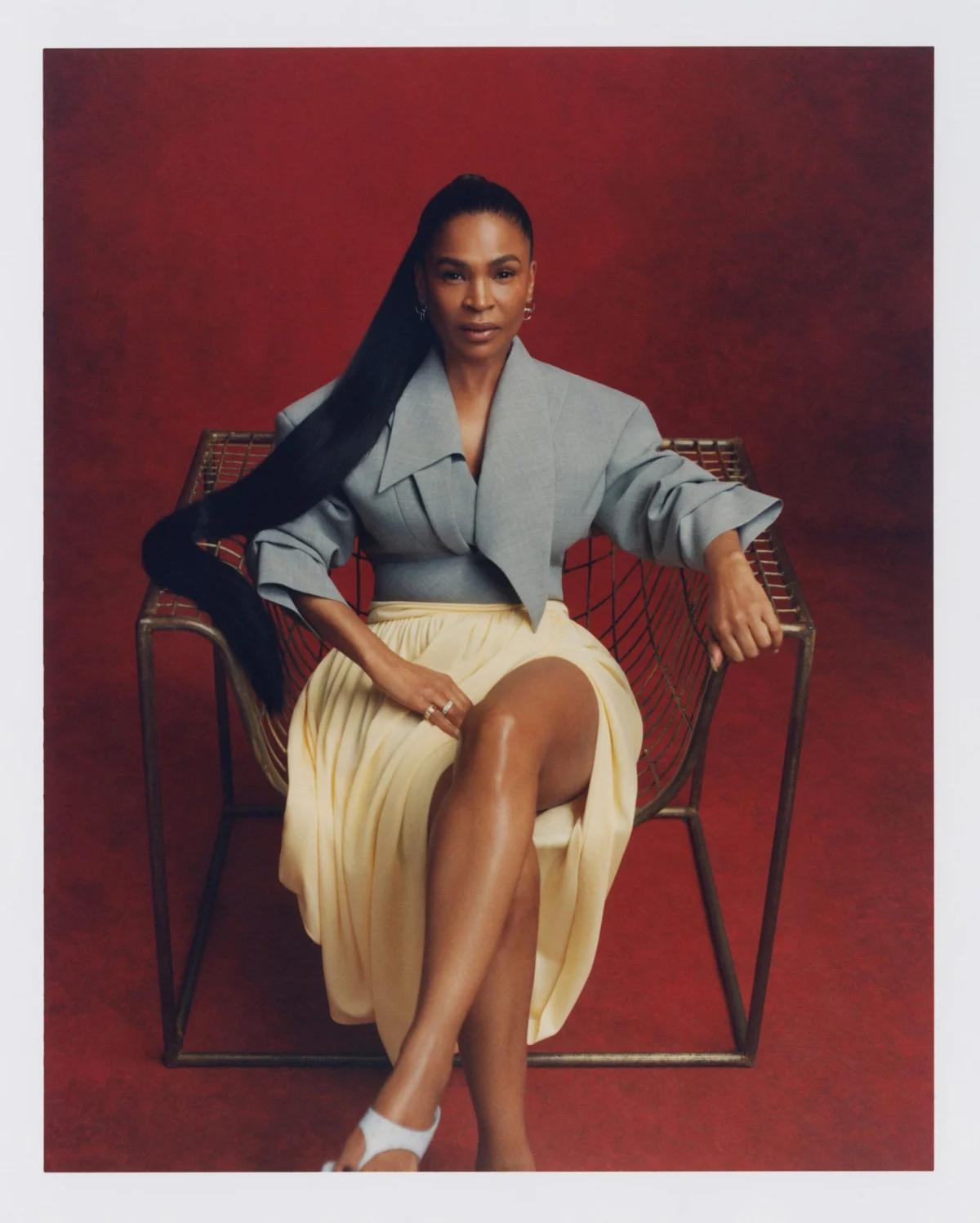
There is a specific, disorienting vertigo that accompanies exiting a darkened movie theater in the middle of a sun-drenched afternoon. The world feels jarringly loud, overly saturated, and fundamentally unreal. For two hours, you have existed within a meticulously crafted illusion, only to be thrust back into the mundane reality of the sidewalk, still wearing the emotional perfume of the film you just inhabited. It is in this headspace—somewhere between the cinematic and the real—that I meet Nia Long for an early lunch at the Chateau Marmont.
I have just screened Michael, the highly anticipated Michael Jackson biopic arriving this April, in which Long portrays the family matriarch, Katherine Jackson. As Long arrives, looking effortlessly chic in an oversized blazer, wide-leg denim, and a low-slung Miu Miu baseball cap, I am struck by a strange, double-exposure effect. The woman before me and the woman I just watched on screen—layered like transparencies held up to the light—begin to merge.
The Art of the Unspoken: Portraying Katherine Jackson
In Michael, Long delivers a performance defined by a masterclass in restraint. In her first appearance, observing her children’s rehearsals, the camera lingers on her face for several beats. She says nothing, yet the frame feels heavy with her presence. While Colman Domingo provides a boisterous, volatile performance as Joe Jackson, and Jaafar Jackson offers an uncanny transformation into his late uncle, Long chooses silence as her primary instrument.

"There have been moments in my life where I’ve been required to be more graceful than I’ve ever had to be in the past," Long reflects, picking at her salmon. "And that requires a sense of really being able to dig deep into some sort of self-examination. Like, what do I stand for? What’s important to me, ultimately, regardless of Hollywood, the noise? Number one, for me personally, my children come before anything."
For Long, Katherine Jackson is not just a character but a mirror for her own philosophy on survival. "I think when you look at Michael’s journey, and you look at Katherine’s journey, the only way you thrive and survive is through a tremendous amount of grace," she says, pausing thoughtfully. "What I think I learned from her is that sometimes grace is really quiet."
A Chronology of Influence: From ‘90s Icon to Industry Veteran
To speak of Nia Long is to speak of a specific pillar of modern American cultural memory. For a vast generation, she remains the "platonic ideal" of ’90s cool—a feeling as much as a look. From her turn as Nina in Love Jones to Jordan in The Best Man and Lisa in The Fresh Prince of Bel-Air, Long’s filmography is a tapestry of Black life at the end of the 20th century.

However, Long is quick to distance herself from the static image of "iconography." She views her career not as a pursuit of fame, but as a commitment to a craft that resonates with truth. "My commitment to work is not for accolades or attention, or even to be famous, quite honestly," she insists. "But I do think because of my commitment to truth and purpose, there is a thing—and I don’t know what that thing is—that people see in my work. It makes them feel good. It makes them feel inspired. It makes them feel like they know me."
Navigating the Fickle Landscape
In a Hollywood landscape that is notoriously fickle—particularly for Black women—Long’s longevity is a testament to her pragmatism. She does not take her current standing for granted. "There are highs and lows," she admits. "I’m having a great year, but I don’t know what’s happening next year."
Her strategy is surprisingly grounded: "The only strategy I have in this game is my bank account. Let’s strategize how we’re going to make money and create generational wealth. That is where I’m strategic." She laughs, momentarily breaking the intensity, before adding, "I work hard to make sure that when I represent us, it’s not just someone putting their agenda on me. Whether it’s my hair, my makeup, my wardrobe, my lines—I am intentional about that."

Second Acts and the Empty Nest
Now that her eldest son has reached adulthood and her 14-year-old is finding his own independence, Long is entering a season of personal and professional expansion. She is shifting her focus toward producing, seeking to control the narrative from behind the camera as well as in front of it.
She recently wrapped production on Don’t Ever Wonder, a romantic dramedy directed by Eugene Ashe. The film marks an onscreen reunion with her Love Jones co-star Larenz Tate. "This is not a continuation of Love Jones," she clarifies. "This is a continuation of love, and of what happens once you’ve had your kids, they’re off to college, and you’re empty nesters. There’s a lot of funny and there’s a lot of heartbreak, and I think it’s a really honest story."
The Weight of Public Scrutiny: Finding Clarity
The conversation inevitably pivots to the 2022 public scandal involving her former partner’s infidelity. It was a moment where the private, messy reality of a 13-year relationship was laid bare for public consumption. Long speaks of this period with an unflinching clarity that is as refreshing as it is rare in the celebrity sphere.

"The amount of pouring into myself that I’ve done is strong and mighty and intentional," she says. "I’ve now identified the things that I need to work on and the things that I need to heal. But I have also identified what is intolerable."
When asked about the outpouring of public support she received during that time, Long views it with characteristic nuance. "I’m proud of myself for giving so much grace. For being able to say people make mistakes and things happen. It’s life. I can’t do anything about that, but I don’t have to protect my ego in any of this."
Her advice for navigating heartbreak—whether in the public eye or behind closed doors—is pragmatic. "It’s not about another person’s behavior. It’s about your bottom line and the magnitude in which you’re committed to self-love. You don’t have to respond to the noise with the undercurrent of your own trauma."

Writing the Future: The Forthcoming Memoir
Currently, Long is channeling her experiences into her first memoir, a process she describes as "one of the biggest, bravest, most challenging things" she has ever done. It is a retrospective that requires her to confront her own history, including her childhood in Iowa City—an environment where she, as a young Black girl, first began to question her own beauty in a world that didn’t reflect her back to herself.
"In writing this memoir, I realized the impact that experience had on my own view of beauty," she says. "I thought I was beautiful because my mother said it and my family said it, but the world told me something different. So to now be a face for Estée Lauder, it’s kind of ironic, because I didn’t feel beautiful until Black Hollywood said I was beautiful."
This reflection serves as a poignant reminder of the labor involved in dismantling restrictive beauty standards. Long’s trajectory—from a young girl in the Midwest to an icon of "Nineties Fine"—was a direct response to an industry that often rendered Black women invisible.

Implications: The Freedom to Just Be
As our lunch concludes, Long prepares to return to the simple rhythms of life: a pizza party with her son and his friends. She rejects the "Black don’t crack" narrative, noting that at 55, she is fully aware of the hormonal and physical shifts of aging. She refuses to be "stored in amber" by her fans’ nostalgia.
"I don’t deprive myself of anything that I want," she says. "I find the balance."
For Nia Long, true freedom is no longer about the big stage or the accolades. It is the quiet, sovereign ability to exist on her own terms. "Being able to do what you want to do when you want to do it, because it serves your spirit, not what everyone else thinks you need to be or should be," she says, rising to leave. "You don’t have to have anyone else’s permission to do what you love. I know I have freedom right now to make a pizza. I’m going to do it."

In this, her next chapter, Long proves that her greatest performance is not in the scripts she reads, but in the life she continues to curate—with intention, with honesty, and, above all, with grace.
 Asro
Asro
 Suro Senen
