

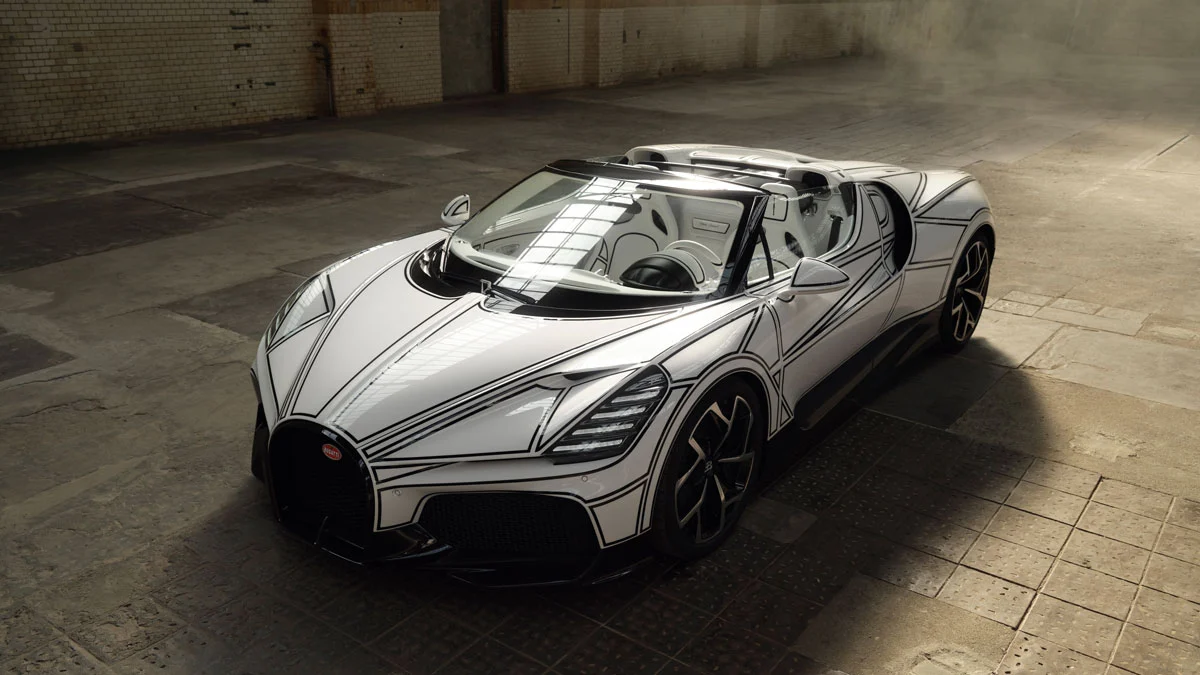
In the rarefied atmosphere of high-end automotive manufacturing, the boundary between engineering and fine art is frequently blurred. However, rarely does a machine emerge that demands to be viewed as both a record-breaking performance tool and a delicate museum-grade sculpture. The newly unveiled Bugatti W16 Mistral "Blanc Éternel" is precisely such an anomaly. As the latest one-off masterpiece from Bugatti’s Sur Mesure customization division, the Mistral "Blanc Éternel" serves as a breathtaking swan song for the legendary W16 engine, marrying the brutal, untamed power of a 1,578-horsepower roadster with the ethereal, fragile elegance of porcelain crafted by the historic Königliche Porzellan-Manufaktur Berlin (KPM).
The Main Facts: A Symphony of Speed and Ceramic
At its core, the "Blanc Éternel" is a celebration of the Mistral—a car already cemented in history as the final iteration of Bugatti’s street-legal W16 powertrain. Restricted to a global production run of only 99 units, the Mistral is the definitive convertible of the modern hypercar era.
Beneath its striking, zebra-striped exterior lies the heart of a titan: an 8.0-liter, quad-turbocharged 16-cylinder engine. Paired with a precision-engineered seven-speed DSG dual-clutch transmission, this powerplant enables the roadster to achieve a 0-to-62 mph (100 km/h) sprint in a blistering 2.4 seconds, surging toward a terminal velocity of 273 mph (440 km/h).

Yet, for this specific one-off commission, performance is merely the foundation. The "Blanc Éternel" takes the aerodynamic, digital-first styling of the Mistral and wraps it in a high-contrast monochromatic livery. By utilizing hand-taped linear patterns, the design team has managed to visualize the complex, "normally invisible" patch layout of the car’s digital design, turning the vehicle into a kinetic, abstract canvas.
A Chronological Legacy: From L’Or Blanc to the Present
The genesis of this collaboration dates back to June 30, 2011, exactly 15 years prior to the unveiling of the "Blanc Éternel." It was on that day that Bugatti introduced the world to the "L’Or Blanc" Veyron Grand Sport—a pioneering project that marked the first time an automotive manufacturer dared to integrate porcelain into the bodywork and interior of a vehicle capable of exceeding 250 mph.
The "L’Or Blanc" (White Gold) Veyron was a collaborative triumph that drew inspiration from the organic, flowing lines of a KPM porcelain vase envisioned by the Italian designer Enzo Mari. It was a bold statement of intent: a declaration that Bugatti would not be confined by the conventional industrial materials of the automotive world.

Fifteen years later, the "Blanc Éternel" acts as both a tribute to that milestone and an evolution of the concept. While the Veyron utilized flowing, organic blue-and-white patterns, the Mistral "Blanc Éternel" embraces a stark, linear geometry that reflects the evolution of digital design. It represents a 15-year arc of refinement, where the audacity of the original concept has been tempered by a deeper understanding of material science and precision engineering.
Supporting Data: The Science of Porcelain in Motion
Integrating porcelain into a vehicle that generates immense heat and vibration is a task that borders on the impossible. KPM, an atelier that has been defining the standard for fine European porcelain since 1763, was tasked with creating custom components that could withstand the rigors of a hypercar environment.
The technical challenges are immense. Porcelain is not a stable industrial plastic or carbon fiber; it is a sensitive, ceramic material that undergoes significant physical changes during its creation. During the firing and curing process in the furnace, the material shrinks by approximately 17 percent. Ensuring that components—ranging from the EB logo and the fuel/oil caps to the interior speaker covers, gear shift, and center armrest—fit perfectly requires a mastery of material science that KPM has perfected over centuries.

"Refining such a sensitive material for use in a vehicle of this performance class represents a remarkable achievement in craftsmanship," noted Thomas Wenzel, creative director at KPM. The precision required to ensure that these porcelain accents do not crack under the extreme vibrations of the W16 engine or the heat of the road is a testament to the synergy between the two brands. To celebrate this achievement, KPM has also released a 1,000-piece limited series of commemorative porcelain cups, allowing collectors a taste of the partnership outside the cockpit.
Official Responses and Design Philosophy
Bugatti’s design director, Frank Heyl, steered the development of the "Blanc Éternel" away from traditional clay modeling, opting instead for a purely digital approach. By manipulating a network of precisely controlled surfaces, the team identified the "patch layout"—the hidden mathematical skeleton of the car’s aesthetic—and highlighted it with hand-taped black lines.
This process was not limited to the exterior. The intricate, zebra-like motif flows seamlessly into the cabin, where the leather upholstery was painstakingly taped and painted to match the exterior’s linear, abstract aesthetic.

When reflecting on the broader philosophy, the words of former Bugatti director Stefan Brungs, spoken at the 2011 unveiling of the L’Or Blanc, remain remarkably relevant today: "At first, it seems to be an unusual idea to use porcelain in a car… But this is what Bugatti stands for: the realization of exceptional ideas whilst striving for the utmost in quality and aesthetics. This allows us to continue Ettore Bugatti’s heritage, who himself loved to experiment with new materials."
This spirit of experimentation is woven into the DNA of the brand. From the furniture-making heritage of Ettore’s father, Carlo, to the sculptural genius of his brother, Rembrandt, and the pioneering automotive designs of his son, Jean, the Bugatti family has always existed at the intersection of industry and art. The "Blanc Éternel" is the logical conclusion of this lineage.
The Implications: A New Benchmark for Customization
The creation of the Mistral "Blanc Éternel" has profound implications for the future of the Sur Mesure division and the broader hypercar market. It demonstrates that the demand for "bespoke" has moved beyond simple color palettes or personalized embroidery. Today’s elite collectors are seeking meaningful collaborations that bridge the gap between high art, historical craftsmanship, and cutting-edge automotive performance.

By partnering with an institution as storied as KPM, Bugatti has elevated the "one-off" hypercar from a mere toy into a collector’s piece that possesses genuine historical and artistic provenance. The "Blanc Éternel" is not just a car; it is a manifestation of the "everything is possible" ethos that has defined Bugatti for over a century.
As the industry shifts toward electrification and software-defined vehicles, the "Blanc Éternel" serves as a poignant, physical reminder of the tactile, mechanical, and artistic heights that the internal combustion era has reached. It is a parting gift to the purists—a car that will likely never be replicated, and one that ensures the W16 era concludes not with a whimper, but with a piece of fine art that resonates through the halls of history.
In the final analysis, the Bugatti Mistral "Blanc Éternel" stands as a triumph of human ingenuity. It proves that even in an age of mass-produced technology and digital manufacturing, there remains a place for the patient, fragile, and exquisite touch of the human hand—whether it is shaping porcelain in a 260-year-old kiln or hand-taping a record-breaking roadster to define the future of design.
 Ali Ikhwan
 Laily UPN
 Raul Delapena Setiawan
