

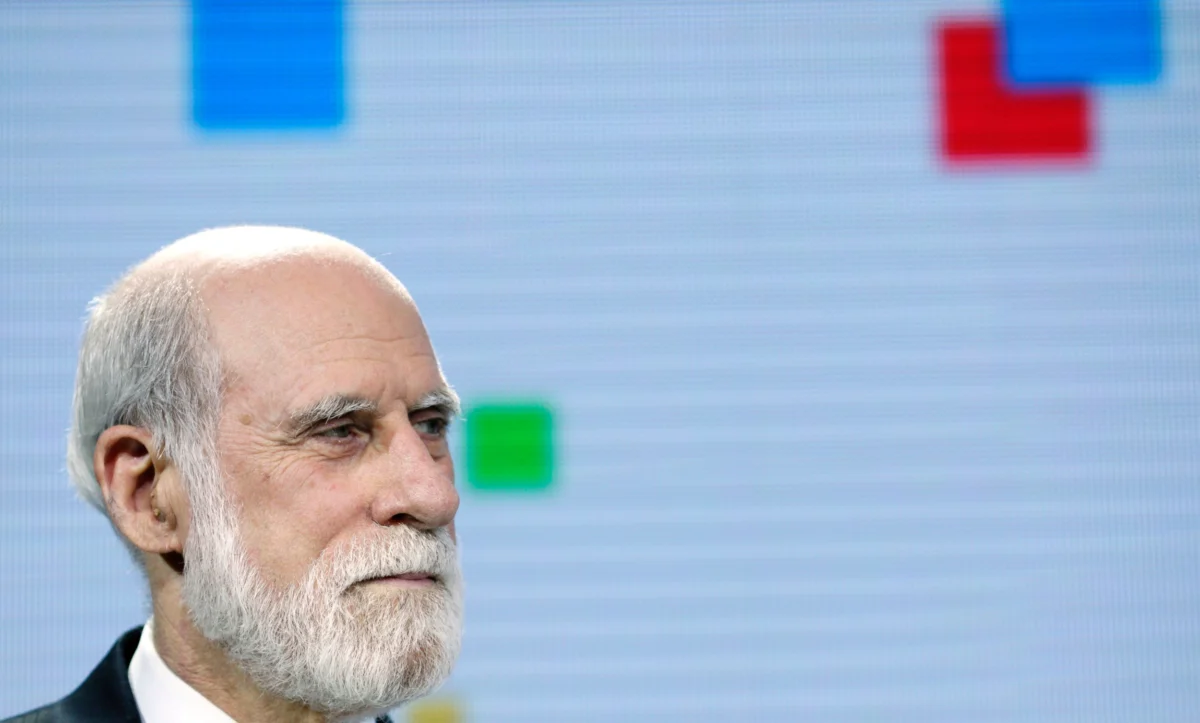
Next week, a chapter of computing history that spans more than half a century will draw to a quiet close. Vinton “Vint” Cerf, the 83-year-old visionary often cited as one of the "fathers of the internet," is set to step down from his long-standing role as Google’s chief internet evangelist. His departure marks the end of an era not just for Google, but for the global technological infrastructure that he helped bring into existence.
The announcement came during a poignant moment at the Open Frontier conference, hosted by the Laude Institute. As Cerf participated via video link, he was honored by his longtime colleague and contemporary, Dave Patterson—the UC Berkeley professor legendary for his work on RISC processor architecture.
“Vint has been at Google for more than 20 years, and he is retiring a week from today,” Patterson announced to the gathered crowd, prompting a standing ovation for the man whose work effectively defined the modern world. “I think we ought to give him a round of applause for a relatively good career.”
The Architect of Connection: A Chronology of Innovation
To understand the magnitude of Cerf’s departure, one must look back to the 1970s, a time when computers were siloed, room-sized monoliths unable to communicate across borders or even buildings. Along with his collaborator Robert Kahn, Cerf developed the Transmission Control Protocol and Internet Protocol (TCP/IP). These protocols serve as the fundamental "language" of the internet, allowing disparate computer networks to recognize one another, exchange data, and form a singular, cohesive global web.
Key Milestones in a Legendary Career:
- 1970s: Development of TCP/IP under the auspices of DARPA, creating the backbone of the nascent internet.
- 1980s: Cerf played a critical role in the transition of ARPANET to the TCP/IP standard, the "big bang" moment for internet expansion.
- 1990s: He served as the founding president of the Internet Society (ISOC), advocating for the open, decentralized nature of the network.
- 2005: Cerf joined Google as vice president and chief internet evangelist, a role in which he became the company’s intellectual ambassador to the world.
- 2004: Awarded the A.M. Turing Award—often called the "Nobel Prize of Computing"—alongside Robert Kahn for their pioneering work in networking.
- 2005: Awarded the Presidential Medal of Freedom by President George W. Bush for his role in shaping the modern information age.
His career has been defined by a commitment to open architecture. Unlike the proprietary, walled-garden models that dominate many sectors of the tech industry today, Cerf’s internet was built on the philosophy of interoperability—the idea that any machine should be able to talk to any other machine, provided they share the same basic rules of engagement.
The Google Years and the "Evangelized" Internet
Since joining Google in 2005, Cerf has functioned as something of a technological statesman. While the title "chief internet evangelist" might seem quaint in an age where the internet is ubiquitous, it served a vital purpose. In the mid-2000s, the web was still maturing, and Cerf’s presence helped bridge the gap between academia, government policy, and the commercial ambitions of a rapidly growing Google.
For two decades, he has been the voice of reason during debates over net neutrality, digital equity, and the governance of the web. While he steps down with the humorous acknowledgment that the internet is now "fully evangelized—for better or worse," his impact on Google’s internal culture remains profound. As of the time of publication, Google had not issued an official statement regarding the transition, though industry observers expect a significant retrospective on his contribution to the company’s ethos.
Open Source and the Future of AI
Cerf’s final public appearances in his official Google capacity have seen him deeply engaged in the current debates surrounding Artificial Intelligence. At the Open Frontier conference, he sat on a panel with some of the most influential minds in computer science, including François Chollet (creator of Keras), John Ousterhout (creator of Tcl), and Matei Zaharia (co-founder of Databricks).
The discussion centered on the fragility of modern, centralized AI models. While the early internet thrived because of its decentralized, protocol-based nature, modern AI is currently dominated by a handful of well-resourced labs that control the hardware, the models, and the interfaces.
Cerf offered a contrarian view on the future of this "agentic" era. He argued that the very nature of autonomous AI agents—software that can act on behalf of users and coordinate with other software—will eventually force a return to the principles of standardization and interoperability that defined his own life’s work.
“The agentic model of AI, with multiple agents from multiple sources interacting with each other, is going to force composability and a requirement for interoperability,” Cerf predicted. He noted that if this comes to pass, the companies that establish the standards for how these agents communicate will hold the keys to the next phase of the digital economy.
The Risks of Natural Language in Agentic Systems
One of the more fascinating insights from Cerf’s recent commentary is his skepticism regarding the reliance on natural language (like English) for machine-to-machine communication. While many researchers believe that Large Language Models (LLMs) can simply "talk" to one another to coordinate, Cerf warned that this is a recipe for error.
“I don’t think English is going to be the best choice,” Cerf said. “There’s a flexibility in it, but there’s ambiguity, and I think precision for inter-agent interaction is going to be very, very important.”
He drew a parallel to the classic "telephone game," where a message becomes distorted as it passes through a chain of people. “Imagine a bunch of agents talking to each other in natural language—that’s kind of terrifying,” he remarked, emphasizing that formal, precise protocols will be necessary to ensure that agents actually understand the agreements they are making with one another.
Personal Legacy: More Than Just Code
Beyond the technical achievements, Cerf is remembered for his distinct personality and his penchant for professional sartorialism. In a lighthearted segment of the conference, Dave Patterson recalled meeting a young, impeccably dressed Vint Cerf in the 1970s.
“He’s always been the best-dressed computer scientist I’ve ever met,” Patterson noted.
Cerf, known for his signature three-piece suits, laughed off the compliment, explaining his fashion choice as a form of non-conformity. “I even had a vest, and for some reason, I always wanted to stick out,” Cerf said. “Instead of having long hair and something in my nose, I thought just dressing differently was one way to do it.”
Implications for the Future
As Vint Cerf steps away from his desk at Google, he leaves behind a landscape that is fundamentally his creation. Yet, the challenges he identified—the tension between centralization and openness, the need for robust standards, and the dangers of unmanaged ambiguity—remain the defining challenges for the next generation of engineers.
His career suggests that the most durable systems are those that are designed to be agnostic to the specific content they carry, focusing instead on the reliability of the connection. Whether the world of AI follows this "Cerfian" path of open protocols or descends into a fractured landscape of proprietary ecosystems remains the central question of the next decade.
For now, the man who helped build the digital world prepares to move on, leaving the internet, as he puts it, "fully evangelized." His legacy is not merely in the protocols that bear his fingerprints, but in the enduring, decentralized, and open spirit of the network that connects us all.
 Asep Darmawan
 Siti Muinah
 Ali Ikhwan
