

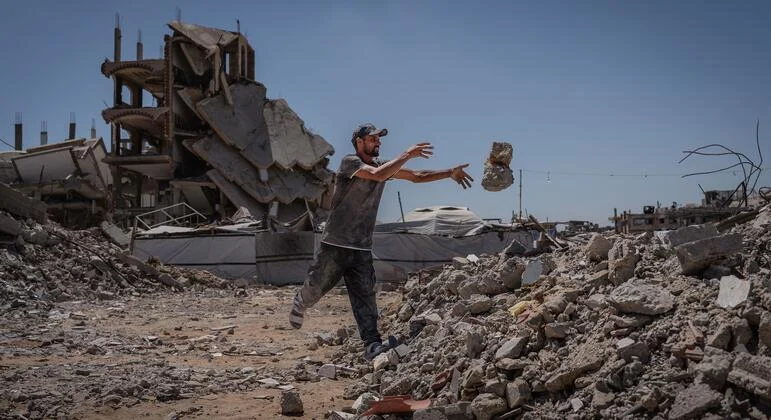
JERUSALEM/GAZA – The humanitarian catastrophe in the Occupied Palestinian Territory (OPT) has reached a new, precarious threshold. As Israeli forces expand their areas of control across the Gaza Strip, the United Nations and its humanitarian partners have issued a stark warning: the "shrinking" of accessible space is placing an unsustainable burden on an already devastated civilian population, while movement restrictions are effectively strangling the delivery of life-saving aid.
In a comprehensive statement released this week, the Humanitarian Country Team in the OPT detailed a landscape defined by lethal access restrictions, the systematic displacement of families, and a deepening public health emergency. The report underscores that as military zones expand, the geographical reality for nearly two million people is becoming increasingly constricted, leaving them with nowhere to go.
The Geography of Exclusion: A Shrinking Territory
The crisis is defined by a rapid expansion of what the UN characterizes as "access-restricted areas." Currently, these zones—where movement is prohibited or strictly controlled by the Israeli military—encompass approximately 65% of Gaza’s total landmass.
For the hundreds of thousands of Palestinians who have been displaced multiple times since the outbreak of hostilities, this reality has transformed the Gaza Strip into a series of overcrowded, disconnected enclaves. The "Yellow Line," a demarcation marker used by Israeli forces to delineate areas of military control, has become a moving boundary that forces families to flee their makeshift shelters with little to no notice.
In a recent incident in Beit Lahia, residents were forced to evacuate after Israeli forces advanced into their area. Reports indicate that incendiary munitions were dropped from the air, setting tents ablaze, while heavy yellow cement blocks were deployed to mark the new, expanded boundaries of the exclusion zone. This tactical expansion, while framed by the military as a security measure, has effectively rendered the vast majority of the territory off-limits to its residents.
Chronology of Escalation: Lethal Force and Access
The humanitarian situation has deteriorated significantly since the collapse of recent ceasefire efforts. The UN’s Office of the High Commissioner for Human Rights (OHCHR) has verified a disturbing trend regarding the use of lethal force in these newly demarcated zones.
- October 10, 2025 – April 2026: During this period, the UN verified the killing of 196 Palestinians in areas near Israeli military deployments.
- The Demographic Toll: Among those killed were 18 women and 43 children.
- The Nature of the Violence: Many of the victims were reportedly killed while attempting to move through areas where demarcation was unclear or non-existent. Others were injured in incidents that the UN describes as "targeting" civilians who were perceived to be straying too close to military positions.
These figures represent only verified cases; aid organizations suspect the actual death toll in these restricted areas is likely higher, as emergency services are frequently unable to access these zones to recover bodies or provide medical care.
Humanitarian Operations Under Siege
The expansion of these military zones has had a paralyzing effect on humanitarian aid. International NGOs and UN agencies have reported that the coordination process for aid convoys has become increasingly unreliable, leading to significant delays and the suspension of essential services.
The killing of service providers—including aid workers and local staff—operating in or near these areas has forced many organizations to scale back or temporarily suspend operations. This has created a cascading effect:
- Supply Chain Disruption: Life-saving assistance, including food and medical supplies, remains trapped at checkpoints or diverted due to security concerns.
- Infrastructure Decay: With humanitarians unable to reach damaged areas, the repair of water, sanitation, and power infrastructure remains at a standstill.
- The Aid Funding Gap: Adding to the operational challenges is a dire financial shortfall. Humanitarian agencies have reported that less than 25% of this year’s required funding has been secured, leaving agencies unable to scale up even if access were granted.
Public Health: A Breeding Ground for Disease
Overcrowding in the remaining "safe" zones has created a perfect storm for a secondary health crisis. With residents compressed into smaller and smaller areas, sanitation systems have collapsed.
Health agencies report a significant rise in skin diseases and acute watery diarrhoea. These conditions are not merely symptoms of a war zone; they are direct consequences of the lack of clean water and the inability of sanitation crews to remove waste from the streets.
A Rare Bright Spot: The Firas Market Initiative
Amid the gloom, the UN Development Programme (UNDP) has achieved a rare, albeit small, success. This week, the UNDP announced that it had successfully cleared 50% of the "mountain of solid waste" that had accumulated at the historic Firas Market in Gaza.
By removing approximately 250,000 cubic metres of debris and waste, the agency has cleared 75% of the market area, providing a glimmer of hope that one of Gaza’s commercial hubs could eventually be restored. However, the UNDP acknowledges that such efforts are "drops in the ocean" compared to the scale of the destruction across the territory.
Official Responses and International Law
The UN and its humanitarian partners have issued a unified call for an immediate cessation of the targeting of civilians. The core of their argument rests on International Humanitarian Law (IHL), which mandates that parties to a conflict must distinguish between military objectives and civilians.
"Civilians must always be protected," the UN stated in its latest briefing. "The use of lethal force against individuals who are often simply trying to find safety or access basic resources is a violation of international human rights and humanitarian law."
There has been no official acknowledgment from the Israeli military regarding the specific allegations of targeting civilians near the "Yellow Line," though the military consistently maintains that its operations are conducted to mitigate threats posed by armed groups and that it takes steps to warn civilians before advancing into specific sectors.
Implications: A Future in Jeopardy
The implications of the current trajectory are grim. As the space available to civilians continues to shrink, the capacity for the international community to provide a "humanitarian shield" is eroding.
- The Displacement Cycle: With nowhere left to flee, the cycle of displacement is reaching its physical limit. The "safe zones" are effectively becoming traps.
- Long-term Health Impacts: The long-term consequences of the current health crisis—including potential outbreaks of more severe communicable diseases—could persist for years after the fighting ceases.
- The Erosion of Humanitarian Space: By normalizing the restriction of movement and the use of lethal force in contested zones, the conflict is establishing a dangerous precedent that undermines the ability of global aid networks to function in future conflicts.
As the international community watches the situation unfold, the message from the UN is clear: without an immediate change in policy regarding access and the protection of civilians, the humanitarian catastrophe in Gaza is set to deepen, further cementing a legacy of destruction that will require generations to address.
The immediate demand from aid agencies remains unchanged: open the crossing points, provide clear and safe humanitarian corridors, and end the military enforcement that restricts the movement of those simply seeking to survive. Until these conditions are met, the people of Gaza remain caught in a closing vice, waiting for a reprieve that currently shows no signs of arriving.
 Lina Hope
 Asro
Asro
 Layla Zulfa
