

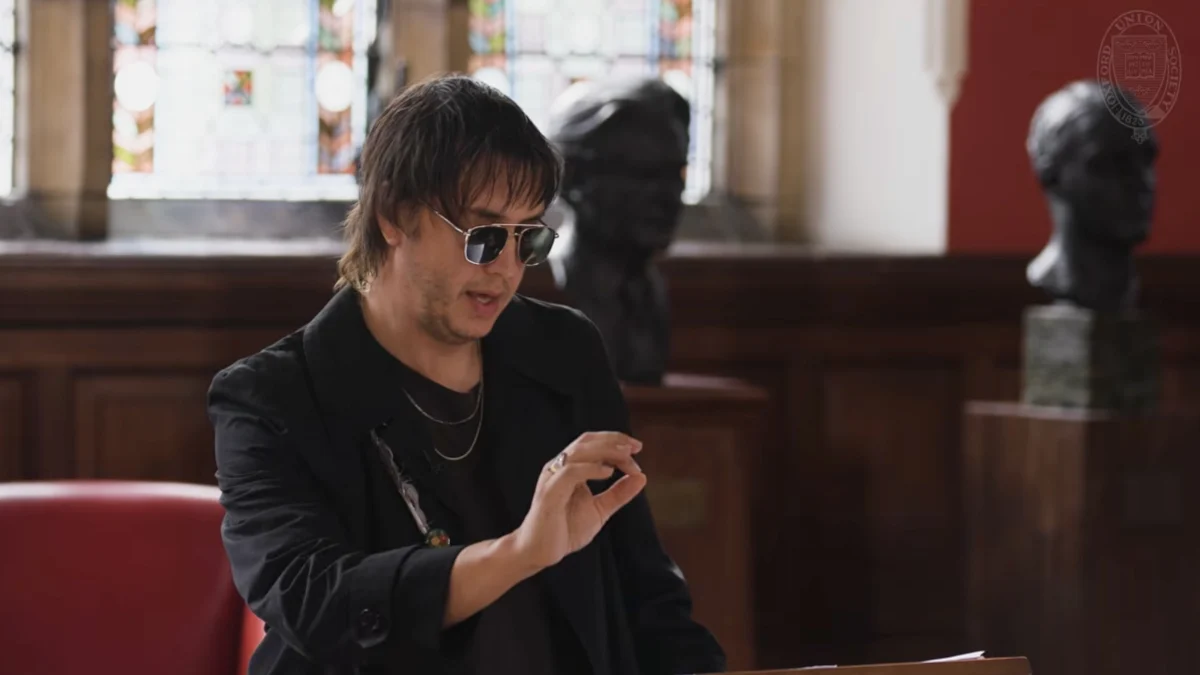
In a wide-ranging and deeply personal appearance at the Oxford Debating Society, Julian Casablancas, the frontman of The Strokes, has sought to clarify and expand upon controversial remarks he made earlier this year regarding Zionism, privilege, and the nature of modern political discourse. The speech, which was delivered in May but recently released in full to the public, serves as a significant pivot for the musician, who has increasingly used his platform to engage with complex geopolitical issues.
The controversy stems from an April appearance on the popular web series SubwayTakes, where Casablancas, when prompted to provide his "most controversial opinion," argued that certain "American Zionists" leverage the benefits of white privilege while simultaneously adopting a narrative of victimhood he likened to "Black people during slavery." The statement ignited a firestorm of criticism and debate, prompting the singer to utilize the academic setting of Oxford to provide a more nuanced articulation of his views.
A Chronology of the Controversy: From Subway to Oxford
The trajectory of this discourse began as a fleeting, high-tension moment in a viral social media format and evolved into a protracted intellectual defense.
The SubwayTakes Catalyst
During his April guest spot on SubwayTakes with host Kareem Rahma, Casablancas was asked for a provocative take. His response was immediate and sharp: he asserted that some American Zionists occupy a position of societal privilege while framing their political stance through a lens of existential persecution. He further waded into the volatile subject of the October 7th, 2023, Hamas attacks, drawing historical parallels between that event and violent slave rebellions or indigenous uprisings, arguing that the brutality of a reaction does not inherently invalidate the underlying historical grievances that triggered it.
The Oxford Expansion
Recognizing that the brevity of the SubwayTakes format inherently stripped his comments of necessary context, Casablancas utilized his Oxford appearance to dismantle his earlier shorthand. He expressed a desire to move away from "rage bait" cycles, which he contends have stripped modern political language of its utility. At Oxford, he clarified that his criticism was not aimed at Jewish individuals as a whole, nor was it a denial of Israel’s right to exist. Rather, he distinguished between what he terms "green liners"—those who respect established international borders—and "expansionists," whom he blames for the ongoing destabilization of the region.
The Semantic Battle: Defining Zionism and "Expansionism"
At the heart of Casablancas’s argument is the belief that the word "Zionism" has become an empty vessel, a term used to deflect from the more specific and controversial policy of territorial expansion.
The "Nerve Point" of Expansion
Casablancas posited that the core of the friction surrounding modern Zionism is not a philosophical disagreement over the state’s existence, but a tangible conflict regarding the expansion of Israeli settlements. He drew a comparative analogy to British history: "You can love England and want its inhabitants safe without wanting it to control India, for example." By framing "expansion" as the true point of contention, he attempted to isolate the policy from the identity of the Jewish people, whom he characterized as brothers and friends.
The Litmus Test of "Genocide"
Perhaps the most contentious segment of his speech involved the language used by activists. Casablancas suggested that the refusal by some to label the current situation in Gaza a "genocide" serves as a modern-day "dog whistle." He compared this linguistic hesitation to the refusal to affirm "Black Lives Matter," suggesting that such reluctance signals a failure to grasp the fundamental human rights at stake. He argued that if an individual’s support for Israel’s existence is predicated on ignoring the humanitarian catastrophe in Gaza, they are—even if inadvertently—providing cover for systemic inequality and supremacy.
Supporting Perspectives and the Critique of Discourse
Casablancas’s speech was not merely a defense of his past comments but a broader critique of how public discourse is conducted in the digital age. He lamented the loss of "ideal distinctions" in our vocabulary, noting that without precise language, we are trapped in "endless rage bait circles."
The "Indoctrinated Moderate"
In his clarification, he introduced the concept of the "good-hearted indoctrinated moderate." This group, he argued, is not malicious but has been conditioned to adopt a victim-oriented language that masks the reality of their political support. By differentiating between those who hold deep, foundational beliefs and those who are perhaps repeating propaganda points, Casablancas attempted to move the needle toward a more analytical, rather than reactionary, form of debate.
Challenging the "Defensive" Stance
The musician noted that he finds the "greater America project" to be equally flawed, yet he does not feel the need to defend it. He challenged his audience to adopt a similar level of critical introspection, suggesting that one can love a country while being deeply critical of its expansionist policies. He argued that acknowledging past and present wrongs is not an act of betrayal, but a prerequisite for progress.
Implications for Public Intellectualism and Celebrity
The involvement of a high-profile rock star in such a polarizing debate highlights a shift in how pop culture figures are engaging with global politics.
The Burden of the Soundbite
Casablancas’s reflection on the SubwayTakes incident serves as a cautionary tale regarding the speed of modern media. He admitted that he had offered nine different takes before landing on the one that went viral, suggesting that the "long audio messages" he prefers are a better medium for his thoughts than the "meandering" soundbites that often define social media engagement. This realization underscores a growing tension between the complexity of historical conflicts and the algorithmic demand for instant, binary opinions.
The Impact on the Fanbase
As The Strokes continue their headlining tour, the singer’s public stance presents a unique dynamic. While some fans and critics have applauded his willingness to engage with uncomfortable truths, others have criticized his use of historical analogies as reductive or insensitive. The intensity of the response, however, confirms that for a significant portion of his audience, the music of the 2020s is inextricably linked to the political stances of its creators.
Conclusion: A Call for Linguistic Clarity
The Oxford speech represents an attempt by Julian Casablancas to reclaim the narrative of his own political identity. Whether one agrees with his assessment of Zionism or his interpretation of historical rebellion, the speech serves as a clear indication that the musician is not retreating from the controversy he ignited.
By demanding more precise language and urging his listeners to look past the slogans of both sides, Casablancas has positioned himself not as a traditional political analyst, but as an observer attempting to navigate a landscape of "muddled" conversations. The long-term implications of his rhetoric remain to be seen, but the event itself confirms that the discourse surrounding the Middle East has reached a point where it is no longer contained within the walls of academia or government, but has become a central component of the modern cultural dialogue.
As the debate continues, the "green liner" vs. "expansionist" distinction may become a more frequent part of the lexicon for those looking to articulate a position that balances support for Israeli security with a critique of territorial growth. For now, the takeaway from the Oxford stage is clear: Casablancas is uninterested in the safety of silence, preferring the heat of the debate, even if it requires the constant, difficult work of clarification.
 Ammar Sabilarrohman
 Lina Irawan
 Nana Muazin
