

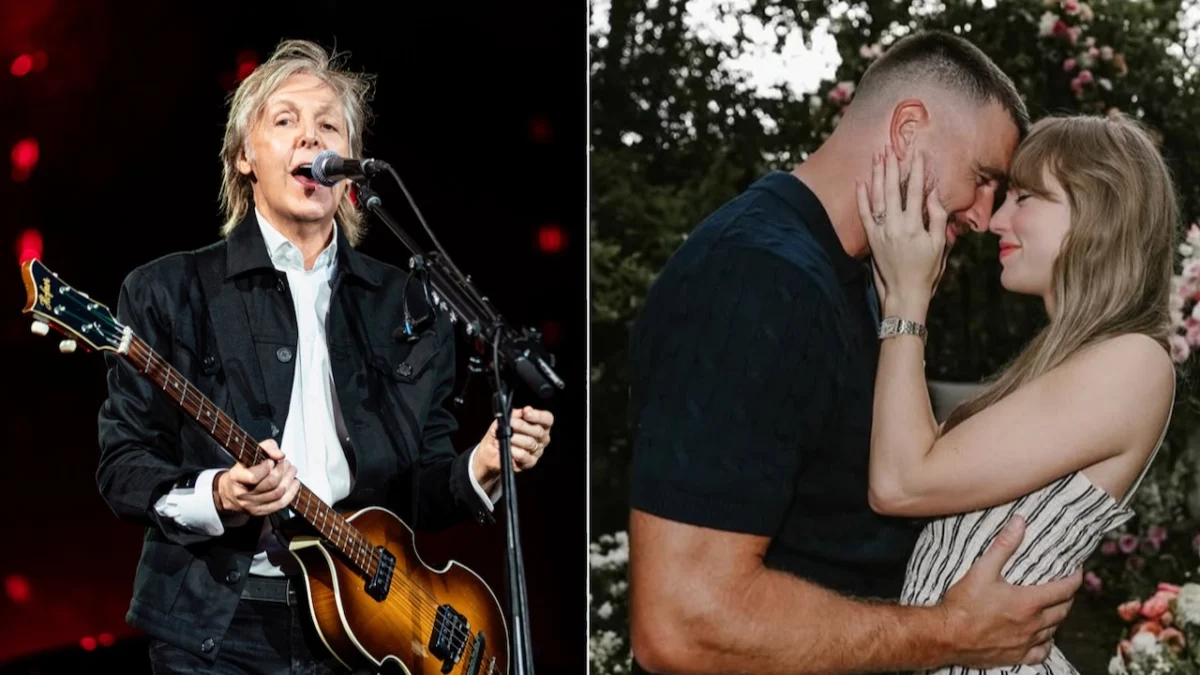
In an era defined by high-production spectacles and viral digital moments, a singular, intimate performance at Madison Square Garden has captured the world’s attention. During the wedding reception of pop icon Taylor Swift and NFL superstar Travis Kelce on Friday night, legendary Beatle Paul McCartney delivered a musical gift of unparalleled historical significance. According to reports, McCartney performed the Fab Four’s 1963 smash hit, "I Want to Hold Your Hand," marking the first time the song has been performed live by a member of The Beatles in 62 years.
The performance served as the emotional centerpiece of a star-studded reception, bridging generations of musical history while celebrating one of the most publicized unions of the modern celebrity age.
The Main Facts: A Return to 1964
The revelation of the performance, first reported by People, has sent shockwaves through the music industry and pop culture historians alike. McCartney, 84, took to the stage at the iconic New York venue to honor the newlyweds, opting for a deep cut from the Beatles’ legendary catalog—a song that hadn’t graced a live stage since the height of Beatlemania.
"I Want to Hold Your Hand," which propelled The Beatles to global superstardom and served as their breakthrough American single, has long been a staple of record collections but a rarity in concert setlists post-1964. McCartney’s decision to revisit the track for Swift and Kelce’s wedding underscores the profound mutual respect between the songwriter and the modern-day songstress.
The reception, held at Madison Square Garden, was a masterclass in exclusivity. While the couple has remained notoriously protective of their private lives, the inclusion of McCartney—and additional guest performer Stevie Nicks—transformed the ceremony from a celebrity wedding into a landmark cultural event.
Chronology of a Classic: The Long Hiatus
To understand the weight of Friday night’s performance, one must look back at the trajectory of "I Want to Hold Your Hand."
1963–1964: The British Invasion
Released in November 1963, the song reached the top of the charts in the United Kingdom before crossing the Atlantic to ignite the "British Invasion" in the United States. It was the quintessential anthem of the mid-60s, characterized by its infectious energy and harmonies.
September 1964: The Final Curtain
The last time the song was performed live by a member of The Beatles was during a concert at New York City’s Paramount Theatre in September 1964. Following that era, the band famously retreated from the concert stage to focus on studio experimentation, eventually leading to the dissolution of the group in 1970. In the decades that followed, McCartney cultivated a massive solo career, frequently performing Beatles hits, yet "I Want to Hold Your Hand" remained conspicuously absent from his setlists, perhaps viewed as a relic of the hysteria of 1964 that was best left in the past.
July 2026: The Revival
Friday night marked the end of a 62-year silence for the track. By choosing this specific song, McCartney offered a bridge between the innocence of the early 60s and the modern, high-stakes romance of Swift and Kelce.
Supporting Data: The Magnitude of the Moment
The significance of this performance cannot be overstated. From a musicological perspective, "I Want to Hold Your Hand" is arguably the most influential song in the history of rock and pop music.
- Chart Dominance: The song spent seven weeks at number one on the Billboard Hot 100 in 1964.
- Cultural Impact: It is widely credited with establishing the Beatles’ foothold in the American market, changing the landscape of the music industry overnight.
- The "McCartney" Factor: McCartney’s voice, which has aged with a gravelly, soulful wisdom, provided a stark contrast to the youthful exuberance of the 1964 recording. The performance was not merely a cover; it was a re-contextualization of a song that defined a generation.
Furthermore, the involvement of Stevie Nicks—another titan of the industry—adds layers to the narrative. Nicks, known for her mystical stage presence and songwriting prowess, provided a secondary musical pillar to the night, suggesting that the event was designed to be a "who’s who" of musical legends paying homage to the couple’s intersection of football and pop stardom.
Official Responses and Behind-the-Scenes
While representatives for Swift and Kelce have maintained a strict "no-comment" policy regarding the private details of the ceremony, sources close to the event have described the atmosphere as "electric" and "deeply emotional."
Industry insiders note that McCartney and Swift have shared a long-standing mutual admiration. The two were famously featured in a Rolling Stone "Musicians on Musicians" conversation in 2020, where they discussed the mechanics of songwriting, the pressures of fame, and the evolution of their respective careers. That rapport is likely what prompted the invitation and the subsequent willingness of McCartney to reach into his archival catalog to provide such a unique gift.
"It wasn’t just a performance," said an anonymous guest. "It felt like a passing of the torch. Seeing Paul up there, playing something that hadn’t been heard live in six decades, in front of the biggest artist of our time—it felt like time stood still."
Implications: The Legacy of the Wedding
The ripple effects of this performance will be felt for years to come. In the immediate term, there is the inevitable spike in streaming numbers for the 1963 original. However, the broader implication is the solidification of Taylor Swift’s place within the pantheon of music history.
The Intersection of Eras
By aligning her wedding with the legacy of Paul McCartney and Stevie Nicks, Swift is effectively cementing her status as the bridge between the analog legends of the 20th century and the digital-first era of the 21st. It signals that while her career is rooted in modern pop, she is deeply connected to the foundational pillars of the music industry.
The "Legend" Standard
For Travis Kelce, entering into this union has thrust him into a world of artistic high-stakes. The presence of McCartney at his wedding underscores the reality that this partnership is not just a high-profile marriage; it is a cultural alliance. The performance sets an incredibly high bar for celebrity weddings moving forward, moving away from the trend of curated social media moments and toward experiences that prioritize historical and artistic weight.
The Preservation of the Songbook
Finally, McCartney’s performance acts as a preservationist gesture. By reviving a song that had been dormant for 62 years, he has re-introduced the song to a demographic that may only know it through history books. It is a reminder that the music of the past remains vibrant, capable of being reclaimed and repurposed for new milestones.
Conclusion: A Night for the History Books
As the dust settles on what is arguably the most significant wedding of the decade, the focus remains on that brief, 62-year-old melody. Paul McCartney, the man who helped invent the modern pop concert, chose to end the longest hiatus of his career for a moment of personal, private celebration.
In doing so, he provided a masterclass in how to honor the past while participating in the future. Taylor Swift and Travis Kelce may have walked down the aisle to start their new life together, but they did so to the soundtrack of music history—a performance that reminded every guest in the room that some songs, and some moments, are truly timeless.
 Asro
Asro
 Lina Irawan
 rifanmuazin
