

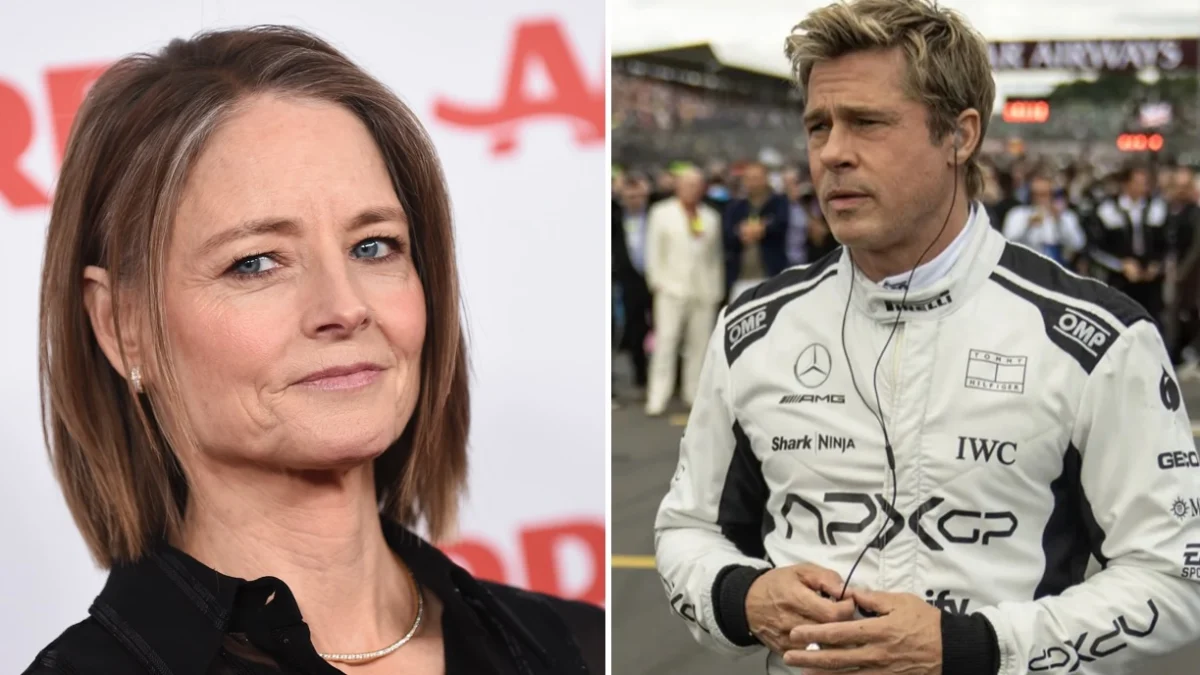
In an era where the lines between human creativity and machine-generated content are increasingly blurred, Academy Award-winning actress and filmmaker Jodie Foster has ignited a firestorm of discussion regarding the future of Hollywood. Speaking at the Aspen Ideas Festival on Tuesday, June 30, Foster turned her critical eye toward the high-octane world of the Brad Pitt-led racing drama F1. Her assessment was both provocative and emblematic of the industry’s current existential crisis: she openly wondered if the film’s hyper-structured narrative and predictable dialogue were the products of artificial intelligence.
The Catalyst: Foster’s Critique of F1
Foster, appearing alongside former Sony Pictures CEO Michael Lynton for a panel titled “Who Owns the Future of Hollywood,” delivered her remarks with a mix of humor and professional skepticism. While acknowledging the financial success of F1, which grossed millions at the global box office, Foster pinpointed a specific, sterile quality to the film that she attributed to the encroaching influence of generative AI.
“I look at a movie like F1 and I’m like, ‘F1 was made by AI,’ wasn’t it?” Foster remarked to the audience. “The structure was exactly the structure that you would learn in film school. The actors say the lines exactly the way it would be written if a computer was processing the ‘optimal’ response for that specific moment.”
For Foster, the issue isn’t necessarily the technical capability of the film, but rather its adherence to a rigid formula. She described the experience of watching the movie as seeing a product that has been engineered to tick every box of a standard blockbuster, lacking the messy, human unpredictability that traditionally defines great storytelling. She noted that while the filmmakers successfully leveraged technology to create “something big and beautiful,” the result felt curated by an algorithm designed to maximize engagement rather than elicit profound human connection.
A Chronology of the AI Shift in Hollywood
To understand why Foster’s comments resonated so deeply, one must look at the rapid evolution of technology in filmmaking over the past five years.
- 2020-2022: The early integration of AI focused primarily on post-production: de-aging actors, digital makeup, and cleaning up audio. These were viewed as tools to assist craftsmen rather than replace them.
- 2023: The landmark SAG-AFTRA and WGA strikes were fundamentally defined by the fear of AI. Writers and actors demanded protections against the unauthorized use of their likenesses and the potential for AI to draft scripts based on existing IP.
- 2024: Studios began experimenting with AI in "previz" (pre-visualization), using software to map out shots and sequences, significantly lowering the cost of production by reducing the need for physical set planning.
- 2025: The release of F1 arrived at a time when audiences began noticing a "sameness" in tentpole films. Critics and viewers alike started pointing out that big-budget movies felt increasingly homogenized—a trend Foster explicitly links to the reliance on data-driven scripts and structural templates.
The Reality of AI: Beyond the Buzzwords
Contrary to a Luddite approach, Foster is far from anti-technology. She acknowledged that AI serves a vital role in "small, helpful things." She revealed that she has even experimented with the technology herself, utilizing AI to generate dream-like sequences for her film My Private Life. Her experience, however, was a testament to the limitations of the medium: the AI-generated images, while visually arresting, were largely nonsensical, lacking the intentionality of a human artist.
This nuance is crucial. Foster differentiates between AI as a tool for efficiency—such as streamlining the labor-intensive process of previz—and AI as a creative driver. Her critique of F1 suggests that when AI is used to dictate the structure and dialogue of a story, the soul of the film is sacrificed for technical perfection.
The "AI-ification" of the Blockbuster
Foster’s suspicion that F1 felt "AI-written" aligns with a growing body of criticism regarding the current state of major studio filmmaking. As noted in critical reviews, including those from Consequence, the film often relies on a distorted version of Brad Pitt’s established "movie star" persona. The pacing, characterized by jarring edits that skip over vast swathes of narrative tension, and the relentless presence of corporate branding, contribute to a viewing experience that feels less like a journey and more like a collection of assets optimized for market penetration.
This "AI-ification" refers to a phenomenon where character development and nuance are sacrificed for a sequence of events that the data suggests will keep an audience from losing interest. It is a feedback loop: studios feed successful scripts into models, the models identify the "most successful" structures, and writers are then tasked with filling those templates with dialogue. The result is a film that is technically "correct" but emotionally hollow.
Labor, Ethics, and the Role of Unions
Perhaps the most significant portion of Foster’s commentary involved the human cost of this technological shift. She highlighted that the fears regarding AI replacing background actors—or "extras"—are already a reality. Studios are increasingly using digital replicas to populate large crowd scenes, a move that reduces the need for human labor and the associated costs of insurance, travel, and craft services.
Foster’s stance on this is clear: she advocates for strong union intervention. “We’re getting rid of a lot of jobs, and hopefully, things like unions will be able to come in and say, ‘You can use my actor 20 times, but you’re going to pay him 20 times.’ And I think that’s fair.”
This assertion touches on the core of the ongoing labor disputes in Hollywood. The goal of the unions is not to ban technology, but to ensure that the economic benefits of increased efficiency are shared by the humans who provide the "raw material"—the voices, faces, and performances—that allow the AI to function in the first place.
The Path Forward: Dominating the Technology
Despite her critiques, Foster remains cautiously optimistic about the future of the medium. Her closing remarks at the Aspen Ideas Festival served as a call to action for the creative class: “If we are able to dominate AI consistently over time, we will be able to make things that reflect us, and we can make things better.”
The implication is that AI should be a subservient tool, not a creative director. If filmmakers can maintain control over the "intent" of a story—ensuring that the machine is merely executing a human vision rather than dictating the narrative arc—then the technology can actually expand the possibilities of what can be shown on screen.
Conclusion: The Human Element in a Digital Age
Jodie Foster’s critique of F1 is not just about a single racing movie; it is a critique of a systemic trend toward aesthetic and narrative standardization. Whether F1 was literally written by an algorithm or simply influenced by the same data sets that power modern AI, the effect on the viewer remains the same: a feeling of detachment.
As Hollywood continues to grapple with the integration of artificial intelligence, the industry will have to decide what it values more: the efficiency and predictability of a machine-optimized product, or the messy, unpredictable, and deeply human stories that have defined the medium for over a century. Foster’s intervention serves as a reminder that while technology can make a film look "big and beautiful," only the human experience can make it feel real. The challenge for the next generation of filmmakers will be to harness the "vroom vroom" of the machine without losing the heartbeat of the story.
 Ammar Sabilarrohman
 Lina Irawan
 Nana Muazin
