

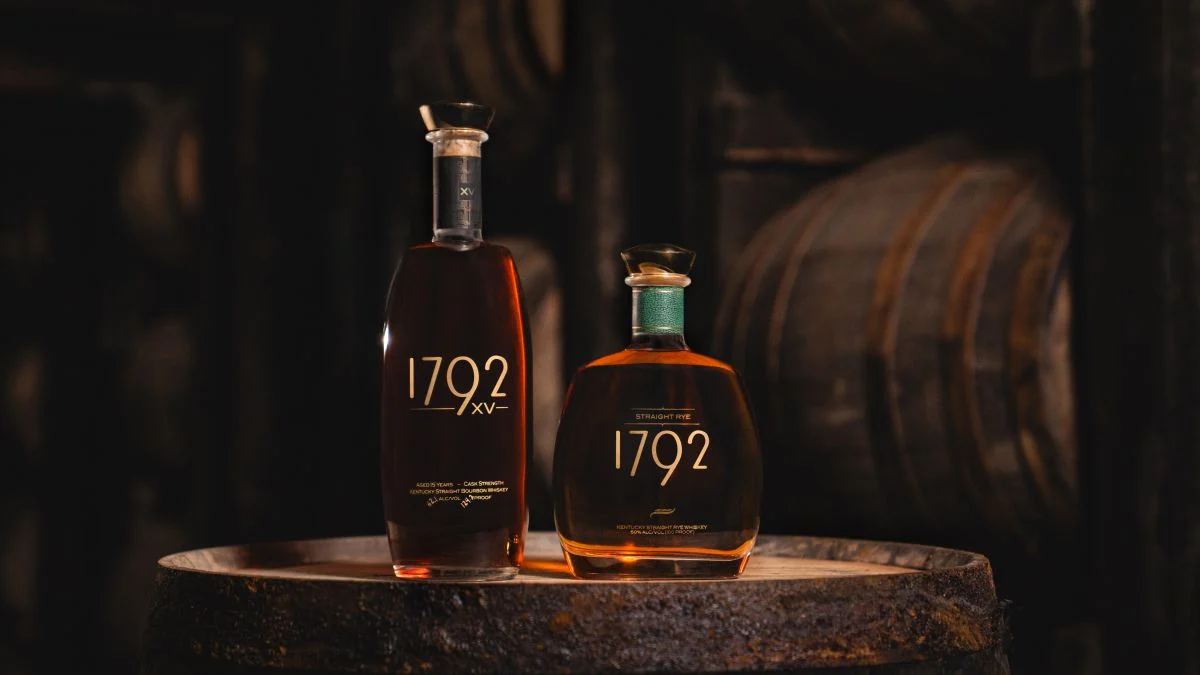
While the whiskey world often finds itself fixated on the legendary releases from Buffalo Trace—frequently sparking long lines and secondary market frenzy—the broader Sazerac portfolio hides some of the industry’s most compelling treasures. Among these, the Bardstown-based Barton 1792 Distillery stands as a pillar of Kentucky tradition. Named in honor of the year Kentucky achieved statehood, Barton 1792 has long been a favorite of enthusiasts who value technical precision and flavor-forward profiles.
In a significant pivot for the distillery, Barton 1792 has just announced two new expressions that serve as a testament to both their heritage and their appetite for innovation. By introducing the brand’s first-ever straight rye whiskey and a rare, 15-year-old cask-strength bourbon, the distillery is signaling a new era of exploration.
The Evolution of a Kentucky Icon
Barton 1792 has spent decades defining the classic Kentucky bourbon experience. Known for their "High Rye" mash bills and a core range that includes the reliable Small Batch, the robust Full Proof, and experimental finishes like Port and Cognac, the distillery has operated with a singular focus: excellence in corn-heavy spirit production.
However, the landscape of American whiskey is shifting. As consumer palates grow more sophisticated, the demand for transparency, age-statement transparency, and category-defying experimentation has reached an all-time high. The introduction of 1792 Kentucky Straight Rye Whiskey and 1792 XV represents a calculated response to this demand, balancing the historical integrity of the Bardstown facility with the modern desire for distinct, complex flavor profiles.
The 1792 Kentucky Straight Rye: A Global Synthesis
For the first time in its history, the distillery is stepping away from the bourbon category to launch a straight rye. This is not merely a brand extension; it is a technical departure from the distillery’s standard operating procedures.
The Technical Craft
Master Distiller Ross Cornelissen has approached this project with a scientist’s rigor. While the distillation and barrel-entry proof mirror the distillery’s core bourbon, the divergence happens at the molecular level of fermentation. Instead of utilizing a neutral yeast, Cornelissen opted for the distillery’s proprietary bourbon yeast strain. This decision was intentional, aimed at drawing out higher esters and fruit-forward notes that are often buried in traditional rye whiskeys.
The grain bill itself tells a story of global sourcing. Recognizing that the character of rye is deeply influenced by the soil in which it is grown, the production team sourced grain from three distinct regions:
- Canada: Chosen for its ability to impart delicate floral aromas and a lightness on the palate.
- Europe: Selected to introduce a bready, herbal foundation that grounds the whiskey.
- Northern U.S.: Utilized for the classic, bold peppery spice that defines American rye whiskey.
The Sensory Experience
Bottled at 100 proof, the 1792 Kentucky Straight Rye is designed to strike a delicate balance between the "burn" of the grain and the complexity of the wood. Upon tasting, one finds the expected rye spice, but it is seamlessly integrated with the sweet notes typically associated with the distillery’s bourbon heritage—maple, vanilla, and oak. It is a whiskey that bridges the gap for the bourbon drinker looking to transition into rye without sacrificing the sweetness they have grown accustomed to.
1792 XV: The Accidental Masterpiece
If the rye is a study in precision, 1792 XV is a study in providence. While the rye was a planned strategic move, the XV (representing its 15-year age statement) was a serendipitous discovery.
"This release wasn’t part of a planned experiment in barrel-proof whiskey," explains Cornelissen. "We noticed that several of our oldest barrels were developing extraordinary characteristics, with flavors and nuances that stood out on their own."
In the industry, age is a double-edged sword. At 15 years, a barrel can easily become over-oaked, losing its nuance to harsh tannins. However, these select casks at Barton 1792 defied the odds, developing a complexity that required no dilution. Consequently, it is bottled at a potent 124.2 proof, making it the first cask-strength, high-age-statement bourbon in the 1792 portfolio.

The Palate Profile
The XV is a powerhouse. It resists the "hot" finish one might expect from a 124.2-proof spirit, instead offering a rich, layered experience. Tasting notes reveal a tapestry of flavors:
- Primary: Dark chocolate and toasted peanuts.
- Secondary: Caramel sundae and warm oak.
- Finish: A unique, lingering note of black licorice and a hint of grape soda, a profile rarely found in such aged stocks.
Chronology of Development
The timeline of these releases reflects a multi-year commitment to quality control. The development of the 1792 Rye began as a test of the distillery’s flexibility, involving trials of yeast strains over several years to ensure the "fruit-forward" goal was achieved without compromising the identity of the 1792 brand.
Simultaneously, the maturation of the 15-year-old stocks that would eventually become XV was monitored over a decade and a half. These barrels were identified in the "deep storage" sections of the rickhouses, where the microclimate allows for a slower, more deliberate extraction of wood sugars. The decision to pull these barrels was made only when the liquid reached its peak, demonstrating the patience required for top-tier limited releases.
Implications for the Market
The launch of these two products has significant implications for both the collector’s market and the casual enthusiast.
Accessibility vs. Exclusivity
The 1792 Kentucky Straight Rye, with an SRP of $40, is positioned as a competitive, everyday luxury. It is currently rolling out to select markets, aiming to capture the mid-shelf segment where consumers are increasingly looking for high quality at a fair price.
Conversely, the 1792 XV, priced at $250, is a play for the travel retail market. By limiting availability to major international transit hubs—including Los Angeles (LAX), San Francisco (SFO), and Incheon (ICN)—Sazerac is signaling the premiumization of the 1792 brand. This strategy acknowledges that the modern high-end whiskey consumer is a global traveler who values rarity and provenance.
The "Sazerac Effect"
The success of these releases will likely bolster the reputation of the Barton 1792 distillery as a standalone powerhouse. While it has always been under the Sazerac umbrella, the distillery is increasingly moving out of the shadow of its sibling, Buffalo Trace. By diversifying its portfolio to include a world-class rye and an ultra-aged bourbon, Barton 1792 is proving that it has the capacity for innovation that rivals any distillery in Kentucky.
Official Stance and Future Outlook
Master Distiller Ross Cornelissen’s remarks highlight a broader shift in the distillery’s philosophy: "Many seasoned bourbon drinkers turn to rye when they’re ready to explore something new." This admission suggests that Barton 1792 is actively curating the journey of its customers, guiding them from entry-level small-batch bourbons to more complex, rye-heavy, and high-age expressions.
Looking forward, the success of the 1792 XV will be the true bellwether for the distillery’s ability to compete in the ultra-premium space. If the market reception is as strong as the initial samples suggest, we may see further experiments with extended maturation and unique yeast profiles.
Ultimately, the release of the 1792 Kentucky Straight Rye and 1792 XV confirms that the best days for the Barton 1792 distillery are not in its past, but in its current ability to honor its history while fearlessly pushing into new, uncharted territories. For those who can track down a bottle of either, the experience promises to be a masterclass in Kentucky distilling.
 Evan Lee Salim
 Asep Darmawan
 Laily UPN
