

By Olivia Tauber
July 2, 2026
In the hyper-accelerated landscape of 2026, where artificial intelligence digests legal documents in milliseconds and global news cycles operate on the speed of a fiber-optic pulse, one corner of Washington, D.C. remains defiantly, analogously slow.
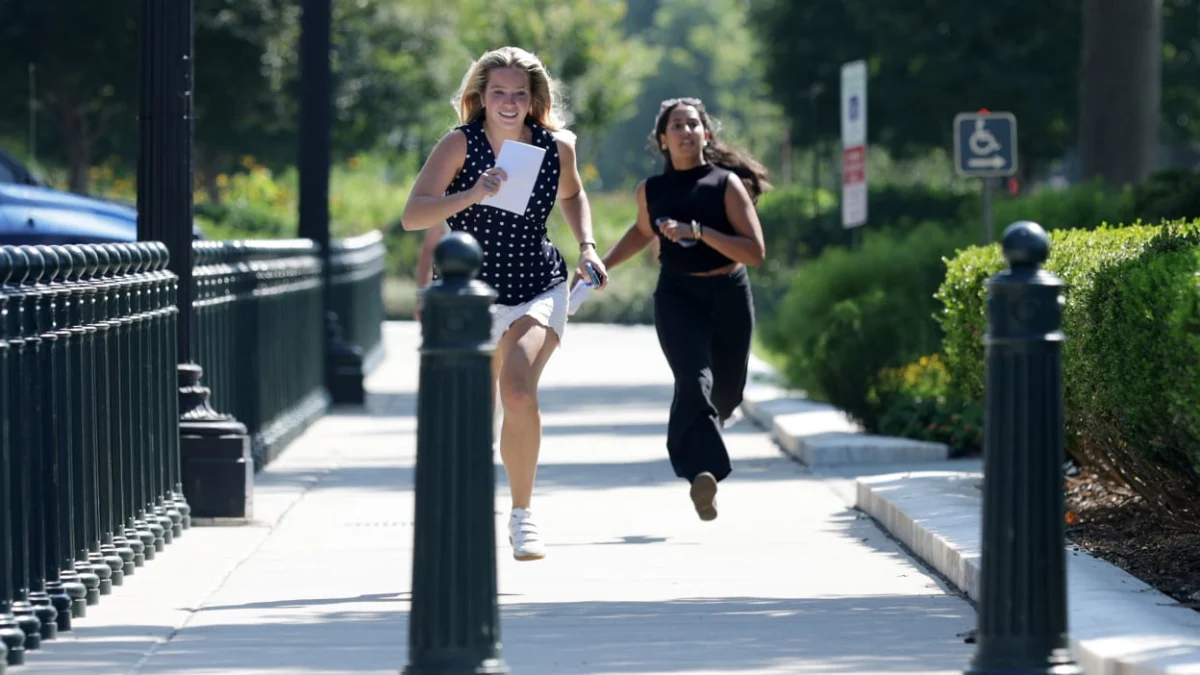
As the Supreme Court handed down a series of consequential rulings on June 30—including a landmark decision on birthright citizenship, as well as contentious rulings on transgender athletes and campaign finance—the fastest news delivery system in the nation’s capital was not a push notification or an automated API feed. It was, once again, a sweaty intern in sneakers, sprinting across the Supreme Court plaza with a stack of printed paper.
The "Running of the Interns" is a ritual that feels like a vestige of a bygone century, yet it persists. It is a spectacle that balances on the razor’s edge between high-stakes constitutional journalism and low-tech absurdity.
The Anatomy of the Ritual: A Chronology of Chaos
The tradition, while evolving over the decades, follows a rigid, unwritten choreography. Long before the era of smartphones, the Supreme Court was a "black box" where recording devices were—and remain—strictly forbidden. For news organizations, the physical paper opinion was the only "source of truth."

The Print Era (1970s–1990s)
In the late 20th century, the "run" was a tactical necessity. News bureaus relied on physical copies of opinions to ensure accuracy. Interns would wait in the press gallery, receive the documents from court clerks, and then dash out of the building to waiting couriers or directly to their bureau’s broadcast trucks stationed on First Street.
The Defining Moment: Bush v. Gore (2000)
The ritual entered the national consciousness during the 2000 presidential election litigation. As the nation held its breath, the pressure on news networks to report the ruling first created an environment of intense competition. The sight of young, frantic interns weaving through crowds became the quintessential visual of "breaking news."
The Modern Paradox (2010s–Present)
The tradition cemented its status as a "media event" during major rulings like the 2012 Affordable Care Act decision and the 2015 Obergefell v. Hodges ruling on same-sex marriage. By then, the "run" had transcended utility. It became theater.
On June 30, 2026, the scene repeated. As the Court released its latest batch of opinions, the interns emerged from the building’s heavy doors. Cameras zoomed in, social media lit up, and the internet did what it does best: it turned the sprint into a meme, a critique, and a celebration of youthful hustle all at once.
Supporting Data: The Digital vs. Physical Divide
To understand why this tradition is so "strange," one must look at the technological reality of 2026.

- The PDF Reality: The Supreme Court now publishes opinions to its website simultaneously with their release in the courtroom. In theory, a reporter sitting in a remote office in London or Tokyo can access the ruling before an intern in Washington has even reached the curb.
- The Pandemic Shift: Between March 2020 and June 2022, the Court released opinions exclusively online due to COVID-19 protocols. During this period, the "run" was declared effectively dead.
- The "Human" Variable: Despite the digital efficiency, the "human" delivery remains a fallback. In a high-stakes environment, physical papers act as a fail-safe against server crashes, internet outages, or the "refresh-button" anxiety that plagues digital newsrooms.
The persistence of the run serves as a physical manifestation of the media’s hunger. Even when the data is instant, the sprint provides a visceral signal to the viewing public that the news has arrived.
The Cultural Phenomenon: Why It Still Matters
The internet’s reaction to this week’s run has been a mixture of nostalgia and disbelief. On platforms like TikTok and X (formerly Twitter), the footage has generated millions of views.
Some observers see the tradition as a symbol of the "dignity of the grind." Others view it as a comical, performative display of legacy media’s reluctance to fully embrace the digital future. There have even been calls for sneaker brands to sponsor the event, turning the dash across the plaza into a de facto fashion runway.
However, beneath the memes lies a deeper truth about the nature of journalism. The "Running of the Interns" reminds us that at the heart of our legal and political system, there are still individuals acting as intermediaries between the institutions of power and the public. In a world of cold, automated algorithms, the sight of a young person running for the sake of information feels surprisingly, and perhaps desperately, human.
Official Responses and Institutional Perspectives
While the Supreme Court has made no official statement regarding the "sport" of the intern run, press officers have historically tolerated it as part of the ecosystem of the Court’s press corps. Reporters who cover the Supreme Court argue that the ritual keeps the focus on the urgency of the Court’s work.

"It’s not just about the paper," says one veteran broadcast producer. "It’s about the signal. When you see that intern hit the sidewalk, the entire newsroom knows the clock has started. It’s a tradition that binds the old guard to the new, even if it makes absolutely no logical sense in the age of 6G."
Implications for the Future of Media
The survival of the "Running of the Interns" raises broader questions about how we consume information. If we have moved beyond the need for paper, why do we hold onto the ritual?
- The Need for Ceremony: Societies are built on rituals. The "run" acts as a ceremony that marks the significance of a Supreme Court ruling. It transforms a document from a dry legal text into a high-octane event.
- The Media Spectacle: News outlets are fighting for eyeballs in a fragmented landscape. Visuals that are "sticky"—like a frantic, high-speed sprint—are valuable assets for social media engagement.
- The Reliability of the Physical: In an era of AI-generated misinformation and deepfakes, there is a subconscious trust in the physical document. The intern with the paper is a "provenance marker." They represent the physical link between the bench and the broadcast.
As we look toward the future, it is likely that the "run" will eventually vanish as the last vestiges of paper-based legal systems are phased out. However, until that day, the sweaty sneakers and the crumpled documents will continue to mark the rhythm of Washington.
In a world where we are increasingly disconnected from the physical processes that govern our lives, perhaps we need these strange, human-powered relays. They are a reminder that, for all our technology, democracy is still something that requires people to show up, work hard, and—occasionally—sprint for the truth.
 Ali Ikhwan
 Raul Delapena Setiawan
 Azzam Bilal Chamdy
