

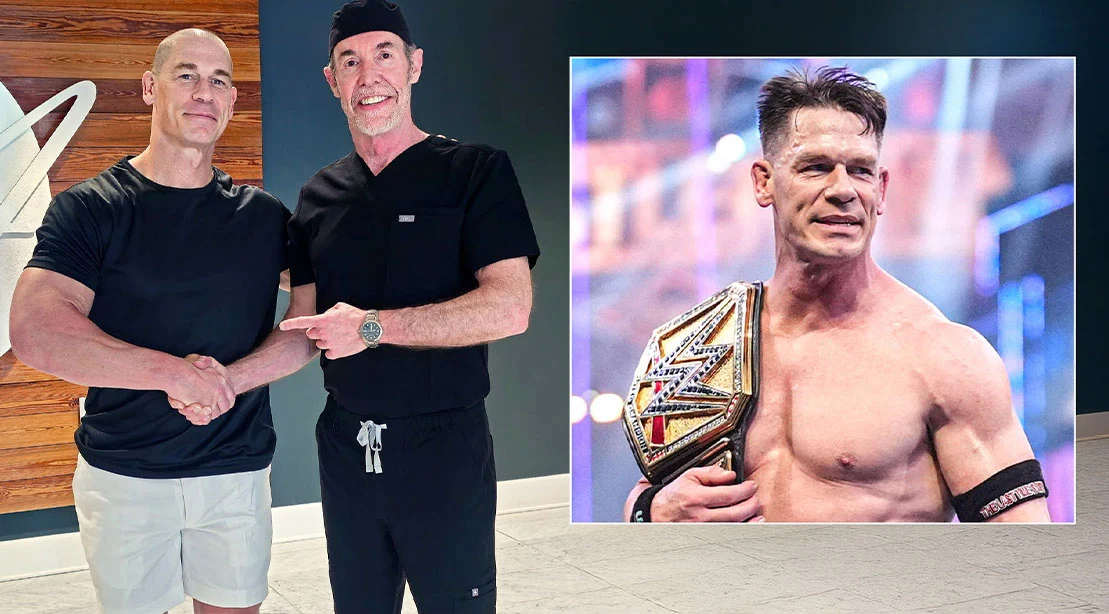
Just when the world thought it had seen every facet of John Cena—from the indomitable WWE champion to the Hollywood leading man—the 49-year-old icon has unveiled a new, deeply personal chapter of his life. Following his retirement from professional wrestling in late 2025, Cena has stepped into the spotlight not for a championship bout, but for a candid exploration of aging, vanity, and the modern masculine experience.
A recent viral photograph, which captured the “You Can’t See Me” star with a shaved head in preparation for a medical procedure, sparked a global conversation. While many fans were initially surprised by the bold, hairless look, the subsequent revelation behind the image has transformed it into a symbol of empowerment. Cena is not just undergoing a transformation; he is leading a cultural shift by demystifying Follicular Unit Extraction (FUE) and dismantling the stigma that has long surrounded male hair loss.
The Catalyst: From WWE Spotlight to Personal Vulnerability
For decades, John Cena’s image was defined by his superhuman persona. However, even the most legendary performers are not immune to the biological realities of aging. In a recent interview with People magazine, the former champion admitted that he initially attempted to mask his receding hairline.
The pressure, however, was not coming from internal vanity alone; it was coming from the very audience that had supported him for years. "As I was trying to hide my hair loss, the audience was bringing it to light," Cena explained. "I saw their signs that said, ‘The bald John Cena.’ They pushed me into going to see what my options were."
This public pressure, while occasionally stinging, served as the catalyst for a life-changing decision. Cena confirmed that he underwent his first hair transplant in November 2025. Reflecting on the delay in seeking treatment, he expressed a sentiment shared by millions of men: "I hate the fact that if there wasn’t so much shame around it, I’d have gotten it done 10 years ago. I thought I was alone, but seven or eight out of 10 men suffer from thinning or baldness."
The Science of Restoration: Understanding FUE
As Cena’s story went viral, public interest in the technicalities of his procedure surged. What exactly is FUE?
Follicular Unit Extraction (FUE) is a sophisticated, minimally invasive surgical technique designed to restore hair density. Unlike older, more invasive methods that involved removing a strip of skin from the scalp, FUE is characterized by its precision. Surgeons harvest individual hair follicles—typically from the back or sides of the head, where hair is genetically resistant to the hormones that cause balding—and graft them into the areas experiencing thinning.
The Procedure at a Glance
- Harvesting: Individual follicular units are extracted using a specialized micro-punch tool.
- Implantation: The harvested follicles are carefully inserted into tiny incisions made in the recipient area.
- Recovery: Because the procedure does not require large incisions, the recovery time is significantly shorter than traditional methods, with minimal scarring.
A standard session of FUE is a marathon, often lasting between 8 to 10 hours. During this time, a medical team can harvest and implant anywhere from 1,500 to 3,000 grafts. For most patients, one or two sessions are sufficient to achieve the desired density, though the final outcome relies heavily on the patient’s commitment to post-operative care.
A Growing Epidemic: The Reality of Male Hair Loss
While John Cena’s experience is high-profile, he is far from an outlier. Hair loss is a near-universal experience for men, yet it remains a topic shrouded in silence. Statistically, two-thirds of American men will experience some degree of hair loss by the age of 35. By age 50, that number climbs even higher.
The psychological impact of this transition can be profound. For many men, hair is intrinsically linked to youth and vitality. When that begins to fade, it can lead to a decline in self-confidence. By speaking openly about his journey, Cena is validating the experiences of the average man who feels he must suffer in silence.
The Financial and Procedural Commitment
While FUE is a life-enhancing procedure, it is also a significant investment. Costs typically range from $4,500 to upwards of $12,000, depending on the extent of the restoration required. Furthermore, the procedure is not a “set it and forget it” solution.
Cena has been transparent about the maintenance required to protect his investment. "I now have a routine: red-light therapy, minoxidil, vitamins, shampoo, conditioner," he shared. This regimen is critical for maintaining the health of both the transplanted follicles and the existing hair. The success of the procedure depends not just on the surgeon’s skill, but on the patient’s long-term discipline.
The Path to "Round 2": A Public Declaration
In June 2026, Cena took to social media to update his followers on his progress. Sharing a photo from the Anderson Center for Hair, he wrote: "Round 2 of FUE Treatment and this time I went all in for best possible results. Thank you @KenAndersonMD and the staff at Anderson Center for Hair for accompanying me on this journey!"
The post, which reached millions of views within minutes, was a masterclass in modern transparency. By showing himself mid-treatment—shaved and vulnerable—Cena dismantled the "miracle cure" myth. He showcased the process for what it is: a medical intervention that requires time, effort, and patience.
Official Responses and Professional Perspectives
Dr. Ken Anderson, the surgeon overseeing Cena’s restoration, has been vocal about the importance of the athlete’s mindset in the success of the procedure. In response to Cena’s social media update, Dr. Anderson commented, "Your commitment to the process and long-term hair health has made all the difference."
The professional consensus in the hair restoration industry is that patients who treat the process as a health journey rather than a cosmetic quick fix yield the best results. Cena’s dedication to his scalp health mirrors the same rigorous training regimen he applied to his wrestling career, proving that success in any endeavor is a product of consistency.
Implications for Men’s Health and Wellness
Perhaps the most significant takeaway from John Cena’s journey is the shift in the masculine narrative. For generations, the idea of "toughness" precluded any admission of insecurity or the pursuit of cosmetic enhancements. By normalizing FUE, Cena is effectively expanding the definition of masculinity to include self-care.
Why This Matters:
- Destigmatization: When a global icon like Cena discusses hair loss, the "shame" factor mentioned in his People interview begins to evaporate.
- Informed Decision Making: By sharing his specific routine, Cena encourages men to consult with medical professionals rather than relying on unproven over-the-counter "snake oils."
- Vulnerability as Strength: The narrative that "the most manly of men are the ones that can show their vulnerable side" is a powerful message for younger generations of men who struggle with the unrealistic expectations of perfectionism.
Conclusion: The New Face of Confidence
John Cena’s hair restoration journey is about far more than follicles and hairlines. It is a testament to the fact that taking control of one’s appearance—and being open about the effort required to do so—is a sign of strength, not weakness.
As Cena transitions into his post-WWE life, he is finding new ways to connect with his audience. Whether he is in the ring or in the clinic, he continues to lead by example. By choosing to share the "bald truth" about his journey, he has provided a roadmap for millions of men to seek the care they need, shed the shame they feel, and ultimately, reclaim their confidence. In doing so, "Super Cena" has proven that the greatest victory is the one that allows you to be authentically, and comfortably, yourself.
 Lina Hope
 rifanmuazin
 Laily UPN
