

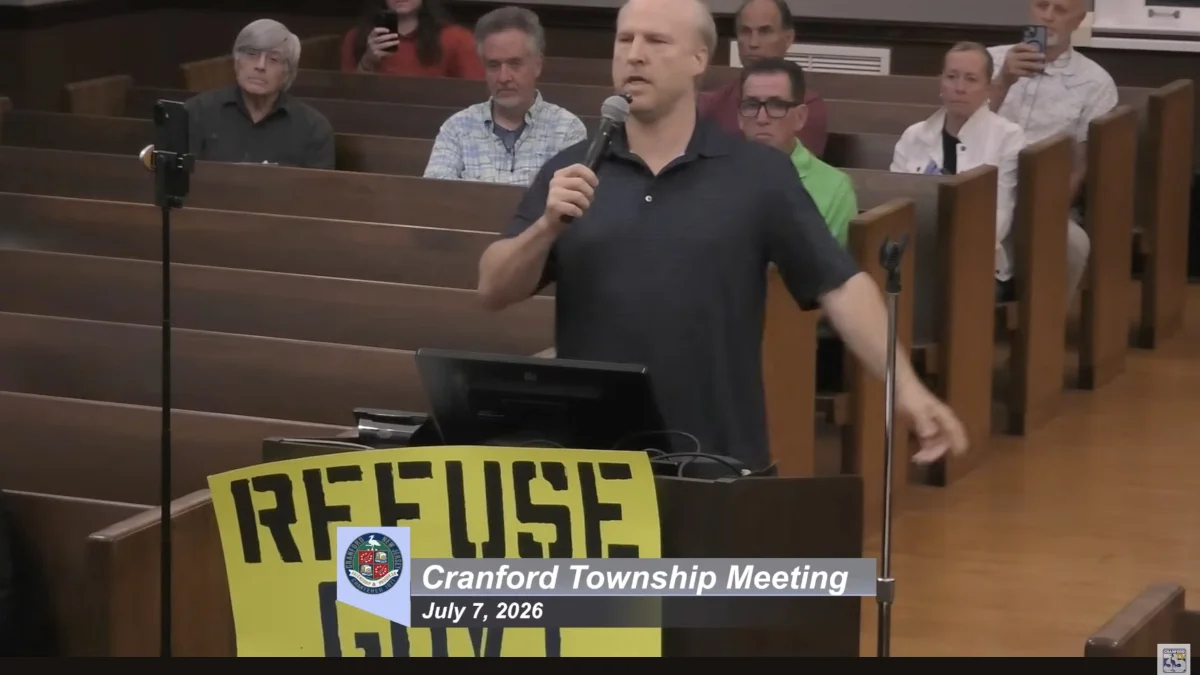
The sanctity of the local government meeting—a cornerstone of civic engagement and democratic oversight—was transformed into an absurdist theater production in Cranford Township, New Jersey, this week. What began as a standard, routine public comment session on July 7, 2026, devolved into a spectacle of karaoke, costume-clad protest, and eventually, physical intervention by law enforcement.
The incident, which saw a known local provocateur arrested while crooning Morrissey and a self-styled "purple bong" belting out Lizzo, has ignited a fierce debate over the limits of free speech, the boundaries of public decorum, and the increasingly performative nature of local governance in the age of social media virality.
The Chronology of Chaos: July 7, 2026
The Cranford Township Committee meeting followed a conventional agenda for the better part of an hour. However, the atmosphere shifted perceptibly when the floor was opened to the public. For residents, the comment period is designed to be a bridge between the governed and the governing; for 52-year-old William Thilly, it has become a stage.
Thilly, who had previously achieved internet notoriety for an impromptu breakdancing routine during a 2025 meeting, arrived at the podium with a clear, if unorthodox, mission. He placed a sign emblazoned with the words "Refuse Govt. Abuse" before the council members. Before the police intervention, Thilly offered a brief manifesto, decrying what he termed a lack of transparency and systemic government abuse on a global scale.
However, the political discourse was short-lived. Thilly produced a portable speaker and began an impassioned rendition of Morrissey’s 1994 hit, "The More You Ignore Me, The Closer I Get." The lyrics—perhaps intentionally ironic given his defiance of the council’s authority—filled the chamber as the meeting’s presiding officer repeatedly called for order. As his allotted three minutes expired, Thilly continued his vocal performance, refusing to vacate the podium. The scene culminated in a tense standoff with law enforcement, who eventually physically removed Thilly from the dais. He was subsequently charged with disrupting a public meeting.
The evening’s theatricality did not end with Thilly’s exit. In a surreal turn, another attendee, dressed entirely in a purple, bong-shaped costume and identifying himself as "Bongholeo," approached the microphone. Accompanied by a prop baby named "Bongholito," he proceeded to perform a modified, cannabis-themed version of Lizzo’s "About Damn Time," leaving local officials to grapple with a level of absurdity rarely accounted for in municipal bylaws.
The Intersection of Dissent and Decorum
The events of July 7 underscore a growing trend in American local government: the transformation of town halls into content-generation hubs. While public comment periods are constitutionally protected forums for grievances, they are not limitless.
"There is a delicate balance between a citizen’s right to petition their government and the government’s right to conduct the public’s business in an orderly fashion," says legal analyst Marcus Thorne. "Courts have consistently held that while a town council cannot restrict the content of speech based on viewpoint, they can impose reasonable ‘time, place, and manner’ restrictions. Singing a Morrissey song, while perhaps entertaining to some, does not constitute ‘petitioning the government’ in any functional sense."
The rise of the "serial provocateur" is a phenomenon fueled by the digital age. By filming their outbursts and uploading them to platforms like YouTube and TikTok, individuals like Thilly are often incentivized by the potential for viral reach. For these performers, the goal is not necessarily to change local zoning laws or tax codes, but to garner attention, monetize the outrage, and disrupt the status quo.
The Institutional Response
Following the incident, the Cranford Township Committee has remained largely tight-lipped, likely to avoid further fueling the controversy. However, the presence of police at the podium serves as a stark indicator of the township’s stance.
Local government meetings are increasingly becoming "hardened" spaces. Many municipalities across the country have begun implementing stricter rules of conduct, including pre-registration requirements for speakers and explicit bans on the use of amplification devices or props. In the wake of the July 7 incident, observers anticipate that Cranford may move to formalize these restrictions further.
Critics of such measures argue that the "policing of decorum" is often a slippery slope toward silencing dissent. "If you define ‘disruption’ too broadly," says local activist Sarah Jenkins, "you end up silencing the very people the public comment period was meant to protect—those who are frustrated, eccentric, or simply not polished enough for the political establishment. Where do you draw the line between a passionate protest and a ‘disruption’?"
The Morrissey Connection: Art vs. Absurdity
The choice of music—Morrissey—is not without its own irony. The former Smiths frontman has become a polarizing figure in the music industry, known for his own history of eccentric public outbursts and cancellations. That a disgruntled citizen would choose a song about alienation and persistence to protest local government underscores the feeling of disconnect that many citizens feel toward their municipal leaders.
However, the "Bongholeo" performance highlights the shift from ideological protest to pure, unadulterated performance art. When the protest takes the form of a man in a costume singing a pop song about marijuana, the political message—if one ever existed—is effectively eclipsed by the absurdity of the delivery. This creates a "noise" that makes it nearly impossible for the council to engage with legitimate community concerns.
Implications for Local Democracy
The implications of these events are profound for small-town governance. When meetings become synonymous with chaos, the average citizen is less likely to attend or participate. The "civic center" becomes a venue for fringe theater rather than a workshop for policy.
Furthermore, the financial cost of such disruptions is not trivial. Between the time spent by council members, the presence of police officers, and the administrative burden of filing criminal charges for disruption, the taxpayers are footing the bill for these performances.
"We are seeing a degradation of the public square," notes political scientist Dr. Elena Rodriguez. "Local government is the level of democracy closest to the people. When that intimacy is replaced by performance art, we lose the ability to solve problems together. The challenge for townships like Cranford is to protect the right to speak without allowing the entire process to be hijacked by those whose primary goal is not reform, but reaction."
Conclusion: A Call for Civility
The Cranford Township meeting of July 7 will likely be remembered as a footnote in the history of public access television—a moment of viral weirdness in an increasingly noisy political landscape. Yet, it serves as a necessary case study for a broader national conversation.
How do we preserve the robust, often messy, freedom of speech that defines our republic while ensuring that local government remains a functional institution? The answer likely lies not in draconian measures that silence all dissent, but in a renewed commitment to civility from both sides of the dais.
Until then, municipal clerks will continue to log the minutes, police officers will continue to stand guard at the microphone, and the residents of Cranford—and towns like it across the nation—will continue to wonder whether their next council meeting will be defined by an agenda of public policy, or the opening bars of a pop song. As for the performers, they have successfully captured the public’s attention, though whether they have advanced their cause remains, at best, a matter of debate.
 Pevita Pearce
 Asro
Asro
 Lina Irawan
