

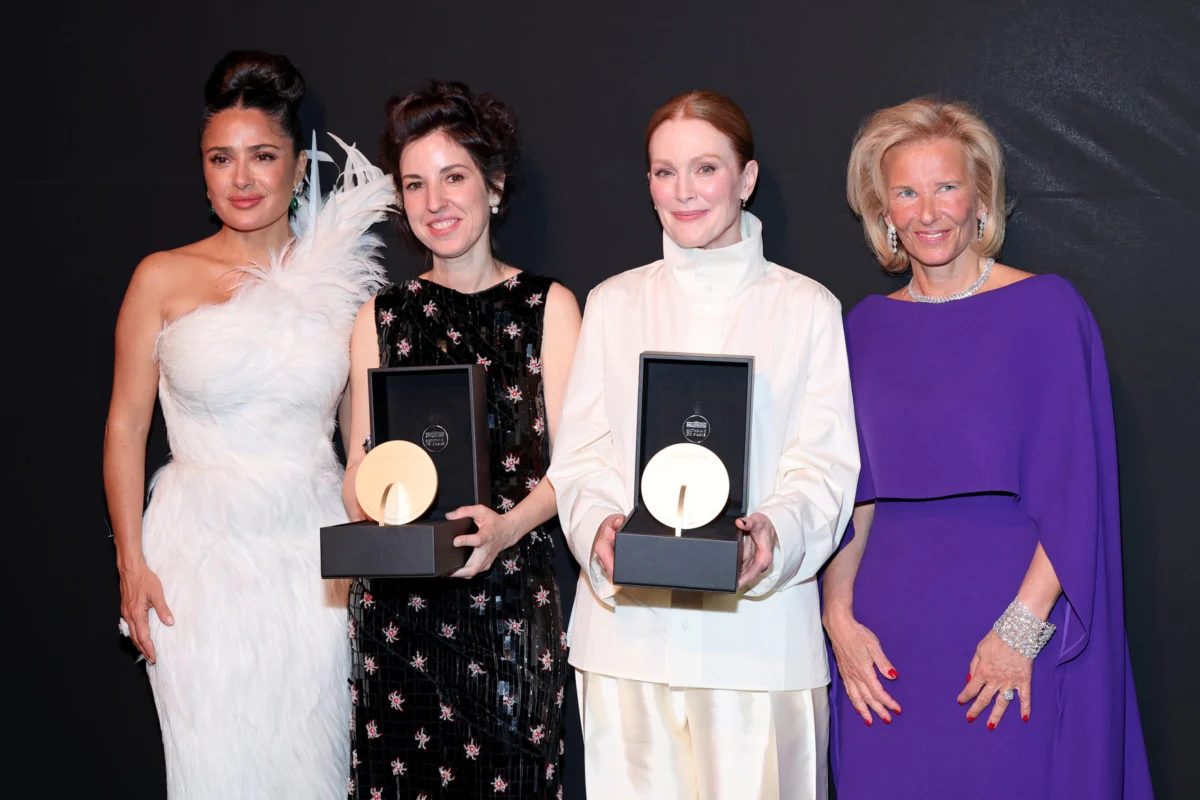
Throughout a career spanning four decades, Julianne Moore has secured the most prestigious honors in the entertainment industry. From an Academy Award for her searing performance in Still Alice to an Emmy and top-tier acting prizes from the film festivals in Berlin, Venice, and Cannes, her mantle is overflowing with validation. Yet, as she stood at the Place de la Castre this Sunday evening, the accolade placed in her hands felt fundamentally different.

The Kering Women in Motion Award, established in 2015, is not merely a recognition of craft; it is a declaration of purpose. By honoring those who use cinema to shift the cultural paradigm regarding the role of women in society, the award aligns perfectly with Moore’s long-standing advocacy. In an industry often preoccupied with commercial metrics, Moore used her platform to confront the persistent, outdated myths that continue to govern female storytelling.

The Cultural Myth of the "Smaller" Story
The evening’s atmosphere was one of electric camaraderie, with a guest list that functioned as a testament to the industry’s power players—including Demi Moore, Ruth Negga, Vicky Krieps, and previous honorees Salma Hayek Pinault and Isabelle Huppert. Standing at the podium, Moore delivered a speech that was as much a manifesto as it was an acceptance address.

"I fucking love actresses," Moore declared, drawing an immediate, resonant response from the crowd.

She quickly pivoted to a critique that has long frustrated her: the assumption that female-led narratives are inherently less vital than their male counterparts. "This is something that makes me crazy," she admitted. "There is a cultural assumption, particularly in the United States, that women’s stories are less interesting or smaller, or that if we’re at the center of a narrative, we need to be strong or accomplishing something great, or doing something that is particularly male, if we want someone to watch us—if we want men to watch us. And I think that’s untrue."

Moore argued that this pervasive bias does not just alienate the female audience; it fundamentally ignores what audiences actually crave. For Moore, the remedy is a return to specificity. She posits that when a story is deeply rooted in a specific female perspective, it transcends the "universal" male experience and finds a more profound, resonant truth that all audiences can appreciate.

Living the Lens: A Personal Commitment to Women
For Moore, the commitment to centering women is not a performative political stance; it is a daily practice. She described her personal life as a deliberate ecosystem of female voices, from the agents and managers who handle her career to the yoga groups that ground her.

"I see the women in my elevator, on the subway, and in the airport. If I need information, I approach a woman," she shared, recalling advice she once gave her children. "When my kids were little, I told them, if you’re ever lost or in trouble, to look for a lady; she will help you."

She was careful to clarify that her focus is not about exclusion, but about reclaiming value. "I’m not saying this to be particularly binary," she noted. "Or to say the relationships I have with men or male-identifying people are not important to me, but to celebrate the fact that female point of view matters… What is the point of view, and how is it specific? I feel it as an actor when the story and direction are specific, and the audience feels it too."

The Statistics of Invisibility
The urgency of Moore’s message is backed by stark industry data. Despite progress in recent years, the disparity remains vast. Statistics from 2025 indicate that women occupied only 37.1% of roles in major motion pictures. Perhaps more damning is the behind-the-scenes data: only nine women helmed the top-grossing films of the year out of 111 directors.

Moore challenged the industry to interrogate this invisibility. "I’m always curious about that narrative," she said. "I want to know where they feel invisible, why they feel invisible, and have we been cultured to only be seen by a particular audience, or to only value that gaze?"

She contrasted the desire to be "seen" with the desire to be an observer—a role she treasures as an actor. "I am more curious about what I observe, what I learn, and what I experience through my own lens. And that’s the most important thing of all: what we as women see, and what we are here to celebrate tonight." Her call to action was clear: the industry must prioritize hiring more female writers, directors, and actresses to ensure that the female gaze is not just present, but dominant in the storytelling landscape.

Chronology of the Evening: A Celebration of a Legacy
The event was curated to honor the breadth of Moore’s work, which spans the avant-garde to the mainstream. Cannes president Iris Knobloch opened the dinner with a poignant focus on "turning visibility into real opportunity," setting the stage for festival chief Thierry Frémaux to present a career-spanning reel.

The montage offered a journey through the evolution of a singular talent: Magnolia, Boogie Nights, Nine Months, Hannibal, Far From Heaven, A Single Man, Crazy Stupid Love, The Kids Are All Right, May December, and her Oscar-winning turn in Still Alice.

"That’s like watching your life flash before your eyes," Moore giggled as the reel concluded. The sentiment was shared by her peers in the room. Halsey, speaking on the black carpet, confessed to being starstruck, while Charlotte Le Bon highlighted the transformative power of Moore’s performances, particularly in Safe and Magnolia. Harry Melling, known for his work in Butterfly Jam, noted that even in brief cameos, such as in The Big Lebowski, Moore’s screen presence is peerless.

Supporting the Next Generation: The Emerging Talent Award
The evening was not exclusively dedicated to the established icons of the screen. In a move that underscored the Kering Women in Motion initiative’s focus on the future, Italian filmmaker Margherita Spampinato was awarded the Emerging Talent Award.

Recognized for her debut feature Gioia Mia, Spampinato was awarded a €50,000 grant to support the production of her second feature film. The award, presented by last year’s recipient, Brazilian director Marianna Brennand, serves as a bridge between current inequality and a future of creative parity.

"This award moves me because it supports the creativity and freedom of new female voices in cinema and art around the world," Spampinato said. She described her work as a love letter to the women in her life—her grandmother and her friends—whose influences shaped her creative vision. For Spampinato, the award represents more than financial support; it is a symbol of the world beginning to recognize the validity of stories told by women.

Implications: A Shifting Industry Standard
The presence of high-profile attendees—ranging from Jordan Firstman, whose film Club Kid recently sparked a bidding war with A24, to directors like Park Chan-Wook—signaled the importance of this event to the broader film ecosystem. The guest list, which included stars such as Sebastian Stan, Colman Domingo, and Daisy Edgar-Jones, suggested that the mandate for gender equality is no longer a "niche" concern but a central pillar of modern cinema.

By joining a sorority of honorees that includes Jane Fonda, Viola Davis, Geena Davis, Michelle Yeoh, and Nicole Kidman, Julianne Moore has solidified her place as a standard-bearer for this movement. The implications of the evening are clear: the industry is being pushed, by both established legends and emerging voices, to move beyond tokenism.

As the gala concluded, the mood was one of collective resolve. The Kering Women in Motion dinner serves as a reminder that the power of cinema lies in its ability to reflect the world as it is—and, more importantly, as it could be. For Julianne Moore, the path forward is illuminated by the very thing she champions: the specific, unapologetic, and essential point of view of women. As she aptly put it, "We need more female voices in our industry, more writers, more directors, more actresses to carry that vision forward." That vision is no longer a request; it is an industry necessity.
 Sagoh
Sagoh
 Pevita Pearce
 Jia Lissa
